
Asia's Currency Crisis: All Asian Currencies Weaken Against US Dollar
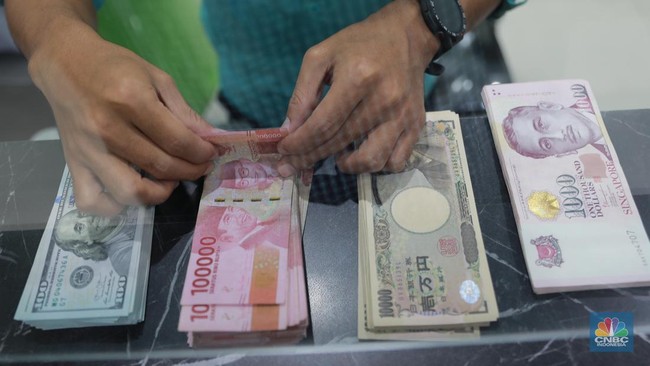
Asian currencies moved uniformly into weakness against the US dollar during early trading on Monday, 9 March 2026, as the greenback strengthened across global markets amid escalating Middle East conflict, which renewed demand for safe-haven assets.
According to Refinitiv data, at 09:45 Western Indonesian Time, all eleven Asian currencies monitored declined uniformly against the greenback.
The deepest weakness occurred in the Thai baht, which fell 1.04% to THB 32.09/US.ThePhilippinepesofollowedwitha1.14.
Pressure was also evident in the South Korean won, which corrected 0.87% to KRW 1,494.1/US.TheJapaneseyenfell0.55, whilst the Taiwan dollar weakened 0.54% to TWD 31.98/US$ and the Malaysian ringgit corrected 0.53% to MYR 3.96/US$.
The Indonesian rupiah also could not strengthen against the US dollar. The rupiah came under pressure with a 0.44% decline to Rp16,975/US, drawingclosertoitspsychologicallevelofRp17, 000/US.
Weakness also occurred in the Indian rupee, which fell 0.37% to INR 92.27/US, followedbytheVietnamesedong, whichweakened0.36. The Chinese yuan fell 0.32% to CNY 6.91/US, whilsttheSingaporedollarweakened0.3.
This directional movement was in line with the strengthening of the US dollar index (DXY), which at the same time rose 0.63% to 99.610. The DXY’s strength reflected increased investor interest in the US dollar, which ultimately pressured most other currencies, including Asian currencies.
The main sentiment stemmed from the escalating Middle East conflict, which showed no signs of abating.
Market participants returned to purchasing the US dollar because of its status as a safe-haven asset and as the currency of an energy-exporting nation, as rising oil prices raised concerns that global inflationary pressure would increase once more. This situation also weighed on Asian stock markets and prompted investors to favour more liquid assets.
Markets also monitored political developments in Iran following Tehran’s appointment of Mojtaba Khamenei as the successor to Iran’s Supreme Leader, Ali Khamenei.
This step was considered to confirm that hardline factions still held control in Tehran, amid a conflict that had entered its second week with the United States and Israel.
This situation was expected to be poorly received by US President Donald Trump, who had previously stated that this figure was “unacceptable”.
With no signs of a ceasefire and tanker vessels still reluctant to transit the Strait of Hormuz, investors were preparing for a period of higher energy costs. The Strait of Hormuz remained a critical route for global oil and gas supplies, so prolonged disruption risked dampening global economic growth whilst simultaneously pushing up inflation.
This condition prompted market participants to look to the US dollar as a safe asset once again. In turn, the strengthening of the US dollar placed other nations’ currencies in weakness, including Asian currencies, during this morning’s trading.