
Asian Currencies in Turmoil: Ringgit and Rupiah Plummet
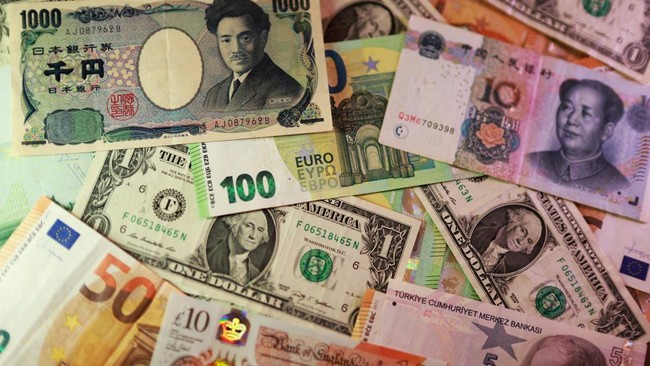
Asian currencies moved lower against the US dollar in trading today, Tuesday (12/5/2026). Pressure mounted as the US dollar index strengthened once again.
According to Refinitiv data at 09:35 WIB, the pressure on Asian currencies was quite pronounced. Of the 11 currencies monitored, nine were in the red, with only two managing to strengthen against the US dollar.
The rupiah was one of the currencies under significant pressure this morning. The Garuda currency weakened by 0.55% to Rp17,500 per dollar.
That level became a new psychological barrier breached by the rupiah and also marked a new all-time intraday low for the rupiah.
The deepest pressure in Asia was recorded by the Philippine peso, which weakened 0.83% to PHP 61.416 per dollar. The Korean won also corrected by 0.77% to KRW 1,485.5 per dollar, followed by the rupiah’s 0.55% decline to Rp17,500 per dollar.
Japan’s yen also fell into the red with a 0.31% weakening to JPY 157.64 per dollar. The Thai baht weakened 0.28% to THB 32.34 per dollar, while the Malaysian ringgit fell 0.23% to MYR 3.929 per dollar.
The Taiwanese dollar also weakened 0.20% to TWD 31.413 per dollar, followed by the Singapore dollar dropping 0.17% to SGD 1.2704 per dollar. The Vietnamese dong also saw a slight correction of 0.03% to VND 26,329 per dollar.
On the other hand, only the Indian rupee and Chinese yuan managed to stay in the green. The Indian rupee strengthened slightly by 0.01% to INR 95.3 per dollar, while the Chinese yuan rose 0.03% to CNY 6.7929 per dollar.
The movement of Asian currencies today is still influenced by the strengthening of the US dollar in global markets.
The US dollar index (DXY) was observed strengthening 0.17% to 98.117 at 09:35 WIB. The dollar’s strengthening came after US President Donald Trump questioned the sustainability of the US-Iran ceasefire. This sentiment emerged after Trump rejected Tehran’s latest peace offer.
This situation once again drove demand for the US dollar as a safe-haven asset. When geopolitical uncertainty rises, market participants tend to seek protection in assets considered safer, including the US dollar.
Reports also indicate that Trump is expected to meet with his national security team to discuss the possibility of resuming military operations. Additionally, the US is reportedly considering plans to escort commercial ships transiting the Strait of Hormuz.
The ongoing conflict is also keeping oil prices high. This condition amplifies inflation risks, as rising energy prices can spill over into production costs, transportation, and the prices of goods and services.
The rising inflation risk ultimately strengthens expectations that high interest rates need to be maintained longer to curb price pressures. Expectations of sustained high US interest rates provide positive sentiment for the dollar but are negative for emerging market currencies, including those in Asia.
Market participants now await the release of US consumer inflation data for April. This data will be a crucial indicator to gauge the extent of the Iran war’s impact on the US economy, as well as the direction of US central bank policy, the Federal Reserve.
Additionally, the market is awaiting Trump’s meeting with Chinese President Xi Jinping this weekend. Trade relations and artificial intelligence issues are expected to be the main agenda items in that meeting.
For Asian currencies, the strengthening US dollar remains the primary pressure. When the DXY strengthens, the room for regional currency appreciation tends to narrow as investors prefer to hold US dollars.
With this sentiment, Asian currencies still risk moving under pressure in the short term. However, the next direction will heavily depend on developments in the US-Iran conflict, US inflation data, and market expectations regarding Federal Reserve interest rate policy.