
Asian Currencies in Turmoil Again: Yen and Won Fall, Two Countries Escape
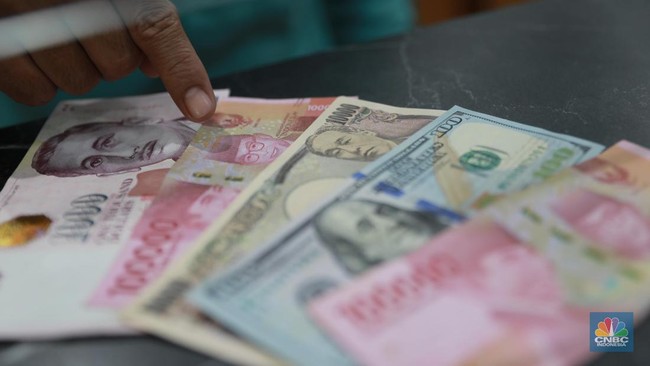
Jakarta, CNBC Indonesia - Most Asian currencies weakened against the US dollar in trading on Tuesday (19 May 2026), even as the US dollar index moved lower in global markets.
Refinitiv data at 09:25 WIB show that of 10 Asian currencies, eight fell while two rose against the greenback.
The rupiah was among the more pressured currencies, weakening 0.37% to Rp17,705 per US.ThemovepushedtherupiahbackthroughthepsychologicallyimportantlevelatRp17, 700perUS.
Rupiah weakness mirrored the broader region. The South Korean won was the region’s most pressured currency, slipping 0.87% to KRW1,501.97 per US$. The Taiwan dollar also declined 0.24%, the Thai baht fell 0.15%, the Vietnamese dong weakened 0.11%, the Singapore dollar fell 0.09%, the Japanese yen declined 0.08%, and the Philippine peso edged down 0.02%.
However, not all Asian currencies fell. The Malaysian ringgit managed to strengthen 0.05% at MYR3.972 per US, whiletheChineseyuanrose0.04.
Interestingly, the broad-based weakness in Asian currencies occurred even as the US dollar index (DXY) fell. The DXY dropped 0.09% to 99.101.
This suggests that pressure in Asia’s currency markets is not solely driven by dollar strength. Market participants remain cautious about developing-market assets amid geopolitical tensions, oil prices, and the trajectory of US Federal Reserve interest-rate policy.
Dollar weakness also stemmed from renewed optimism over the potential US-Iran deal, easing inflation concerns and reducing demand for dollars as a safe-haven asset.
US President Donald Trump said he had postponed the planned attack on Iran that had been scheduled for Tuesday. The decision came after requests from Saudi Arabia, Qatar, and the United Arab Emirates. The Gulf states said a deal with Tehran acceptable to Washington still seemed possible.
Earlier, the dollar had strengthened as oil prices jumped on Middle East tensions, sparking concerns that US inflation could rise again. This led traders to pare expectations for a Fed rate cut this year and even to price in the possibility of a rate hike before year-end.
Although sentiment toward the dollar is easing, Asian markets have not fully recovered. Investors await clearer signals on the US-Iran conflict, oil price movements, and the latest cues from the US central bank.
Market participants now await the FOMC minutes and early US PMI data to gauge the path of monetary policy and the US economy ahead.