
Asian Currencies in Sharp Decline: Rupiah Not the Worst Hit
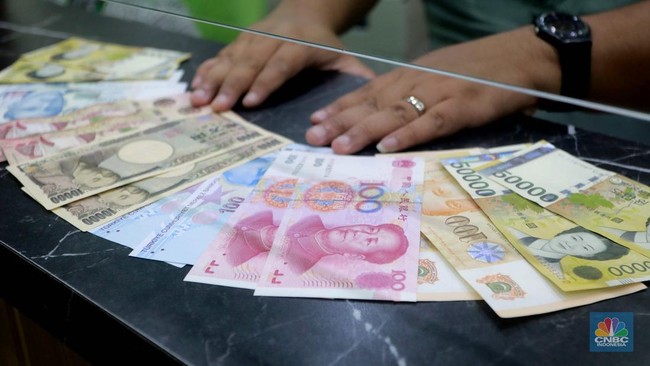
Asian currencies moved lower against the US dollar in trading on Monday (11/5/2026). Pressure mounted as the US dollar strengthened in global markets, following a resurgence in demand for safe-haven assets.
According to Refinitiv data as of 09:15 WIB, pressure affected nearly all Asian currencies. Eight out of ten regional currencies weakened, while two others managed to strengthen against the US dollar.
The rupiah was among the Asian currencies that weakened this morning. The Garuda currency fell 0.23% and stood at Rp17,400/US$.
The deepest pressure was recorded by the Thai baht, which stood at THB 32.36/US$ after weakening 0.81%. The Korean won also corrected 0.72% to KRW 1,472.1/US, whilethePhilippinepesoweakened0.69.
The Japanese yen also came under pressure to JPY 157.04/US, ora0.25, followed by the Malaysian ringgit, which depreciated 0.15% to MYR 3.924/US$.
The Singapore dollar also entered the red zone with a 0.13% weakening to SGD 1.268/US$.
On the other hand, the Vietnamese dong became the currency with the largest strengthening this morning. The dong stood at VND 26,275/US$ after strengthening 0.12%. The Chinese yuan also managed a slight strengthening of 0.07% to CNY 6.7954/US$.
The movement of Asian currencies today is still influenced by the direction of the US dollar in global markets. The US dollar index (DXY) as of 09:15 WIB was observed strengthening 0.14% to 98.038.
The strengthening of the US dollar occurred after markets returned to seeking safe-haven assets amid the lack of any bright spot in resolving the US-Iran conflict, which has lasted for 10 weeks.
US President Donald Trump rejected Iran’s response to his peace proposal and called it “TOTALLY UNACCEPTABLE.” Iran reportedly offered to transfer some of its enriched uranium stock to a third country but still refused to dismantle its nuclear infrastructure.
This situation made market participants cautious again. Demand for the US dollar as a safe-haven asset increased, thus pressuring other countries’ currencies, including those in Asia.
From an economic perspective, the US dollar also received support from US employment data that was stronger than expected. Data released on Friday showed US nonfarm payrolls rose 115,000 in April, far above market expectations of a 62,000 increase.
This data strengthened the view that the US central bank (The Federal Reserve/The Fed) might maintain interest rates longer this year. High US interest rates typically make the US dollar more attractive to global investors.
Now, market participants are awaiting the release of US April inflation data. This data will be an important indicator to see how far the rise in oil prices is spilling over into broader price pressures in the US economy.
For Asian currencies, the strengthening of the US dollar is a negative sentiment. When the DXY strengthens, pressure on regional currencies tends to increase because investors prefer to hold US dollars.
With this sentiment, Asian currencies remain at risk of remaining under pressure in the short term. However, the next direction will very much depend on developments in the US-Iran conflict, US inflation data, and market expectations regarding The Fed’s interest rate policy.