
Asian Currencies in Sharp Decline, Only This Country Escapes
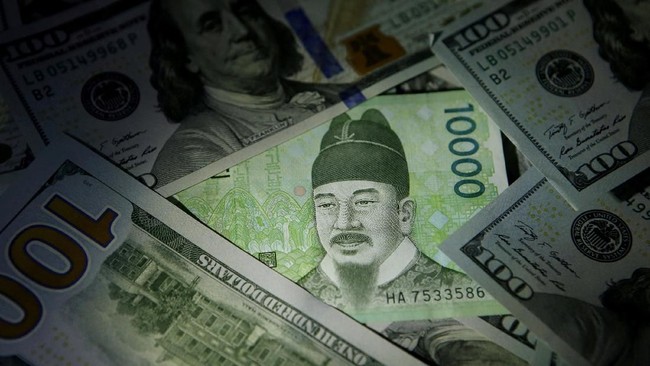
Jakarta, CNBC Indonesia - The majority of Asian currencies moved lower against the US dollar on Tuesday morning’s trading (24/3/2026). According to Refinitiv data at 08:40 WIB, most Asian currencies were in the red zone. The deepest weakening occurred in the Thai baht (THB), which fell 1.24% to THB 32.66/US.ThiswasfollowedbytheSouthKoreanwon(KRW), whichweakened0.85, and then the Taiwanese dollar (TWD), which dropped 0.36% to TWD 31.975/US.Next, theSingaporedollar(SGD)alsocorrectedby0.25. Below that, the Malaysian ringgit (MYR) depreciated 0.15% to MYR 3.942/US, whiletheChineseyuan(CNY)fell0.14. Meanwhile, the Japanese yen (JPY) was recorded weakening 0.12% to JPY 158.62/US, andtheVietnamesedong(VND)dippedslightlyby0.04. Amid the weakening of the majority of Asian currencies, the Philippine peso (PHP) instead became the only currency to strengthen, rising 0.17% to PHP 59.802/US.Meanwhile, therupiahtodayhasnotyetbeentradedinthedomesticspotmarketduetothejointleavefollowingEid.Nevertheless, therupiah′smovementdirectioncanstillbeobservedfromthenon − deliverableforward(NDF)market.BasedonRefinitivdata, theone − monthtenorrupiahNDFcontractthismorningwasrecordedintherangeofRp16, 964 − Rp16, 975/US. This level indicates that the rupiah in the offshore market is still moving below the Rp17,000/US$ area, while also reflecting relatively eased pressure compared to previous periods when the same tenor NDF had breached that psychological level. Meanwhile, the US dollar index (DXY) this morning was recorded strengthening 0.41% to 99.362. This strengthening of the US dollar is the main trigger for the pressure on the majority of Asian currencies. Today’s DXY rise also serves as a rebound after in the previous trading on Monday (23/3/2026), the US dollar index closed weakening 0.70% to 98.950. This followed US President Donald Trump delaying plans for an attack on Iran’s energy infrastructure. That step was taken after Trump claimed there were productive talks between the US and Iran, thus temporarily easing market concerns over potential larger energy supply disruptions. Trump stated he had asked the US Department of Defense to delay “any and all” military strikes on Iran’s power plants and energy infrastructure for five days. The statement was made just hours before the deadline he set for Tehran to fully reopen the Strait of Hormuz. Nevertheless, Iran’s Foreign Ministry denied such talks and emphasised that their conditions for ending the war remain unchanged. This situation briefly led markets to see a chance for easing tensions, allowing risk assets to gain momentum and the US dollar to weaken in the previous trading. Steven Englander, Head of Global G10 FX Research and North America Macro Strategy at Standard Chartered in New York, quoted from Reuters, said the market seems to still capture some form of communication between the two parties. According to him, although it does not necessarily mean an agreement is near, the market for now chooses to believe that a communication channel is ongoing.