
Asian Currencies Face Sharp Declines, Rupiah Suffers the Most
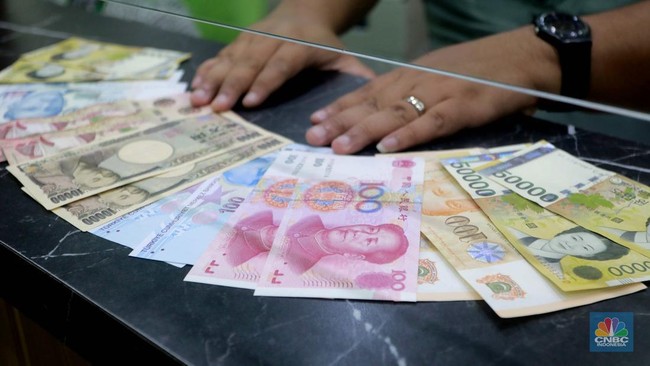
Asian currencies are experiencing significant declines against the US dollar this morning, Friday (17 April 2026). The pressure comes as the US dollar strengthens slightly.
According to Refinitiv data, at 09:23 WIB, out of 11 Asian currencies, nine weakened and only two strengthened against the greenback.
The deepest weakening occurred in Indonesia’s rupiah, which fell 0.35% to Rp17,185 per dollar. This level also marks the rupiah’s weakest intraday point ever.
The rupiah’s decline was followed by the Philippine peso, which weakened 0.19% to PHP 60.09 per dollar, while the Thai baht dropped 0.16% to THB 32.05 per dollar.
Pressure was also evident in the Japanese yen, which weakened 0.14% to JPY 159.4 per dollar, followed by the Malaysian ringgit, which fell 0.1% to MYR 3.95 per dollar, and the Vietnamese dong, which weakened 0.09% to VND 26,333 per dollar.
The Chinese yuan fell 0.05% to CNY 6.82 per dollar, the Singapore dollar weakened 0.04% to SGD 1.27 per dollar, and the South Korean won dipped slightly 0.02% to KRW 1,479.9 per dollar.
Amid the dominance of weakening, only two Asian currencies managed to strengthen. Namely, the Indian rupee, which appreciated 0.14% to INR 92.893 per dollar, and the Taiwan dollar, which strengthened slightly 0.03% to TWD 31.551 per dollar.
This movement aligns with the strengthening of the US dollar index (DXY), which at the same time rose 0.05% to 98.266.
From an external perspective, the US dollar is indeed tending to strengthen, but it is still on track for its third consecutive weekly decline. Market sentiment is starting to improve as hopes increase that the US-Iran conflict will soon subside, thereby reducing demand for safe-haven assets and lowering energy-driven inflation pressure.
US President Donald Trump stated that he is confident the war with Iran will end soon, even claiming that Tehran has agreed to several terms, including reopening the Strait of Hormuz and halting nuclear ambitions. Trump also announced a 10-day ceasefire between Israel and Lebanon, which is seen as strengthening the chances for further US-Iran negotiations.
As geopolitical tensions ease, oil prices continue to weaken, helping to lower inflation expectations and reduce speculation that the Federal Reserve needs to maintain tight policy for longer.
New York Fed President John Williams assessed that high uncertainty requires the central bank to be cautious in providing policy guidance, although the baseline projection still leaves room for interest rate cuts in the long term.
Ultimately, although the US dollar strengthened slightly this morning, the easing of safe-haven drivers keeps Asian currency movements pressured and limited.