
Asian Currencies Face Mixed Fortunes: Won and Ringgit Gain Ground, Rupiah Plunges
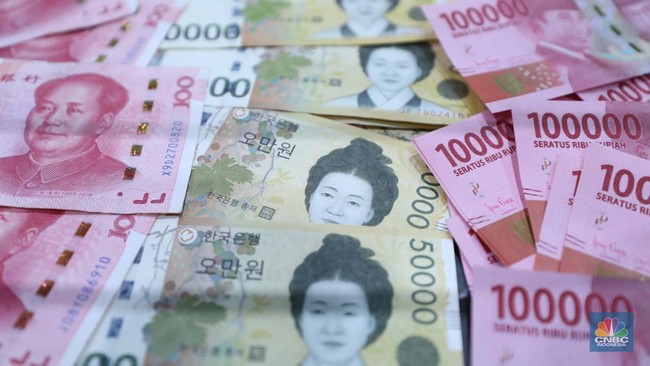
Jakarta — Asian currencies traded with mixed results on Monday 16 March 2026, reflecting broader volatility in the US dollar amid ongoing geopolitical tensions in the Middle East and elevated energy prices.
According to Refinitiv data at 09:05 Western Indonesia Time, of ten monitored Asian currencies, five strengthened, three weakened, and two remained flat against the US dollar.
The strongest performer was South Korea’s won, which appreciated 0.32% to KRW 1,496.6 per US dollar. The Singapore dollar followed with a 0.19% gain to SGD 1.28 per US dollar, whilst the Japanese yen appreciated 0.16% to JPY 159.46 per US dollar. Taiwan’s dollar also gained marginally by 0.05% to TWD 32.063 per US dollar, with Malaysia’s ringgit rising 0.05% to MYR 3.934 per US dollar.
In contrast, the Indonesian rupiah slipped 0.03% to Rp16,940 per US dollar. China’s yuan depreciated slightly by 0.02% to CNY 6.89 per US dollar, whilst the Philippine peso faced the heaviest pressure, weakening 0.22% to PHP 59.83 per US dollar. Vietnam’s dong and Thailand’s baht remained flat at VND 26,270 and THB 32.42 per US dollar respectively.
The US Dollar Index (DXY) declined 0.12% to 100.248 during morning trading, though it had registered its strongest weekly performance since September 2024, gaining approximately 1.7% the previous week. This strength has been driven by heightened demand for safe-haven assets as the Middle Eastern conflict entered its third week, coupled with persistently elevated energy prices.
Market participants remain concerned about conditions in the Strait of Hormuz, reportedly remaining “practically closed” amid increased attacks on vessels and reported mine-laying activities in the region. These developments pose substantial risks to energy supply disruptions, with Brent crude oil surging sharply throughout the month and breaching the psychological threshold of $100 per barrel.
The sharp increase in oil prices has triggered renewed concerns about accelerating global inflation, prompting investors to maintain positions in US dollar-denominated assets. This dynamic has constrained appreciation potential for other Asian currencies, resulting in the mixed trading patterns observed during Monday morning’s session.