
ASEAN mulls sharing fuel and food resources as fears of prolonged disruptions grow
ASEAN mulls sharing fuel, food resources as fears of prolonged disruptions grow
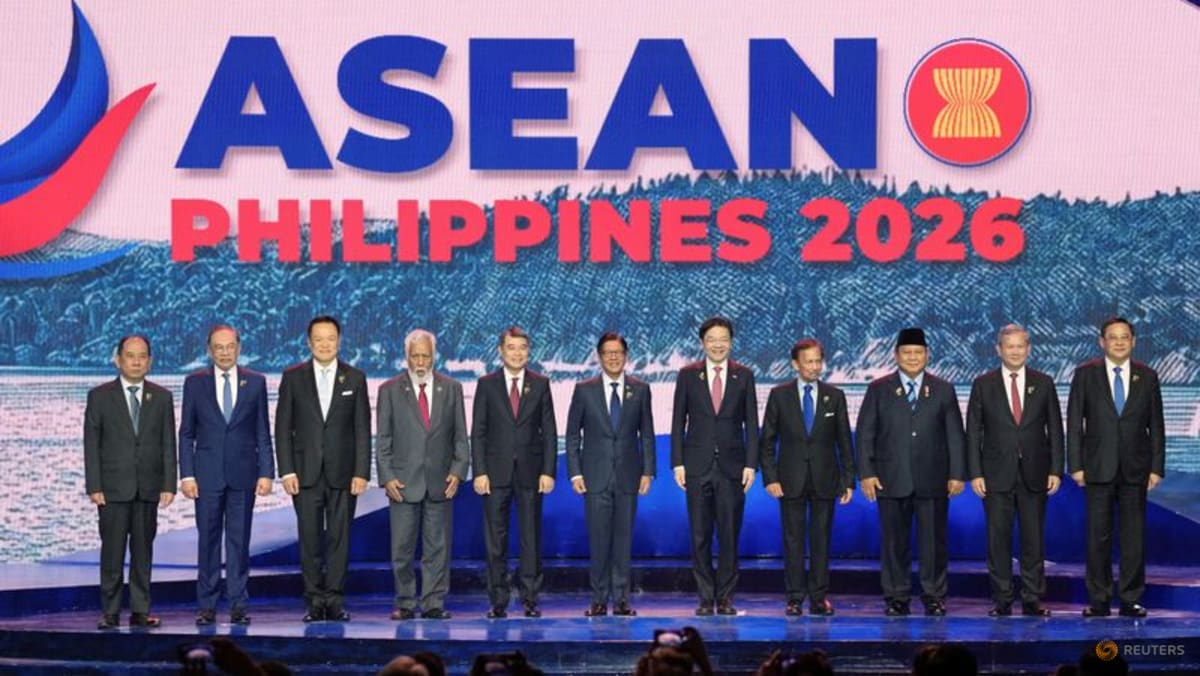
Leaders proposed a regional fuel stockpile and a standby arrangement for food security at the 48th ASEAN Summit on Friday (May 8).
CEBU: A regional fuel stockpile and a standby arrangement for food security were among measures proposed on Friday (May 8) at the Association of Southeast Asian Nations (ASEAN) Summit, as member countries continue to grapple with the impact of the Middle East conflict.
Philippine President Ferdinand Marcos Jr, the 2026 chair of the 11-member bloc, urged member states to pursue “practical cooperation” in an increasingly uncertain world.
Prolonged closure of the Strait of Hormuz - the waterway through which Asia obtains a significant share of its oil and gas - in the Middle East war has strained energy and fertiliser supplies, raising prices and threatening livelihoods.
“At a time of heightened volatility, ASEAN must strengthen coordination and reinforce preparedness, (and) pursue practical collective measures to safeguard a stable energy supply and improve interconnectivity,” Marcos said in his opening remarks at the plenary.
On the regional fuel stockpile, Marcos told the media after the summit that ASEAN leaders had discussed a “mechanism” for having a “reservoir” of different fuel products that can be shared among member states.
“The situation right now is very different for each country. Some countries have a surplus of a certain kind of fuel. Other people have a shortage, and we’re trying to balance that out,” he said at a press conference.
“And when something like this happens - a war happens and a trade route like the Strait of Hormuz is closed with all the attendant effects - we have somewhere to immediately run to for emergency supply.”
ASEAN is expected to issue a joint declaration that includes plans to launch a contingency plan that upholds international law, sovereignty and freedom of navigation in response to the Middle East conflict. This is based on a draft declaration seen by Associated Press.
On Thursday, Malaysia’s Investment, Trade and Industry Minister Johari Ghani reportedly said that ASEAN is exploring the possibility of establishing a regional fuel stockpile to improve resilience against future supply disruptions.
The proposal would allow member states to coordinate fuel needs and reserves as a regional grouping instead of acting individually, he said on the sidelines of the summit, held in Cebu in central Philippines.
Johari said the proposed framework could involve the private sector and enable all ASEAN member states to access the stockpile and attract more investment into the energy sector in future.
Malaysia Prime Minister Anwar Ibrahim said on Friday ASEAN must recognise that strategic collaboration with trusted partners and regional groupings can strengthen ASEAN’s long-term energy security.
“In this context, ASEAN should fully leverage cooperation with the Gulf Cooperation Council (GCC), including the broader ASEAN-GCC-China nexus, to build more reliable and resilient energy arrangements,” he said in his plenary remarks.
ASEAN, Gulf states, as well as China held a historic first meeting at last year’s ASEAN Summit pledging to build a new model of cooperation against a backdrop of an “increasingly complex” global environment.
Common interests include strengthening food and energy security, confronting climate change by investing in clean energy, and protecting freedom of navigation and the safety of maritime lanes.
Anwar on Friday reiterated ASEAN’s need to diversify fossil fuel sources and reduce over-dependence on vulnerable supply chains, noting that restoring “order” in trade routes and energy prices could take up to 18 months, depending on geopolitical developments.
“At the same time, the ASEAN Power Grid remains central to our energy transition and long-term security. Greater investment is needed to accelerate cross-border interconnectivity and low-carbon growth,” he added.
Singapore Prime Minister Lawrence Wong cautioned that even if the Strait of Hormuz were opened tomorrow, it would take at least months for damaged infrastructure to be repaired and for goods to flow again.
ASEAN should reinforce its collective energy security and work towards “swift ratification” of the ASEAN Petroleum Security Agreement as another tool to tackle energy crises, he said.
The agreement is aimed at improving energy security among ASEAN member states, primarily through a voluntary, commercial-based petroleum-sharing scheme during supply emergencies.
Wong encouraged member states to go beyond the agreement and use it as a basis for other measures that could strengthen ASEAN’s collective energy security.
“I know that our ministers and officials have also been discussing various ideas, including the possibility of a regional fuel stockpile,” he said.
CALL TO STRENGTHEN FOOD SECURITY ARRANGEMENT
On food security, Anwar proposed exploring a “regional standby arrangement for food security” during crises.
While Anwar did not give details on how such an arrangement might work, he said it will ensure faster coordination and emergency response among member states.
“The energy crisis is already feeding directly into food insecurity. Higher fuel prices are raising fertiliser, transport and production costs, creating immediate supply pressures across the region,” he said.
“If disruptions persist, ASEAN faces the risk of lower yields and sustained food inflation well into next year. Food security must therefore be treated as a regional strategic priority.”
Anwar also suggested strengthening the ASEAN Plus Three Emergency Rice Reserve mechanism by expanding it to include fertilisers.
The mechanism, which includes the ASEAN member states plus China, Japan and South Korea, involves stockpiling rice for immediate release during disasters, without disrupting market prices.
Singapore’s Wong said intra-ASEAN supply chains should be strengthened, especially for critical goods like foo