
As the World Moves Towards Multipolarity, Can Local Currency Transactions Withstand Rupiah Depreciation?
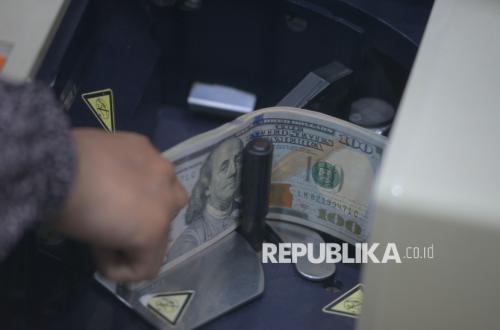
REPUBLIKA.CO.ID, JAKARTA — Economist and lecturer at Hasanuddin University (Unhas), Muhammad Syarkawi Rauf, assesses that the global economy is moving from unipolar to multipolar, in line with ongoing geo-economic and geopolitical dynamics. Facing the transition to a multipolar world, Syarkawi views one step to minimise the weakening of the rupiah exchange rate as strengthening local currency transactions (LCT).
“The unipolar world is characterised by US dominance with the US dollar as the sole dominant currency in international transactions. Meanwhile, a multipolar world positions the US no longer as the sole player (monopoly),” Syarkawi stated in his comments to Republika, quoted on Friday (24/4/2026).
He explains that in a multipolar world, several other countries also control the global economy with their respective currencies. The candidates are the European Union with the euro and China with the yuan.
Syarkawi notes that the discourse on the end of US dollar dominance was triggered by US sanctions against Russia following the annexation of Crimea, Ukraine, in 2014. This forced Russia to stop using the US dollar in its international transactions. The Russian government then switched to using the Chinese yuan.
“This situation was exacerbated by the behaviour of US President Donald Trump, who imposed extra high reciprocal tariffs on several countries, including those in the BRICS group,” he explained.
BRICS is known to include Brazil, Russia, India, China, and South Africa, formed in the mid-2009–2010 period. Indonesia itself joined BRICS in early 2025. From BRICS, the idea of establishing a common currency for those countries emerged.
Eight Decades of US Dollar Dominance
Syarkawi explains a brief history of US dollar dominance up to the current transition. He mentions that the British pound sterling was the dominant currency in international transactions until the late 1930s, the beginning of World War II. The role of the British pound sterling faded since World War I because the British Government faced financial difficulties, selling assets to finance the war and facing competitive pressures from other currencies.
During that period, the British Government’s debt increased sixfold to 130 per cent of Gross Domestic Product (GDP). The risk of debt default rose, debt costs increased, with the yield on British Government bonds rising as prices fell further.
Up to the Great Depression period in the 1930s, the British pound sterling remained the dominant currency in international transactions. Its role was fully replaced by the US dollar after World War II. The pound sterling was devalued in 1949.
The end of the golden era of the pound sterling marked the beginning of global US dollar dominance. The momentum came during a meeting of around 700 delegates from 44 countries in 1944 in Bretton Woods, New Hampshire, USA.
“That meeting gave birth to the Bretton Woods Agreement. This agreement became the starting point for the US dollar to replace the role of the British pound sterling as the dominant global currency. To date, the dominance of the US dollar in the global financial system has been more than 80 years,” he revealed.
The Bretton Woods meeting produced the Bretton Woods System (BWS), a foreign exchange system linking each country’s currency to the US dollar. There were 44 countries that agreed to convert their foreign exchange reserves into US dollars.
Factually, after more than 70 years, the world index of international currency usage shows a decline in the role of the US dollar as the world’s primary currency. The US dollar usage index fell from 61 in 2015 to 59.65 in 2025. Conversely, the euro and yuan indices increased. The euro usage index rose from 29.94 in 2015 to 30.22 in 2025, while the yuan increased from 0.95 in 2015 to 2.85 in 2025.
However, China’s yuan usage index does not align with China’s dominance in global trade. In the early 2000s, China’s international trade value was USD 474 billion, four times smaller than the US’s USD 2 trillion.
But since 2012, China’s international trade has surpassed the US. In 2024, the US international trade value was USD 5.3 trillion, smaller than China’s USD 6.2 trillion.
This condition contrasts with the use of the yuan as a global foreign exchange reserve, which only reached USD 1.95 trillion in 2025. Meanwhile, the use of the US dollar as a global foreign exchange reserve reached 56.77 per cent, down around 14.42 per cent over the last 10 years from 71.19 per cent.