
As New Head of Barantin, Karding Targets Dismantling Sectoral Egos
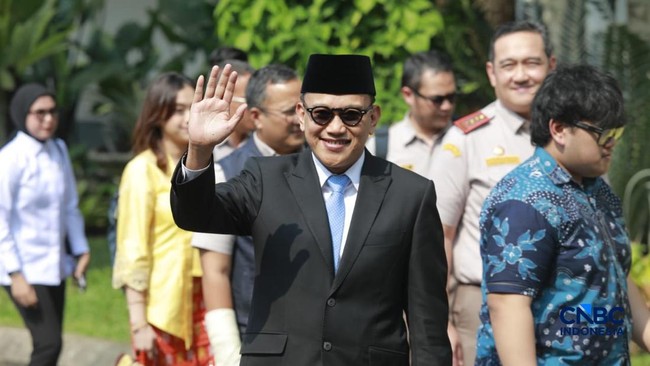
Bekasi, CNBC Indonesia - The Head of the National Quarantine Agency (Barantin), Abdul Kadir Karding, has immediately set ambitious targets at the start of his tenure. He emphasised that Barantin must transform into a more transparent institution, adaptive to global standards, while accelerating exports without impeding domestic industries.
Karding stated that Indonesia is currently at a crucial juncture in the global trade system. According to him, attention from trading partners such as the European Union presents an important opportunity for improvement.
“This is where we are tested to continuously improve without erasing the traces of previous steps. Today, we stand at a crossroads full of opportunities. Strategic trading partners like the European Union and other countries are providing constructive attention that we greatly appreciate,” Karding said in his speech at the handover ceremony in the Auditorium Tagor Sutan Harahap BUTTMKHIT, Bekasi, West Java, on Wednesday (29/4/2026).
He assessed that global demands now point towards a more transparent and standardised quarantine system. Therefore, Barantin in the future cannot focus solely on domestic matters.
“This reflects how the global quarantine system demands higher transparency, a more modern audit approach, and increasingly neat policy harmonisation. So, moving forward, we should not only look inwards, but we must connect with international regulations so that we can be accepted in friendly countries,” he said.
Target for the First Year: Transparency to Regulatory Reform
In his first year, Karding mapped out several priority steps. The first focus is to strengthen regulatory transparency, including opening dialogue spaces in reference to global standards such as the World Trade Organization.
“For the short term, in the first year, the first thing we will do is strengthen transparency. Every new regulation will be accompanied by an official translation, and we will open dialogue spaces in accordance with the Sanitary and Phytosanitary Agreement, or SPS, as well as with the WTO,” he explained.
The second step is to build more inclusive policy dialogues by involving various stakeholders.
“The second is inclusive policy dialogue. We will invite business associations, related ministries, farmer groups, fishermen, all stakeholders, to jointly review existing regulations,” he said.
He considered this important to ensure the quarantine ecosystem aligns with export enhancement targets.
“The goal is one: we must ensure the establishment of a quarantine ecosystem that aligns with the mission to accelerate exports and is not counterproductive to the national industry,” he stated.
Dismantling Sectoral Egos
Karding also highlighted the classic issue in bureaucracy, namely sectoral egos between institutions. He assessed that this often hampers policy effectiveness.
“The third is firmness in dividing roles between institutions. In Indonesia, our main problem is high sectoral egos. Based on laws, based on government regulations, each strengthens their own, this is my authority, this is yours, it cannot be mixed, and so on,” said Karding.
He even alluded to the term “deep state” often mentioned by the President as a critique of regulatory rigidity.
“Well, ladies and gentlemen may have heard the term deep state often mentioned by the President. Its meaning is that the President does not want our culture and traditions to be hindered by regulations that can actually be changed, discarded, discussed, and communicated,” he said.
To that end, Barantin will strengthen cross-ministry coordination, such as with the Ministry of Marine Affairs and Fisheries and the Ministry of Agriculture, including other related institutions.
“We must divide and work together, especially with several institutions,” he said.
Promoting Mutual Recognition to Bilingual Guides
Karding also targeted strengthening international cooperation through the Mutual Recognition Agreement (MRA) scheme to facilitate trade.
“We will issue joint changes, clarifying each authority, especially related to MRA, or Mutual Recognition Agreement. This is also important,” said Karding.
According to him, this harmonisation is crucial so that trading partners are not confused by the multitude of regulatory doors in Indonesia.
“This harmonisation will eliminate confusion for trading partners and solidify governance. So if we have high sectoral egos, our trading partners will be confused,” he said.
In addition, Barantin will also prepare open procedural guides in two languages to make them more accessible to global business actors.
“Open procedural guides, registration process flows, required documents, and time estimates will be compiled in a bilingual guide. We must think about the needs of our partners,” said Karding.
Prepare Proactive Diplomacy to Europe
The final step is to strengthen proactive diplomatic communication, particularly with Europe.
“The fifth is proactive diplomatic communication. We will send official responses to Europe, accompanied by a roadmap for strengthening transparency and efficiency. Not just answers, but an affirmation that Indonesia is ready to stand as an equal and dialogue in the spirit of partnership with them,” he said.
Karding emphasised that all these steps aim to enhance Indonesia’s position in the global eye.
“We must have authority; we must be taken into account by other countries,” he concluded.