
As millions in Indonesia and Malaysia rush home for Hari Raya, have their road trips become more perilous?
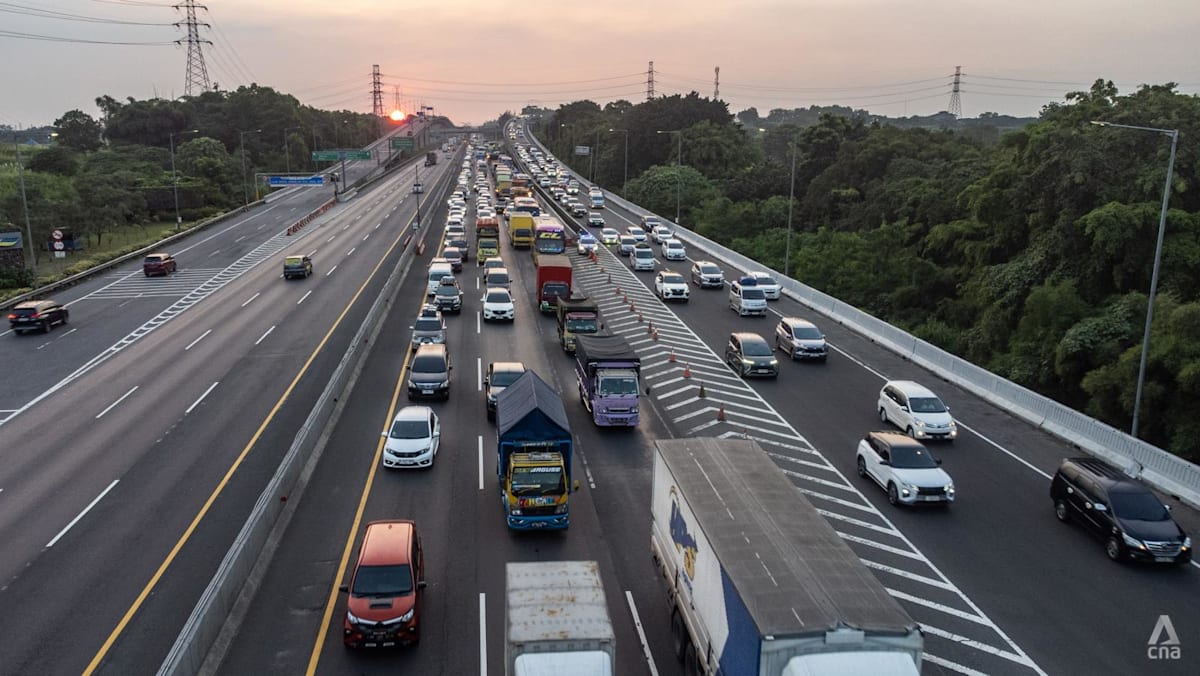
As millions in Indonesia, Malaysia rush home for Hari Raya, have their road trips become more perilous?
Government budget constraints in Indonesia, rising vehicle ownership in Malaysia as well as tensions in the Middle East could compound an already arduous and risky journey for millions heading to their home towns this Hari Raya season.
JAKARTA/JOHOR BAHRU: By the time Bayu Arfiansyah, his wife Noviana and his father Karyadi left their home on Saturday (Mar 14), the toll roads leading out of Jakarta were already crowded with fully booked buses and cars packed with passengers and belongings.
Eid, the Muslim holiday which marked the end of the fasting month Ramadan, was soon approaching, and the 27-year-old civil engineer was determined to spend the holidays with friends and relatives in his home town near the border of Central and East Java.
The first leg of their 650km journey was already stressful. Bayu had to jostle for space with impatient drivers weaving between lanes and cutting into queues with little warning. But the worst was still ahead of them.
As the night wore on, more vehicles from other parts of the Greater Jakarta Area poured onto the highway. Traffic slowed and, in some places, ground to a halt because of accidents, roadworks and long queues of vehicles trying to enter rest areas and petrol stations.
“At least the traffic is still moving,” Bayu, his face illuminated by the endless sea of red brake lights, told CNA journalists who accompanied him for the first half of his journey.
Meanwhile in Malaysia, graphic designer Nik Kamal Al’Azamim spent an entire day on the road with his wife and three children to get from Johor Bahru near the southern tip of Peninsular Malaysia to his home town Bachok some 700km away in the northern state of Kelantan.
“Normally the drive from Johor Bahru to Bachok takes about nine hours,” he said. “But during the Raya season, that time almost doubles. It usually becomes a 15 (hour) - to 16-hour journey.”
The trip, he added, is rarely smooth, especially with young children in the car.
“Children can have all sorts of moods. They get hungry, they want something to drink, or they need to go to the toilet,” said Nik Kamal, 38.
Every year, scenes like these unfold across Muslim-majority Indonesia and Malaysia as millions set off on long journeys to return home at the end of Ramadan.
During this period, tickets for aeroplanes, trains and buses are typically booked out weeks in advance. Those that remain often see prices surge by more than 100 per cent as demand spikes.
Experts and travellers told CNA this is part of the reason many prefer to use their own cars or motorcycles for the homecoming exodus - known in Indonesia as mudik and in Malaysia as balik kampung, both meaning “returning to the village”.
Indonesia’s Ministry of Transportation predicts that over 140 million people will travel during the festive season, making it one of the largest annual homecoming migrations in the world. Of that number, around 53 per cent are expected to use private cars while around 16.7 per cent will travel by motorcycle.
Meanwhile in Malaysia, toll operator PLUS Malaysia Berhad estimates that up to 2.3 million vehicles could travel daily on its highway network from Mar 18 to 23 when the exodus is near its peak.
The surge in vehicles not only leads to heavy traffic congestion but also increases the risk of accidents.
Last year in Malaysia, more than 15,000 road accidents and 123 deaths were recorded from Mar 29 to Apr 6, during the police safety campaign known as Ops Selamat.
In Indonesia, 223 deaths were recorded by the Indonesian Traffic Police Corps between Mar 20 and Apr 2, 2025, as people travelled to their home towns.
Officials in both countries say fatigue, reckless driving, as well as unsafe vehicle and road conditions were the main causes of these accidents.
These risks could be compounded this year by rising fuel prices linked to global tensions in the Middle East, said analysts.
Higher costs for petrol, experts said, may prompt bus operators to scale back services to manage operating expenses as well as push more travellers to opt for the cheaper - but often more dangerous - form of transportation: motorcycles.
Indonesia also faces rising budgetary constraints which could affect how public transportation and roads are inspected and maintained. Meanwhile, private vehicle ownership has been on the rise in Malaysia and the country’s road networks are struggling to keep up.
NO BREAK DUE TO CRIPPLING CONGESTION
Despite carefully planning his route and setting off a full week before Eid to avoid the predicted mudik peak on Tuesday and Wednesday, Bayu still found himself caught in crippling traffic about a third of the way into his journey.
He had planned to stop for a break every two hours, but the congestion kept him behind the wheel for nearly four hours before he could finally take a well-deserved break at a crowded rest area.
It was close to midnight and yet the stop was jam-packed with weary travellers and those looking for a bite to eat before fasting began at dawn.
The petrol station near the exit was even more chaotic, as queues of vehicles waiting to refuel intersected with those trying to leave the area.
“I worry that there might be fuel scarcity because of what’s going on in Iran right now, especially as I move further away from the big cities,” Bayu said of the global fuel supply disruption caused by a recent military escalation in the Middle East. “That’s why I fill up every chance I get.”
Bayu spent the next 30 minutes queueing for fuel before resuming his journey.
While what should have been a nine hour-drive stretched into a 15-hour journey for him, it was nothing compared to Malaysian Nik Kamal’s worst experience about a decade ago.
A trip from Johor to Kelantan typically takes around nine hours on a normal day but that year Nik Kamal spent 22 gruelling hours on the road.
“We stopped at every R&R (highway pitstop) to sleep, eat and rest. At some