
Artemis II Mission Delayed! Helium Issue Forces NASA Rocket Back to Hangar
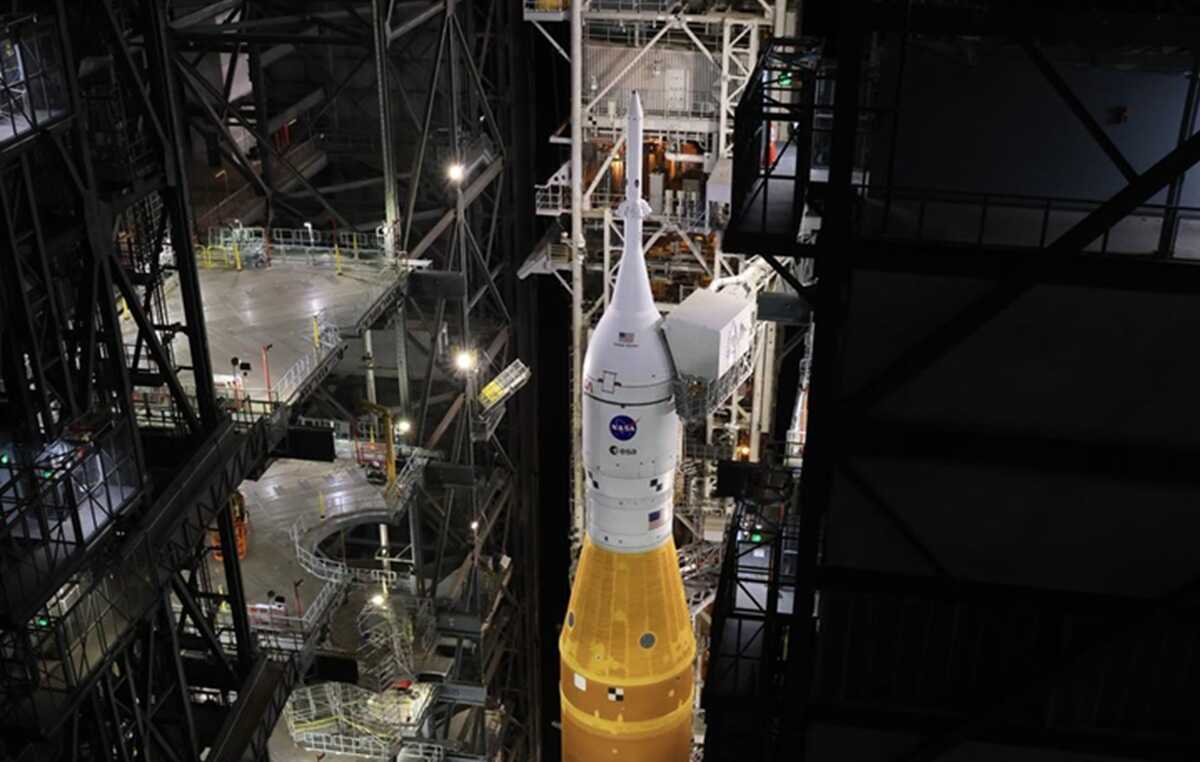
Hopes of seeing humans return to the vicinity of the moon in the near future must be put on hold for a while. The four astronauts of the Artemis II mission will have to wait longer after the Space Launch System (SLS) rocket was withdrawn from Launch Complex 39B to the Vehicle Assembly Building (VAB) at the Kennedy Space Center on Wednesday (February 25).
This step was taken after technicians discovered a disruption in the helium flow in the upper stage of the rocket. Because this area is inaccessible while on the launch pad, NASA was forced to bring the giant, 98-meter-tall rocket back into the building for repairs.
Initially, NASA targeted a launch window of March 6. However, due to this technical problem, the launch schedule has been pushed back to April 1, 2024, at the earliest. This helium issue was detected on February 20-21, just one day after NASA completed a “wet dress rehearsal,” a full fuel loading and launch countdown simulation.
The Artemis II mission is a historic mission that will carry NASA astronauts Reid Wiseman, Victor Glover, Christina Koch, and Canadian Space Agency astronaut Jeremy Hansen on a 10-day journey around the moon.
NASA Administrator Jared Isaacman explained in a social media post on X that the team was unable to flow helium through the vehicle during routine procedures on the Interim Cryogenic Propulsion Stage (ICPS).
“The team was unable to flow helium through the vehicle during routine purge and repressurization procedures on the SLS rocket’s ICPS,” said Isaacman.
Helium is stored in tanks connected to the ICPS, which can only be accessed when the rocket is inside the VAB. Isaacman stated that the withdrawal was necessary to allow technicians to determine the exact cause of the damage and carry out precise repairs.
NASA is trying to avoid the “back-and-forth” drama that occurred during the 2022 Artemis I campaign, where the rocket had to travel between the launch pad and the VAB three times due to hydrogen leaks before finally launching in November of that year.
Artemis II Launch Director Charlie Blackwell-Thompson gave the withdrawal order at 9:28 a.m. local time. The SLS rocket was then transported by the giant Crawler-Transporter 2 vehicle over a distance of 6.4 kilometers.
At a speed of only 1.6 km/h, the journey took about 10.5 hours before the SLS was finally parked safely in High Bay 3 of the VAB at 8:00 p.m. NASA is now racing against time to diagnose and fix the problem. The target is for the rocket to be able to return to the launch pad soon to complete the final tests before the April launch window opens, with launch opportunities available every day from April 1-6. (Space/Z-2)
NASA has released a report on the findings of the Investigation Team regarding the Boeing CST-100 Starliner Crewed Flight Test.
NASA’s Curiosity rover has discovered a unique geological formation in the shape of a “spider web” on Mars. This boxwork phenomenon is believed to have formed from ancient water activity.
A rare planetary parade will occur in February 2026. Mercury, Venus, Neptune, Saturn, Uranus, and Jupiter will be visible together, peaking on February 28.
NASA, through the Chandra Observatory and the James Webb Telescope, has discovered the ancient galaxy protocluster JADES-ID1, which formed very early, challenging theories of the formation of the structure of the universe.
The planetary parade phenomenon will bring six planets to the night sky at the end of February.
The Artemis II mission to the Moon has been further hampered by liquid hydrogen leaks. This is the technical and political reason behind the use of the most “fussy” fuel in the space world.