
Armageddon in the Oval Office: Religious Symbolism and US Foreign Policy
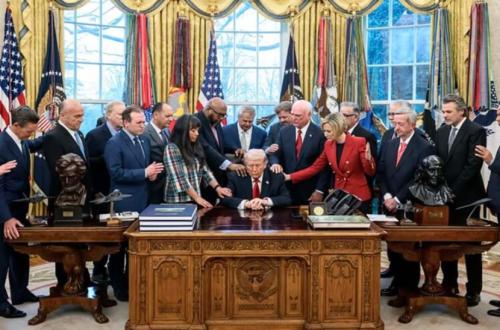
In American politics, religion has long occupied a place in the public sphere. Consequently, the sight of clergy offering prayers for the president at the White House may not always be considered extraordinary.
However, when religious symbols and rituals appear to draw closer to the centre of strategic decision-making—indeed reaching defence institutions—legitimate questions arise: to what extent does religious belief shape American foreign policy.
This question is particularly relevant when considered alongside the influence of certain evangelical and Christian Zionist groups in American politics. In widely cited scholarship, John J Mearsheimer and Stephen M Walt demonstrated that American support for Israel rests not only on strategic considerations, but is also sustained by a powerful domestic political configuration, including Christian groups that view Israel through a theological and eschatological lens (Mearsheimer and Walt, 2006). In other words, for some quarters, Israel is not merely a political ally, but also part of a broader horizon of religious belief.
It is here that the term Armageddon frequently emerges. Briefly understood, in certain Christian traditions Armageddon refers to a great war at the end times between forces of good and evil before the final judgement.
In more apocalyptic Christian Zionist interpretation, conflict in the Holy Land is sometimes viewed not merely as political conflict, but as part of a series of end-times prophecies (Clark, 2007; Al Jazeera, 2024). Therefore, support for Israel for some groups carries weight that is not only political, but also religious.
Certainly, not all evangelicals think in this manner. Generalisation would be misleading. Yet it is equally difficult to ignore that such thinking patterns do exist and possess political resonance. Reuters reported that on 21 May 2025 Defence Secretary Pete Hegseth led a Christian prayer service at the Pentagon, something considered unusual for a sitting Pentagon chief.
Reuters also broadcast video of clergy praying for the US President in the Oval Office on 5 March 2026. These events are insufficient to conclude that American foreign policy is entirely driven by religious agenda. However, they demonstrate that religious language, symbols, and rituals now appear increasingly close to the centre of state power.
Concern grows larger when this end-times imagination is linked to Jerusalem, particularly the Al-Aqsa/Haram al-Sharif complex. In many Middle Eastern opinions and media, there is apprehension that interference with the status of this sacred site could be read as part of an extreme religious agenda seeking to provoke large-scale conflict. This concern does not arise in a vacuum.
For the Arab and Muslim world, Al-Aqsa is not merely a religious site, but also a symbol of dignity, history, and collective identity. Consequently, any provocation there readily triggers emotional explosions across nations.
It is at this point that criticism must be raised. First, from the perspective of democracy and public rationality, state policy cannot rest on religious interpretation believed only by one group. Modern states must stand upon reasons that can be debated openly: international law, security, regional stability, protection of civilians, and public interest. Apocalyptic interpretation, however meaningful to its believers, cannot serve as legitimation for decisions of war and peace.
Second, from a strategic perspective, mixing religious language and foreign policy risks narrowing diplomatic space. If conflict is framed as a cosmic struggle between good and evil, compromise will easily be suspected as weakness. Yet diplomacy demands clear-eyed reading of reality, self-restraint, and willingness to seek political solutions. From this perspective, the criticism of Mearsheimer and Walt remains relevant: foreign policy too driven by ideological and emotional coalitions can drift from calm strategic assessment (Mearsheimer and Walt, 2006).
Third, from an ethical standpoint, Armageddon language is problematic because it easily obscures real human suffering. Civilians, children, refugees, houses of worship, schools, and hospitals destroyed can be reduced to part of a “grand drama” deemed sacred. Criticism from Middle Eastern media essentially moves in this direction: when conflict is transposed from the realm of politics still subject to negotiation into the realm of theology that is absolute, the path to peace narrows whilst violence becomes more easily justified.
Also lamentable is that echoes of such language have begun appearing in domestic Indonesian social media. Posts have emerged invoking “crusade” symbolism, discussing Armageddon carelessly, then spreading it with language more inflammatory than clarifying. Rather than helping the public understand the roots of conflict, such approaches risk awakening religious sentiment, provoking identity anger, and diverting attention from the real issues: civilian safety, protection of sacred sites, respect for international law, and the importance of political resolution. In an already heated situation, what the public needs is not dramatisation, but calm, clear, and responsible explanation.
Therefore, the world must take care not to become ensnared in sensational Armageddon language devoid of actual solutions. The Middle East conflict is not a theatre stage for end-times drama. It is a real issue: occupation, regional security, human dignity, respect for sacred sites, and the future of peace. For a country like Indonesia, the challenge is ensuring that public discourse remains grounded in sane language: the protection of Al-Aqsa.