
Are Campuses Ready as Robots Become Smarter?
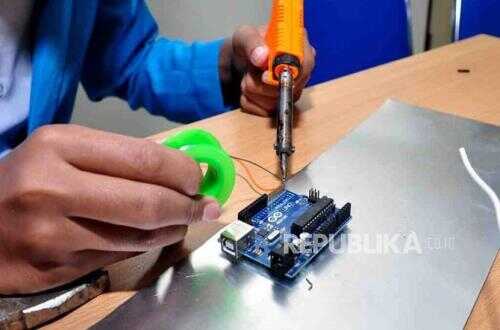
Robotics no longer exists solely on cinema screens or is confined to large factory production lines. It is present around us in industrial automated machinery, public service robots, and intelligent systems in healthcare and education.
Behind this progress, one foundation often overlooked by the public is electrical engineering. Without precise electrical systems, accurate sensors, reliable actuators, and integrated control, robots are merely frames without intelligence.
A robot is fundamentally an electro-mechanical system that operates in a measured and coordinated manner. Sensors function as senses, actuators as muscles, and control systems as the decision-making brain. Therefore, mastery of electrical engineering is not a supplement but a primary prerequisite in modern robotics development.
The question arises: is our higher education truly preparing this foundation?
Unfortunately, the acceleration of robotics technology has not been fully matched by learning readiness in universities. In many campuses, electrical engineering education remains trapped in theoretical approaches. Practicals often stop at basic modules and have not been directed toward comprehensive and contextual robotics systems design.
As a result, students understand concepts but lack real experience in designing, integrating, and testing electrical systems in the context of future technology.
This condition presents a serious challenge amid Industry 4.0 demands. Industry no longer seeks graduates who merely understand formulas and circuits, but talent capable of integrating electrical systems with automation, programming, and artificial intelligence. When curricula and teaching methods lag behind, the gap between graduate competencies and industry needs widens.
This is where the role of higher education becomes highly strategic. Electrical engineering education must shift toward project-based approaches. Students must be encouraged early on to design simple robots, automation systems, or intelligent devices that combine theory and practice.
This approach not only enhances technical skills but also trains critical thinking, collaboration, and problem-solving—competencies that form the core of 21st-century graduates.
As a Digital Business Campus, Nusa Mandira University recognises that learning quality must continually adapt to technological development. Through strengthening quality assurance systems and learning development, Nusa Mandira University promotes the integration of digital technology in academic processes.
Various activities, such as workshops on artificial intelligence implementation for digital transformation, form part of efforts to equip students with relevant intelligent technology foundations aligned with modern robotics development.
Laboratories must no longer be viewed merely as formal practical spaces. They must become spaces for exploration, innovation, and experimentation. Adaptive lecturer support, contextual curricula, and collaboration with industry are key to keeping electrical and robotics education relevant to real needs. Learning quality is not measured by the volume of material but by the depth of student learning experience.
Robots are not created to completely replace humans, but to improve work efficiency and quality. Therefore, electrical engineering students need to equip themselves with cross-disciplinary skills in programming, control systems, and basic artificial intelligence understanding. Higher education must be present as a space preparing the future, not merely repeating the past.
If universities can adapt and innovate, Indonesia will not only become a user of robotics technology but also a producer of ideas and innovation. At Nusa Mandira University, improving learning quality is key to ensuring students are prepared to face an increasingly automated and intelligent world.