
Appreciation for Government's Cancellation of Online School Policy, DPR: Momentum to Strengthen Education Quality
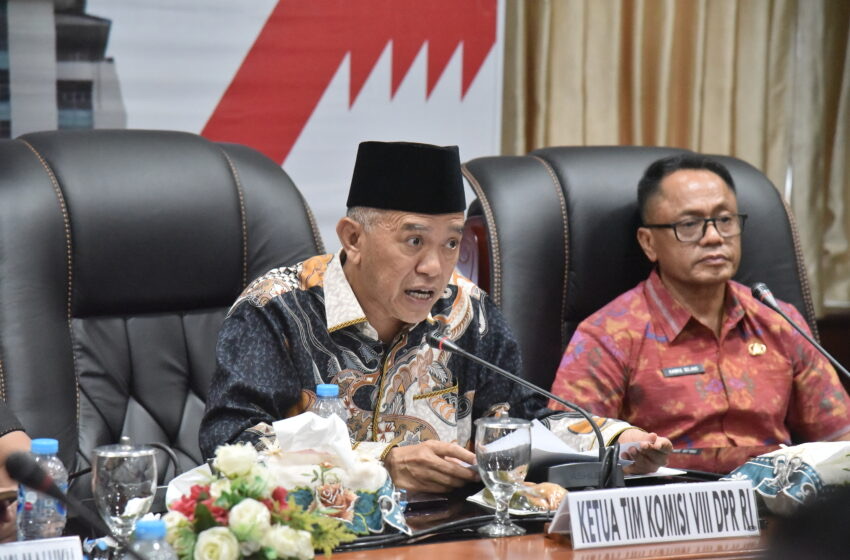
The government prioritises maintaining education quality.
The government’s policy to cancel the plan for online learning as an anticipation of global crises and an energy efficiency strategy has received appreciation from various parties. Commission VIII of the House of Representatives (DPR) RI welcomes the swift action of the government, in this case the Coordinating Ministry for Human Development and Culture (PMK), which has cancelled the online learning policy.
Deputy Chairman of Commission VIII of DPR RI, Singgih Januratmoko, assesses that the cancellation of this policy is a form of government responsiveness to field dynamics and the aspirations of stakeholders, especially in the madrasah and religious education environment, which is a working partner of Commission VIII.
“We appreciate this decision. Education quality is the main foundation of human development. A policy that prioritises a balance between energy efficiency and learning quality is a necessity,” stated Singgih in his written statement on Thursday (26/3).
According to Singgih, Commission VIII sees that quality face-to-face learning (PTM) remains the preferred option, especially for character building and deep conceptual understanding in the madrasah environment. In the madrasah context, Singgih continued, face-to-face learning plays an important role not only in knowledge transfer but also in moral development, religious values, and spiritual character, which are distinctive features of Islamic education. As a working partner of the Ministry of Religious Affairs, Commission VIII of DPR RI notes several crucial data points that are the main considerations. Based on the 2024 National Assessment report, there has been a decline in numeracy and literacy competency indices by 5.2 points in areas with high intensity of online learning over the past three years.
Meanwhile, data from the Ministry of Religious Affairs’ Management Information System for Supervision (Simwas) shows that around 34% of madrasah in 3T regions (Frontier, Outermost, Disadvantaged) face significant challenges in internet quota availability and signal stability, resulting in high dropout rates at the Tsanawiyah and Aliyah levels.
“Online learning is not a bad thing, but if forced in conditions where infrastructure is not yet evenly distributed, it is feared that it will widen the education quality gap. This is where adaptive policy is important. Do not let energy savings erode our long-term investment in human resources,” he emphasised.
Not stopping at appreciation, Singgih Januratmoko also offers several solution-oriented suggestions for the government, especially the Ministry of Religious Affairs as the direct partner of Commission VIII, to optimise post-policy cancellation, including through blended learning or needs-based mixed learning.
According to Singgih, instead of full online learning, the government can implement learning with a blended model (mixed) with a portion of 70% face-to-face and 30% online, adjusted based on zoning and infrastructure availability. This approach is more effective and still provides room for energy efficiency without sacrificing material depth, especially for Aliyah madrasah and religious higher education.
Singgih also suggests redirecting the energy saving budget previously allocated for online learning operations into more targeted internet quota subsidies. Focused on students, lecturers, and educators in madrasah and religious higher education who fall into the economically disadvantaged category. The Integrated Social Welfare Data (DTKS) and Ministry of Religious Affairs data can serve as the main basis for distribution.
To achieve long-term energy efficiency without disrupting the learning process, Commission VIII of DPR RI encourages the Ministry of Religious Affairs along with local governments to accelerate the installation of rooftop Solar Power Plants (PLTS) in madrasah buildings. Currently, out of 83,000 madrasah in Indonesia, only about 15% utilise solar energy. This will be a permanent solution to rising electricity costs without having to reduce learning hours.
Commission VIII of DPR RI will continue to monitor the implementation of this policy to ensure that energy efficiency steps do not run independently but go hand in hand with improvements in equitable and future-oriented education quality for the nation’s generation.
“Education is a long-term investment for the nation. Therefore, every policy must consider its impact on the quality of future generations,” he concluded.