
Applause! After Holiday Break, Rupiah Becomes Asia's King Today
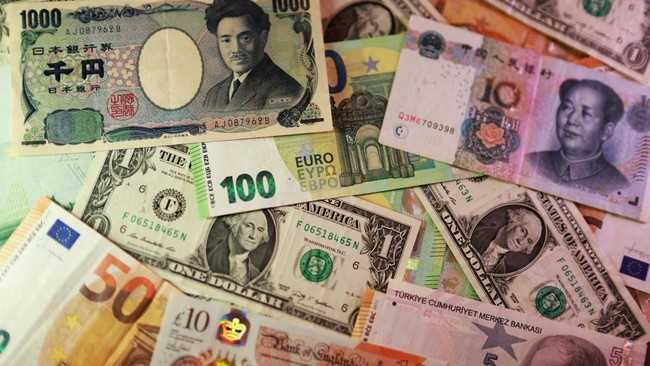
Jakarta, CNBC Indonesia - The majority of Asian countries’ currencies moved in the green zone against the US dollar on Wednesday morning’s trading (25/3/2026). This follows the weakening of the US dollar in the global market.
According to Refinitiv data, as of 09:20 WIB, out of eleven Asian currencies, seven strengthened and four weakened against the greenback.
The largest gain was led by the rupiah, which rose 0.47% to Rp16,895 per dollar. It should be noted that today marks the rupiah’s first trading day after the long Lebaran holiday. Previously, on the last trading day of Tuesday (17/3/2026), the rupiah closed up 0.06% at Rp16,975 per dollar.
Next, the Taiwanese dollar strengthened 0.15% to TWD 31.87 per dollar, followed by the Indian rupee which rose 0.13% to INR 93.89 per dollar, and the South Korean won which gained 0.12% to KRW 1,494.6 per dollar.
Strengthening was also seen in the Vietnamese dong, which rose 0.08% to VND 26,329 per dollar, the Malaysian ringgit which gained 0.08% to MYR 3.95 per dollar, and the Chinese yuan which increased 0.07% to CNY 6.88 per dollar.
On the other hand, not all Asian currencies followed suit in strengthening. The Thai baht was the most pressured, falling 0.12% to THB 32.56 per dollar. The Philippine peso weakened 0.08% to PHP 59.92 per dollar, while the Japanese yen and Singapore dollar both dropped 0.04%, to JPY 158.73 per dollar and SGD 1.27 per dollar, respectively.
This directional movement aligns with the weakening of the US dollar index (DXY), which at the same time fell 0.18% to 99.253.
The US dollar remains under pressure amid reports that the US is pursuing negotiations with Iran to end the conflict.
US President Donald Trump stated that Iran has offered a “gesture of goodwill” in negotiations related to ensuring the smooth flow of energy through the Strait of Hormuz. Israeli media also reported that Washington is pushing for a one-month ceasefire to open room for talks.
Meanwhile, other reports indicate that the US has sent a proposal containing several points to Iran to resolve the conflict.
Nevertheless, the market remains cautious. Tehran is reported to have denied engaging in negotiations with the US, while several Gulf countries have signalled readiness to join the war against Iran. This uncertainty keeps investors weighing conflict risks, although sentiment has temporarily eased due to hopes of de-escalation.
The weakening oil prices due to these developments provide some breathing room for the market. The decline in energy prices alleviates concerns that a surge in energy costs could reignite global inflation and prompt interest rate hikes.
On the other hand, US Federal Reserve official Michael Barr emphasised that the central bank still has the potential to maintain high interest rates for some time to control inflation. This statement serves as a reminder that the direction of US monetary policy will remain a key factor in the movement of the US dollar and global currencies.