
APHI Supports Development of High-Quality Carbon Initiatives
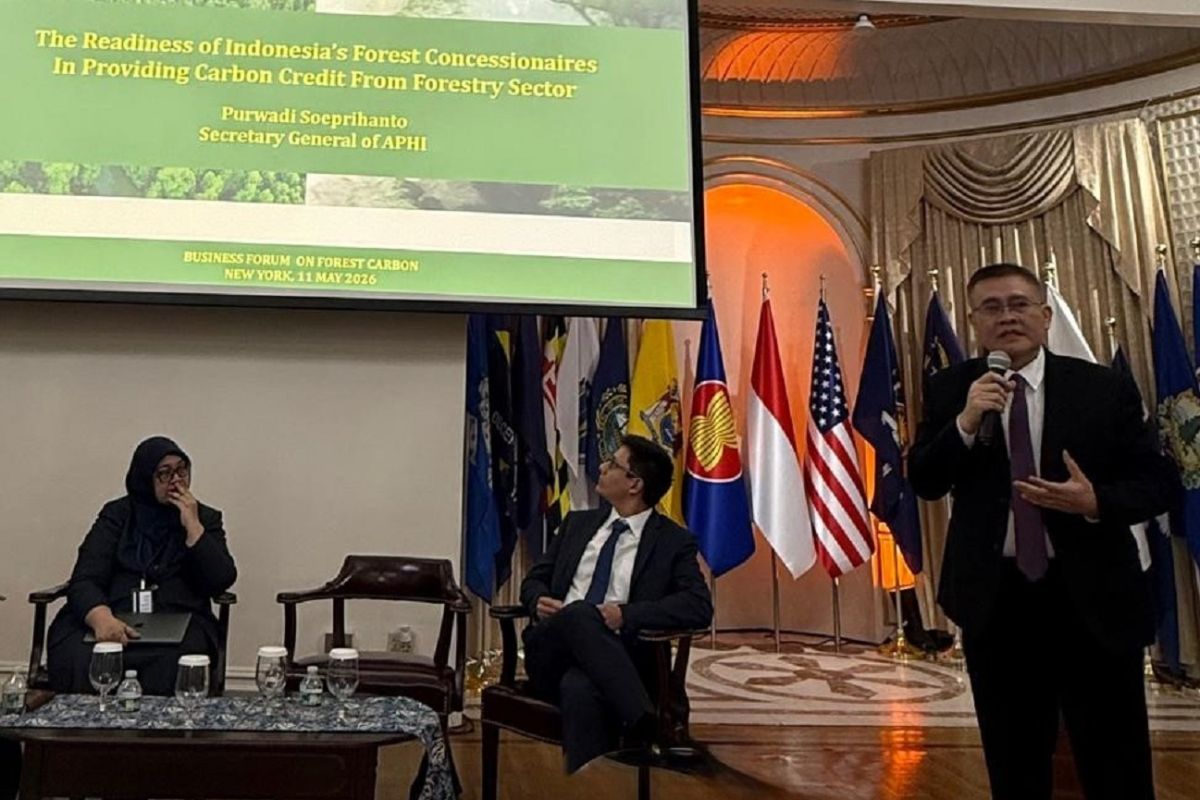
Carbon must be part of multi-business forestry and developed through robust landscape governance. Jakarta (ANTARA) - The Indonesian Forest Entrepreneurs Association (APHI) states its support for the development of high-quality carbon initiatives that can make a real contribution to Indonesia’s Nationally Determined Contribution (NDC) targets. APHI General Chairman Soewarso said the issuance of Ministerial Regulation on Forestry No. 6 of 2026 marks an important milestone in accelerating the development of Indonesia’s forestry sector carbon market while providing certainty for businesses in developing high-integrity carbon projects. “APHI and all its members are fully committed to promoting the development of high-integrity and quality carbon initiatives, so they can make a significant contribution to Indonesia’s greenhouse gas emission reduction targets,” he said in his statement in Jakarta on Tuesday. At the Business Forum on Carbon Market held in New York, United States, on Monday (11/5), Soewarso stated that acceptance in both domestic and international markets is an important factor in supporting the growth of Indonesia’s forestry carbon trade. In addition, he said, it opens up investment opportunities in peatland restoration projects, forest rehabilitation, and sustainable forest management that can produce high-quality carbon credits. Meanwhile, APHI Secretary General Purwadi Soeprihanto emphasised that Indonesia’s forestry concession areas have great potential to support carbon project development, with at least 48.69 million hectares of potential area for greenhouse gas emission reduction projects and around 3.5 million hectares of potential area for carbon removal projects. According to him, carbon projects must be placed as part of multi-business forestry development that can support community livelihood systems while strengthening climate change mitigation financing. “Carbon must be part of multi-business forestry and developed through strong landscape governance, accurate spatial planning, and supported by international cooperation and investment to produce high-integrity carbon credits,” he said. He added that international collaboration is very necessary to accelerate the development of peatland restoration projects, mangrove rehabilitation, sustainable forest management, and forest rehabilitation. Meanwhile, strengthening investment and regulatory certainty are important factors in increasing the attractiveness of Indonesian carbon projects in the global market. The business forum, which is part of the United Nations Forum on Forests (UNFF) 2026 activities, brings together government, forestry business actors, investors, emission trading associations, and international partners to discuss opportunities for developing carbon projects in Indonesia’s forestry sector. Previously, Forestry Minister Raja Juli Antoni, who also attended the forum, emphasised that Indonesia is now entering a new era of forest management that no longer relies solely on timber production, but also on carbon value, environmental services, biodiversity, and community-based green economy. According to him, Indonesia has around 120 million hectares of tropical forest, which is one of the world’s most important climate assets and is ready to be part of the global climate change solution. “Indonesia’s forests are ready to become a place for international world investment,” said the Forestry Minister at the Indonesia-IETA Business Forum and Indonesia America Chamber of Commerce (IACC) in New York. The government, he continued, has issued Ministerial Regulation on Forestry No. 6 of 2026 as a foundation for strengthening transparent, integrated, and legally certain forestry sector carbon trading. He explained that the regulation opens up opportunities for developing Indonesian forestry carbon credits that align with international standards while strengthening the implementation of Forestry Multi-Business (MUK) as a new paradigm for sustainable forest management. Through this approach, forest areas can be developed for various sources of income such as non-timber forest products, environmental services, ecotourism, to carbon trading. Raja Juli emphasised that this step is part of Indonesia’s efforts to support the FOLU Net Sink 2030 target while strengthening the competitiveness of national green investment in the global market. Meanwhile, Director General of Sustainable Forest Management of the Ministry of Forestry Laksmi Wijayanti stated that Indonesia is opening up global partnership opportunities to strengthen carbon trading and nature-based finance (nature finance) through sustainable forest management. According to her, Indonesia has forest areas covering around 63 percent of the national land area, which is an important capital in developing a green economy based on forestry. “The government’s current focus is to accelerate the implementation of (Ministerial Regulation No. 6/2026), strengthen operational guidelines, build market trust, and facilitate credible and high-integrity partnerships,” she said.