
Anticipating Price Increases, Bandung Regency Government Continues to Hold Cheap Market Operations
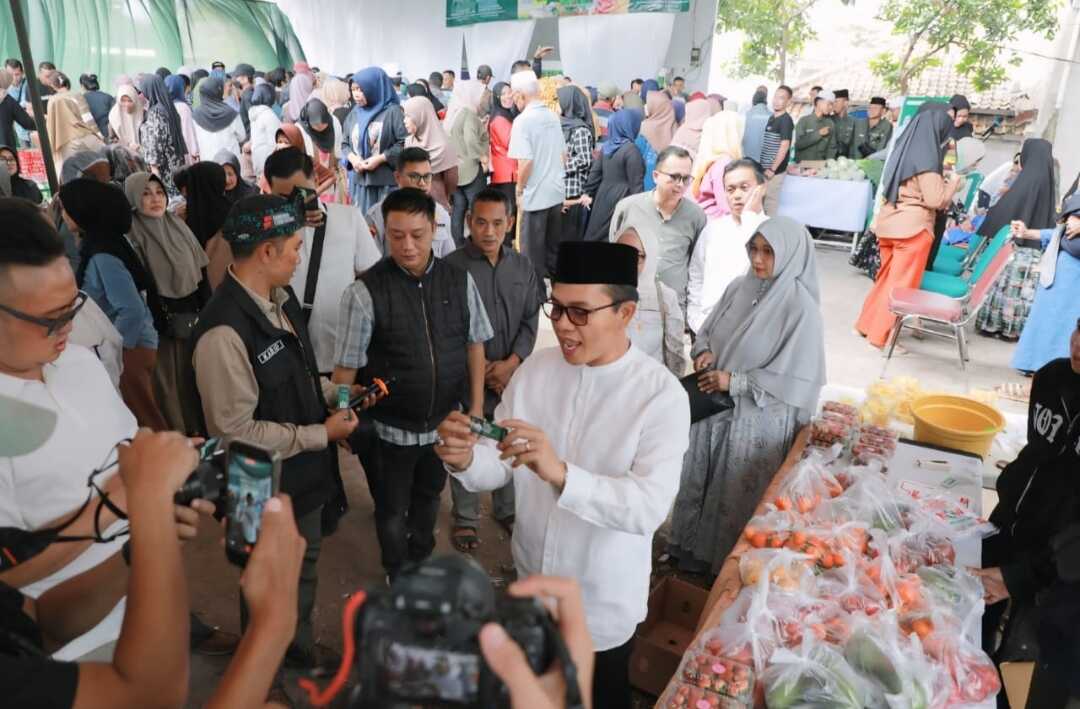
Bandung Regency Government continues to strengthen its strategy to curb local inflation through direct market intervention. One of the measures is the Cheap Staple Food Movement (Gerakan Pangan Murah, GPM), which this time targets thousands of residents in the Sapan area, Tegalluar Village, Bojongsoang District, on Friday (6 March).
Initiated by the Food Security and Fisheries Service (Dispakan) together with the Trade and Industry Service (Disperdagin) of Bandung Regency, it serves as a key instrument for the regional government to maintain price stability and ensure affordability of living costs amid fluctuations in staple commodity prices.
Regent Dadang Supriatna emphasised that the GPM is not merely a ceremonial event but a systematic effort to curb inflation at the grassroots level.
“These cheap food movements will be rolled out evenly across all sub-districts in Bandung Regency. We hope this measure effectively stabilises basic food prices and keeps the inflation rate under control,” he said.
In its implementation, the Bandung Regency Government partners with various business partners and food producers to cut distribution chains, so prices reaching consumers are far below market price. To further ease the burden on residents, the government provides a special subsidy.
Subsidi Rp20k
A total of 2,500 staple packages have been prepared for residents of Tegalluar and surrounding areas. The government provides a price reduction of Rp20,000 per coupon for each purchase of staple goods.
The activity involved residents from 14 RWs (neighbourhood associations) in Tegalluar who queued from the morning.
At the same location, Acting Head of Disperdagin Bandung Regency Dicky Anugrah stated that they routinely monitor prices in traditional markets to determine the points at which GPM intervention is prioritised.
In addition to focusing on strengthening the economy and food resilience, Dadang also included a humanitarian agenda. The moment is used to distribute zakat mal to vulnerable community groups.
“This year, zakat mal is distributed to 1,063 beneficiaries consisting of orphans, the poor, and the elderly in 14 RWs of Tegalluar Village,” he said.
This figure changed from the previous year, which reached 1,800 people, indicating shifts in social welfare data in the area.
Dadang hopes this assistance can help ease residents’ needs ahead of Eid al-Fitr.
“May our efforts to maintain food stability and assist others always be blessed. We ask for prayers that we remain trustworthy in carrying out this task,” he said.
Sensus Ekonomi is a data instrument conducted regularly every five years.