
Anti-Monopoly Bill: Business Community Calls for Strengthening KPPU Governance
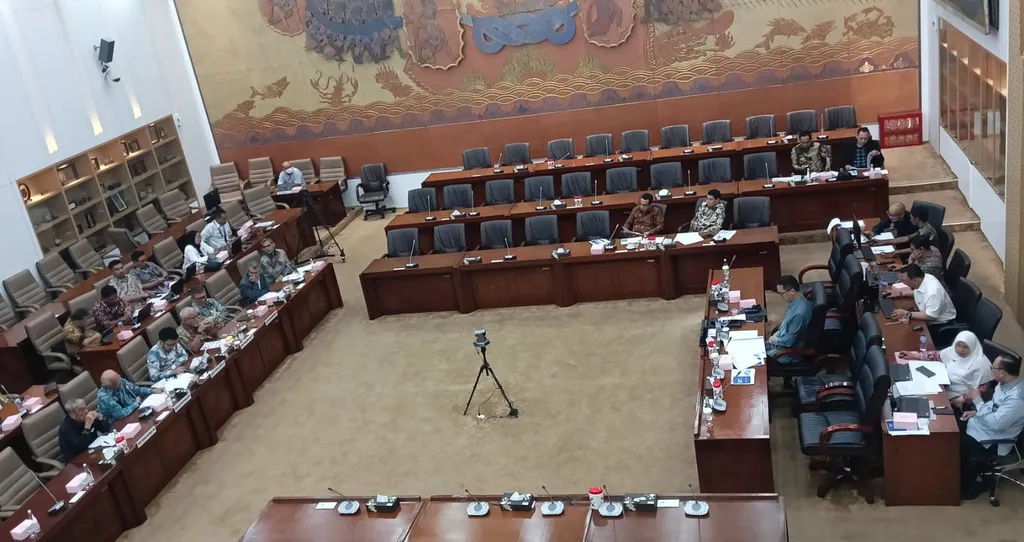
The revision of Law No. 5 of 1999 is expected to produce a more adaptive regulatory framework, including protections for business investments.
JAKARTA, KOMPAS — The business world has highlighted several issues in the revision of Law No. 5 of 1999 on the Prohibition of Monopolistic Practices and Unhealthy Business Competition. One of them is the institutional capacity of the Business Competition Supervisory Commission (KPPU), which is not balanced with its authority.
In the General Hearing Meeting (RDPU) of the Working Committee of Commission VI of the House of Representatives (DPR), in Jakarta on Monday (30/3/2026), regarding the preparation of the academic paper and draft revision of the law, industry players highlighted several fundamental problems that could disrupt the investment climate.
Executive Director of the Indonesian Textile Association (API) Danang Girindrawardana stated that business actors fundamentally support strengthening the role of the KPPU in supervising healthy business competition. However, institutional improvements are crucial so that the extensive authority does not cause uncertainty.
“We want to ensure that the KPPU institutionally can truly carry out its role in supervising healthy business competition,” said Danang, who is also a member of the expert board of the Indonesian Employers Association.
Several important aspects to highlight, according to Danang, include the retention of several old provisions in the draft revision, including Article 36 of Law No. 5 of 1999. Its substance grants the KPPU broad authority, from investigation, prosecution, to decision-making.
This concentration of functions is considered potentially problematic in terms of governance because it is not matched with adequate institutional capacity.
According to Danang, the KPPU currently has a relatively small structure but holds the authority to decide on business competition cases involving investments worth trillions of rupiah. “This is imbalanced. An institution with limited capacity can determine the fate of large investments and tens of thousands of workers,” he said.
In addition, the aspect of imposing sanctions is also deemed to lack a clear calculation basis. Under the current regulations, the KPPU can impose administrative fines ranging from Rp 1 billion to Rp 100 billion. However, the mechanism for determining the sanction value is not fully transparent.
“The fine should be based on clear parameters, whether state losses, losses to other business actors, or public losses. Currently, there is no firm benchmark,” said Danang.
He also warned that the enforcement of business competition law should not lead to uncertainty that hinders investment. In practice, even just reporting to the KPPU can affect a company’s reputation even before any decision is made.
On the other hand, several associations stated their support for retaining the legal remedy mechanism up to the Supreme Court level as regulated in Article 44. This is considered important as a form of control over KPPU decisions.
Danang also highlighted the examination provisions in Article 39 of the draft revision, which allow summoning witnesses and involving police apparatus. According to him, there needs to be guarantees of equal treatment for the reported parties, given the potential for misuse of reports in business competition.
“Business competition is not always pure. There is also the potential for reports aimed at bringing down competitors. This must be anticipated so as not to damage the business climate,” he said.
Philosophically, the revision of the Business Competition Law is still important to maintain a balance between large and small business actors. The regulation is expected to encourage fair competition without stifling small businesses, while not holding back the growth of large businesses.
“The principle is fair competition. The big ones do not suppress the small ones, and the small ones are encouraged to grow healthily,” said Danang.
Commission VI of the DPR is expected to consider these various inputs in the discussion of the law revision to produce a more accountable, transparent regulatory framework that maintains legal certainty and a conducive investment climate.
Adisatrya Suryo Sulisto, the leader of the general hearing meeting of the working committee for preparing the academic paper and draft revision of the law, stated that the main goal of the law revision is to create a level playing field for all business actors.
Thus, there is no domination by large business actors that can hinder the growth of small and medium enterprises. “We want an efficient and innovative market and business world in Indonesia. That can only be achieved if the competition is healthy,” said Adisatrya.
He added that imbalances in business competition could reduce market efficiency and harm consumers. In unhealthy competition conditions, the public risks not getting quality products at affordable prices.
Strengthening the KPPU’s institution is considered important to increase the effectiveness of business competition supervision. Adisatrya emphasised that this step is not intended to burden business actors.
“Strengthening the KPPU should not be seen as an effort to burden the business world. On the contrary, the institution must be strengthened so it can supervise and promote efficiency and healthy business competition,” he said.
The DPR, continued Adisatrya, will continue to monitor the development of the KPPU while ensuring that the law revision can create a balance between legal certainty, business actor protection, and consumer interests.
The discussion of the revision of Law No. 5 of 1999 is expected to result in a regulatory framework that is more adaptive to economic dynamics, including cross-border business practices, while keeping the domestic investment climate conducive.