
Anindya and Trade Minister Frank on Reasons for Indonesia's Insistence on Close Trade Ties with the US
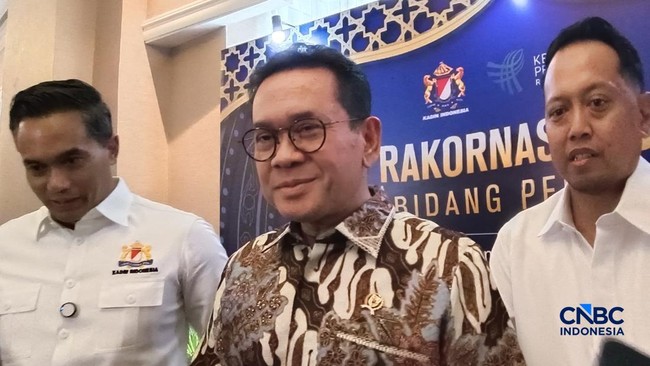
The government and business actors are united in preserving trade relations with the United States (US), not merely due to export values, but because of the substantial surplus and its impact on domestic labour-intensive industries. Amid geopolitical dynamics and public criticism, the US market is deemed too strategic to relinquish.
Trade Minister Budi Santoso revealed that the US market’s contribution to Indonesia’s export performance is highly significant, particularly in terms of trade surplus.
“Sometimes, especially regarding our market to America. Our exports to America last year were US$30.9 billion, our surplus US$18.11 billion or 11% of our exports are to America. Our top export destination is China, second is America. But the largest surplus we have is with America, then India,” Budi stated at the Kadin Indonesia National Coordination Meeting in Jakarta on Thursday (30/4/2026).
According to him, the size of the market and surplus leaves Indonesia with no choice but to continue safeguarding trade relations with the US, including through long-initiated trade agreement efforts.
“Well, this large market cannot possibly be abandoned. That’s why we must still have a trade agreement with America. We have wanted to make a trade agreement with America since 1996, on 16 July 1996 we had what is called TIFA, Trade and Investment Framework Agreement. TIFA is the precursor to how we make a trade agreement with America,” he explained.
“But it’s not easy, negotiations always fail. Because America knows they will be a market for Indonesia. And it’s proven that our market is quite large in America,” he added.
Budi said the negotiation process with the US has lasted nearly three decades without a final outcome, unlike other agreements that can be concluded more quickly with compromises.
“(From) 1996 to now means 30 years we’ve been making a trade agreement with America and it’s never finished. Finished in less than a year was then after there was ART (Agreement Reciprocal Trade). Indeed, in negotiating, we each must be able to lower our egos. If we can’t lower our egos, the negotiation will never end,” Budi said.
On the other hand, Budi also responded to social media criticism regarding the trade agreement process allegedly violating the constitution. He affirmed that the government’s steps comply with applicable rules.
“Well, secondly, if we look at social media it’s buzzing, some say that we violate constitutional regulations when negotiating or signing ART. If we look at Law No. 7 of 2014, the Trade Law in Articles 83 to 87 it states that the government may enter into international trade agreements. The government may consult with the DPR no later than 90 days since the trade agreement is signed. Since it is signed,” he explained.
“So not before signing. So after signing then consultation. Then some say why the legal basis is Perpres not a law. Well, the legal basis isn’t finished yet. Right, consult first then it will be stipulated in a Perpres or law depending on the consultation results with the DPR. Well, that perhaps is what we need to explain to the public, that what the government does, what the president does is all in accordance with the rules, in accordance with the constitution,” he emphasised.
Furthermore, he stressed that Indonesia’s exports to the US are dominated by labour-intensive manufacturing sectors, such as textiles to footwear, which absorb a lot of workforce.
“And once again I convey, we have a large market in America, we must save that market. I think you all agree because our exports to America are mostly labour-intensive manufacturing industries. We export textiles, textile products, ready-made clothing, footwear and so on. Well, that’s what we’re doing with America now,” he said.
Business Stance
In agreement, Chairman of the Indonesian Chamber of Commerce and Industry (Kadin) Anindya Novyan Bakrie stated that the US position remains crucial, even though it is not Indonesia’s largest export destination.
“Of course everyone knows that the largest export is to China, first. Second is to America, these two are superpower countries,” Anindya said on the same occasion.
According to him, the large surplus makes the US an unignorable trade partner.
“Moreover, why many ask, why back and forth to America so often? Because America although number two, the surplus is number one. So in a sense, if we’re doing business there’s a client like that, we must listen, like it or not,” he said.
He also appreciated the government’s efforts to maintain good trade relations with the US amid various global challenges.
“Well, this is what we appreciate the government for continuing to foster good relations even though certainly not without criticism and risks. Especially when talking about geopolitics like this. So we thank you,” he said.
Going forward, Kadin hopes that market access openings are not only enjoyed by large exporters but also by business actors who have not yet penetrated the global market.
“Well, in that context, today I hope together with all of you how we can collaborate with the government to ensure that this market access opening is enjoyed by many parties. Not just those who already export but those who haven’t exported,” he concluded.