
Andra Soni Outlines Banten Provincial Government Strategy to Tackle Poverty
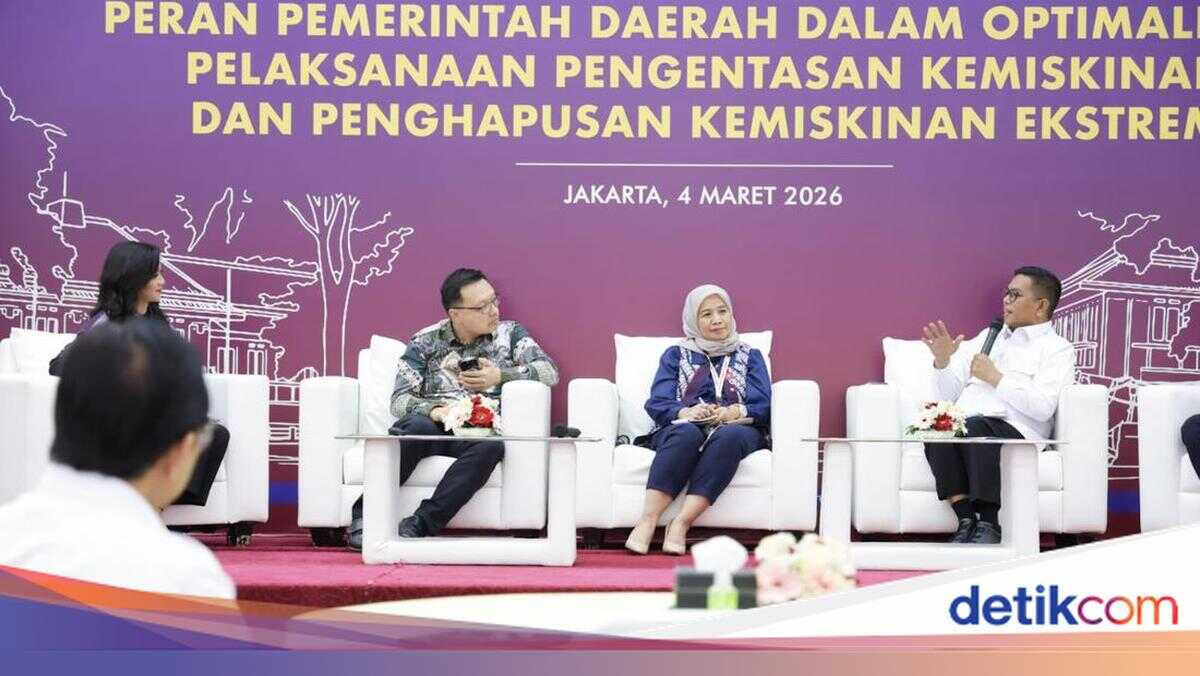
Gubernur Banten Andra Soni becomes a speaker of the best practice programme on poverty alleviation at the Coordination Meeting on the Role of Local Governments in Optimising the Implementation of Poverty Alleviation and Eradication of Extreme Poverty at the Coordinating Ministry for Human Development and Cultural Affairs, Jakarta, today.
Andra Soni began the briefing by noting how the province’s location close to Jakarta is advantageous for development in Banten Province. He also shared personal experience on how empowerment through education can impact empowerment of others.
‘What we are doing is in line with government directives. One of them is Presidential Instruction (Inpres) Number 8 of 2025 on Optimising the Implementation of Poverty Alleviation and the Eradication of Extreme Poverty, a principle that we must carry out together,’ Andra Soni said in a written statement, Wednesday (4/3/2026).
According to Andra Soni, previously attention to villages was lacking and access was impeded. This caused slowdowns across various sectors including the economy and education.
‘Thus the Banten Provincial Government is also responsible for building village roads. Helping in life infrastructure in villages,’ he added.
Andra Soni hopes the Desa Sejahtera Road Construction Programme (Bang Andra) will raise the economy and productivity of villages, particularly in the agricultural sector. The move is expected to boost the province’s Gross Regional Domestic Product (PDRB). Given the location and potential of the region, he is optimistic that the Banten Province’s PDRB will be further increased.
‘The economy of Banten Province in 2025 grew solidly by 5.37 percent (YoY), with PDRB at current prices reaching Rp 936.20 trillion,’ he stated.
Andra Soni disclosed that currently the Banten Provincial Government is focusing on the Free School Programme for senior secondary schools (SMA), vocational schools (SMK), and Madrasah Sancta (SKh).
‘In 2026, it will be extended to Madrasah Aliyah schools at the SMA/SMK level,’ he stated.
He admitted that there has been reluctance about Madrasah Aliyah due to authority. He said the governor and provincial government are representatives of central government in the region. Therefore governors or provincial governments can intervene in madrasah schools which fall under the authority of the Ministry of Religious Affairs of the Republic of Indonesia.
‘I hope BPK, auditors and others share the same understanding,’ Andra Soni said.
Regarding Free School, to date, it has funded 60,705 children in Banten who were not admitted to state schools. The programme collaborates with 801 private schools at SMA, SMK, and SKh levels.
‘The budget is roughly Rp 165 billion for one cohort. So this year the budget will be increased again,’ Andra Soni explained.
‘That commitment to poverty alleviation includes building village roads and free schools. Our hope is that collaboration with the Central Government can run well, and we can maximise empowerment,’ he added.
Meanwhile, Coordinating Minister for Human Development and Cultural Affairs of the Republic of Indonesia Muhaimin Iskandar said poverty remains a fundamental challenge. It is characterised by a shrinking middle class and a significant rise in the number of people vulnerable to poverty.
‘This indicates not the solidness of the middle class economy,’ he said.
According to him, economic shocks can easily push vulnerable groups into poverty. Meanwhile, one of the pillars of Indonesia’s economic growth is middle-class spending.
Cak Imin also reminded about Presidential Instruction No. 8 of 2025 for poverty alleviation. Also the target of 0 percent extreme poverty by 2026 and a poverty rate target of 5 percent by 2029. According to him, in poverty alleviation programmes, social protection alone is not enough.
‘Social empowerment is required,’ he said.
Cak Imin also described eight policy steps in the package for community empowerment, including extreme poverty must work, 10 thousand worker housing units, cancellation of debt for health insurance contributions, SMK go global, market 101 nights, renovation and rehabilitation of pesantrens, agrarian reform for the poor, and accelerated post-disaster recovery in Aceh and Sumatra.
‘Local governments play a strategic role as the driving force of regional poverty alleviation. Regencies/cities that succeed in reducing poverty will receive fiscal incentives from the Ministry of Finance,’ he concluded.
For the panel discussion, the session was guided by Frisca Clarissa with sources Andra Soni; Deputy for Community Empowerment and Protection of Migrant Workers at the PMK Ministry, Leontinus Alpha Edison; Secretary of the Extreme Poverty Convergence Task Force Niken Ariati; and from the Tsu Tji Andri Manongko Foundation.
(adv/akd)