
Ancient Mosque in Remote Pidie Unites Youth in Ramadan Celebrations
A hadith states: “Whoever performs prayer during Ramadan with sincerity and faith, seeking Allah’s pleasure, will have their past sins forgiven” (Hadith narrated by Bukhari).
This hadith is among those practised by Muslims throughout the holy month of Ramadan. It is unsurprising that mosques, prayer halls, study circles and other places of worship are filled with religious activities and supplications for forgiveness.
At the Ancient Mosque in Padang Village, Mangki Kemukiman, Simpang Tiga District, Pidie Regency, Aceh Province, residents gather each night to celebrate Ramadan. From the time before sunset through to Tarawih prayers, Quran recitation sessions and pre-dawn meals, the mosque buzzes with activity.
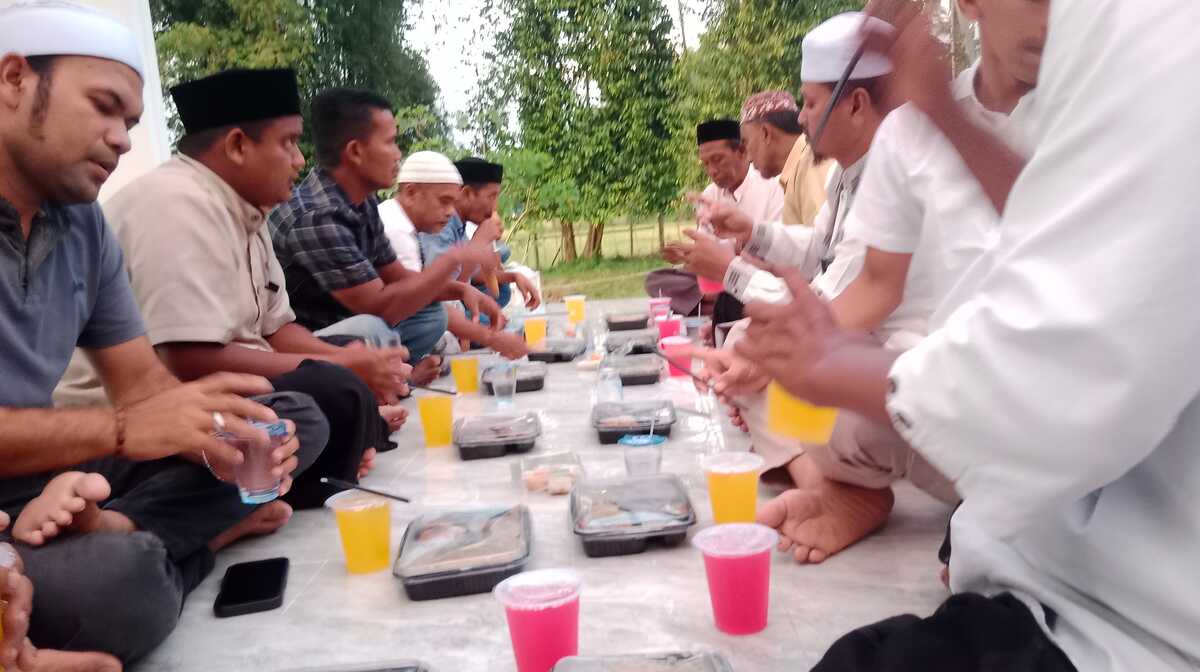
Notably, the ancient mosque, affectionately called Masjid Tuha (the Old Mosque), is regularly filled with local youth and those from surrounding areas. They work collaboratively to organise various activities to celebrate Ramadan. They clean the surroundings, fill water vessels for ablutions, prepare the interior for Maghrib and Tarawih prayers, host Quran recitation sessions that extend until dawn, and organise communal breaking of fasts whilst enjoying the beauty of sunset over the vast rice fields.
“Long ago, this mosque was built with wooden construction, featuring eight supporting pillars and measuring 8 by 8 metres,” explained Ir Musallamina, the Mosque Coordinator, to Media Indonesia on Saturday (28 February). “In 1971, a new mosque was constructed approximately 200 metres to the east. The old mosque building then remained unused for decades. To revive the ancient mosque site, residents rebuilt it with permanent concrete octagonal construction, with a capacity of around 50 worshippers. By Allah’s will, on 20 January 2020, it emerged as a sturdy and fully operational structure.”
The mosque is designed with surprising elegance, resembling a miniature palace adorned with Moroccan-style lighting. Its floors are tiled ceramic, and the interior is covered with carpets and prayer rugs of Turkish manufacture. The cool atmosphere created by air conditioning, surrounded by lush forest vegetation, makes worshippers unaware they have completed twenty Tarawih prayer cycles plus three Witr prayers.
“This beauty is for the comfort of worshippers. Many interior accessories were sourced from the Middle East, specifically from Turkey and Morocco. Many young people are attracted to join the congregation, and this strengthens their bonds,” explained Musallamina, a civil engineer who personally designed the unique and beautiful structure.
The Ancient Mosque is surrounded by dense forest, located approximately 200 metres west of residential areas. To the west of this minimalist concrete structure lies vast rice fields stretching as far as the eye can see, resembling Turkish carpets. Between the mosque boundary and the rice fields runs a clear irrigation channel. When viewed from the middle of the rice fields, the white mosque appears like a miniature palace. The white-painted building stands out like a Muslim woman in a hijab standing at the edge of the village, looking to cross the expanse of rice fields.
Access to the mosque, with a capacity of approximately 50 worshippers, is via an entrance on the southern side, passing through and exiting northward along a 2.5-metre-wide alley. The location is situated in an inland settlement approximately 3 kilometres south of Selat Malaka beach, 7 kilometres east of Sigli City (the capital of Pidie Regency), and approximately 130 kilometres east of Banda Aceh (the capital of Aceh Province).
According to Media Indonesia’s investigation, the Ancient Mosque is said to have been originally built in the 16th or 17th century. It was deliberately built far from residential areas to avoid detection from Portuguese attacks and later Dutch colonial assaults when they attacked settlements searching for Acehnese resistance leaders.
According to local residents, after the new mosque was constructed 200 metres to the east, the old wooden structure fell into disuse for decades. Faint sounds were occasionally heard late at night, reportedly resembling people chanting Islamic praise and invocations. This was attributed to the fact that in the past, the ancient mosque site was frequently used for suluk—intensive spiritual practices with Quranic recitation and prayers to Allah—during Ramadan. However, thanks to the restoration with concrete construction and the addition of ornate decorative lighting, the eerie impression of the past has faded with time.
“This was previously a place where many engaged in suluk practices, drawing closer to Allah and praying for forgiveness from all sins,” explained Usman, 76, an elder of Mangki Kemukiman, Simpang Tiga District.
Today, the ancient mosque site, covering approximately 50 by 30 metres, serves as an excellent location for religious tourism. Most remarkably, during Ramadan, numerous residents, diaspora members living abroad, and several executive and legislative officials frequently make donations for communal breaking of fasts at this beautiful mosque. Every week, donors contribute funds for feasts, including goat meat served as a spicy Acehnese curry. Some provide Indian-style rice dishes, whilst others offer different meals.
Donors typically provide funds which are then spent and prepared by a volunteer committee comprising young people working alongside adults. Hundreds of guests and surrounding residents attend these iftar gatherings, sitting on mats on the mosque courtyard illuminated by the sunset in the western horizon.
According to local residents, this religious asset serving ten villages, originally built around the 17th century, is actively used and crowded only during Ramadan. There are no Friday prayers held at this location. Occasionally, people pray individually or farmers rest to recover from their work in the rice fields.