
Ancient Chinese Academies Promote Cultural Exchange Through Eastern Wisdom
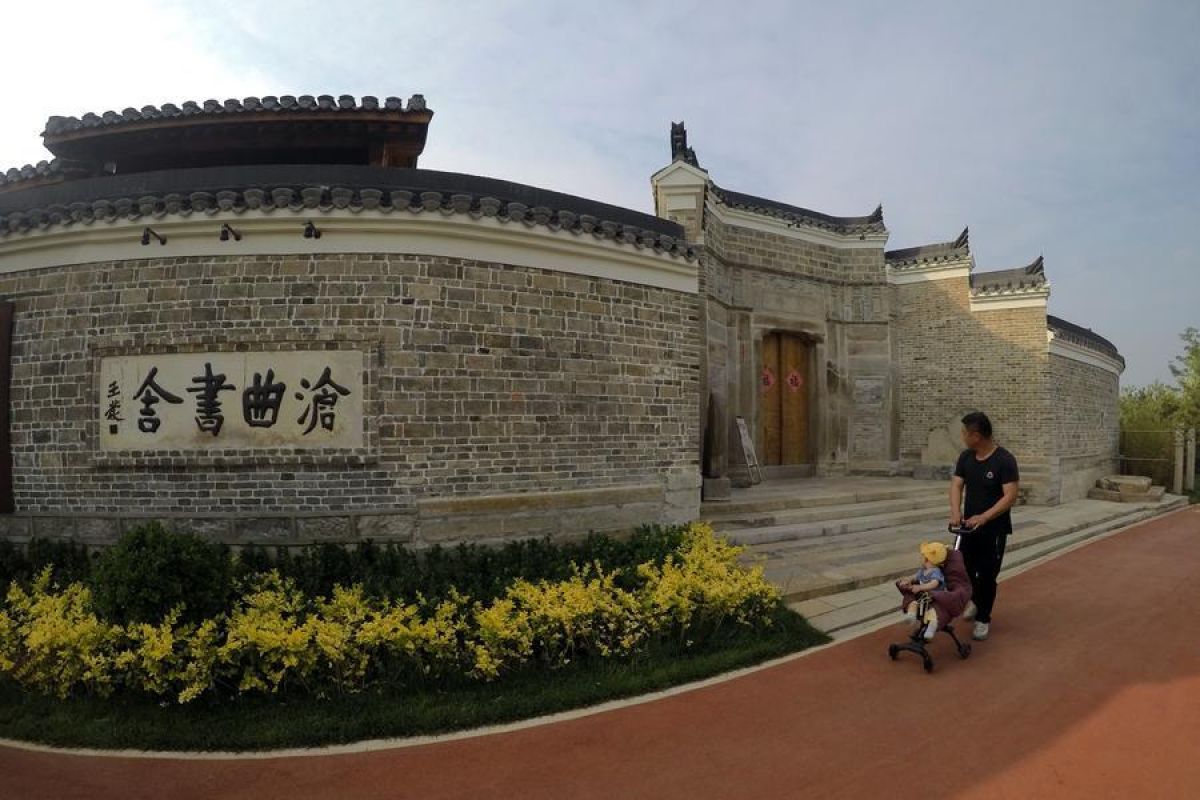
Nanchang (ANTARA) - As the world seeks ways to foster dialogue across civilisations while preserving distinct identities, the ancient Chinese “shuyuan,” or academies, emerge as a guide from Chinese history.
SEARCHING FOR CONSENSUS AMID DIFFERENCES
Originating from the Tang Dynasty (618-907), “shuyuan” are unique Chinese institutions that combine education, libraries, ritual performances, and scholarly debates.
During the Song Dynasty (960-1279), these institutions became China’s primary intellectual centres, where scholars frequently engaged in critical reflection, intense idea exchange, and debates.
The wisdom of Chinese “shuyuan” began to gain reception in the West during the Ming Dynasty (1368-1644).
In the late 16th century, Italian missionary Matteo Ricci visited the Yuzhang Academy in Nanchang, Jiangxi Province, eastern China, and interacted with Zhang Huang, who was then head of the renowned Bailudong Academy (White Deer Grotto).
Ricci brought Western knowledge of astronomy, geography, and mathematics, while Zhang inherited thousand-year-old Confucian theories.
Ricci studied Confucian classics under Zhang’s guidance, while Zhang incorporated Western geographical knowledge into his own works, reflecting mutual respect and interaction.
In a letter to Rome, Ricci wrote that they had found much in Chinese classical texts that aligned with their beliefs.
Xiao Hongbo, president of the Jiangxi Academy of Social Sciences and director of its Academy Culture Research Centre, identifies this spirit of “seeking consensus amid differences and building synergy through exchange” as a key wisdom in traditional Chinese culture for managing differing opinions and resolving conflicts.
This spirit of dialogue remains alive today.
In October 2025, nearly 200 academics from 51 countries and regions gathered at the Kaoting Academy in Fujian, eastern China, to attend the Conference on Zhu Xi Philosophy and Global Civilisational Dialogue, exploring how the late Chinese philosopher Zhu Xi’s thought can provide insights for resolving civilisational clashes.
Former UNESCO General Conference Chair Simona-Mirela Miculescu noted that Zhu’s belief in the inseparability of learning and virtue aligns with UNESCO’s mission to build peace through understanding, learning, and mutual respect.
At a time when the “Clash of Civilisations” theory still holds sway in the world, and divisions and conflicts hinder human progress, Chinese academies, with their millennia-old practices, offer Eastern wisdom that promotes dialogue and strengthens cooperation.
NEW PLATFORM FOR CIVILISATIONAL DIALOGUE
Inspired by “shuyuan,” Korean scholar Ju Se-bung established the Baegundong Academy in 1543, modelling it after the Bailudong Academy, the first of its kind on the Korean Peninsula. Over about two centuries, more than 900 academies emerged across the region. To this day, the Bailudong Academy Directives remain upheld as school mottos in some institutions in South Korea and Japan.
Another prominent Korean scholar, Yi Hwang, later developed the Baegundong Academy into the Dosan Academy in Gyeongsangbuk-do to promote Zhu Xi’s philosophy. Its cultural traces are reflected in daily life: the 1,000-won banknote features Yi Hwang’s portrait on the front and the Dosan Academy on the back, a shared cultural heritage for every South Korean citizen.
“For modern South Koreans, academies remain part of their daily lives and one of the most important cultural symbols,” said Keum Jia, an associate professor in the Faculty of Foreign Languages at Peking University.
Deng Hongbo, director of the Chinese Academy Research Centre, states that although academies abroad share the same lineage as those in China and retain their core cultural functions, they have developed distinct characteristics influenced by factors such as the time of dissemination and geographical location—for instance, academies in Korea emphasising ceremonial rituals, those in Japan focusing on publishing, while academies in Southeast Asia serve as spiritual anchors connecting communities to their homeland.
Deng found that through the systematic collection and study of historical documents from Korea’s Joseon Dynasty and Japanese academies, various valuable archives were revived. Such work affirms the academies’ contributions to the East Asian Confucian civilisation rooted in Chinese characters, and provides strong academic support for historical practices of inter-civilisational mutual learning.
As academies spread eastward, another path led westward.
In Naples, Italy, beside a winding street named “Salita dei Cinesi” (Chinese Slope), stands a three-storey yellowish-brown building, the “Collegio dei Cinesi” (Chinese College), founded by Italian missionary Matteo Ripa.
After serving as a painter and translator in the Qing Dynasty (1644-1911) royal court, Ripa returned to Italy in 1723 and established the college with a clear mission to overcome language and cultural barriers by nurturing truly inclusive cross-cultural talent.
Over more than 100 years until 1868, the college educated 106 Chinese students from more than 10 provinces, most of whom returned to China to become bridges between East and West. When the British embassy mission led by George Macartney visited China in 1793, in