
Analyst: Prabowo's Warning Is Not Merely About War
The Bantargebang tragedy stands as evidence of systemic failure.
Political analyst Ray Rangkuti contends that President Prabowo Subianto’s warnings regarding potential economic hardship ahead cannot be attributed solely to global conflict. He argues that internal governance issues exert a far greater influence on Indonesia’s current predicament.
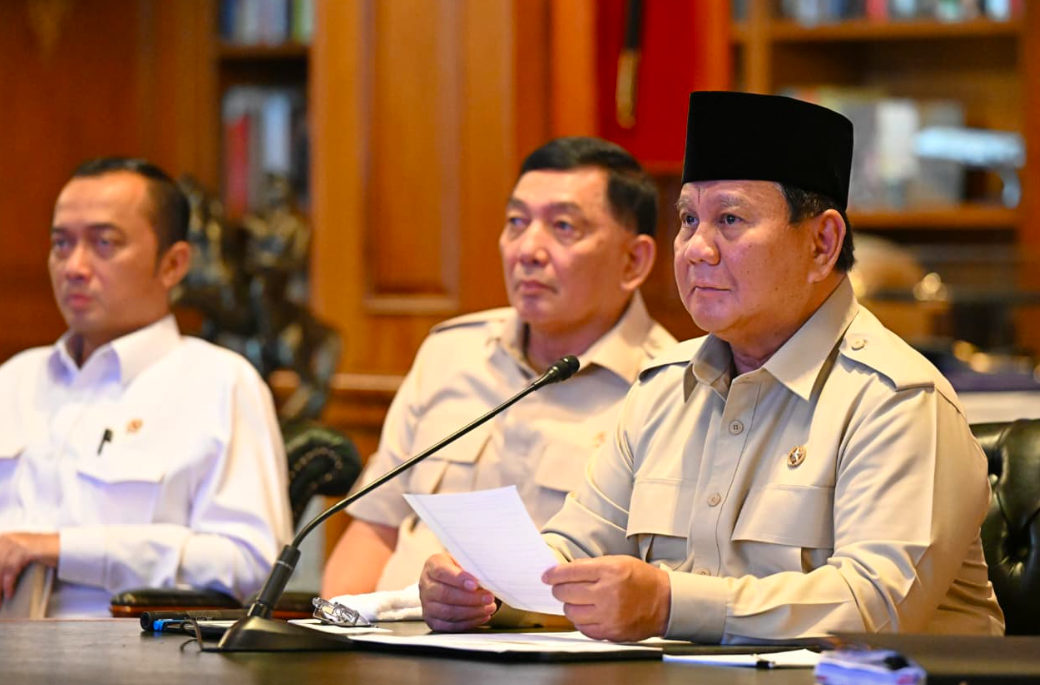
Previously, Prabowo convened several ministers and cautioned about potential economic fallout from Middle East conflicts, including warfare involving Iran. He also pledged to brief the public on the situation.
However, according to Rangkuti, Indonesia’s difficulties do not originate exclusively from external factors. “The hardships emerging, I believe, are not merely consequences of an America-Israel versus Iran war. But also stem from government management. Essentially, it is not external causes but also internal ones,” he stated when reached on Tuesday, 10 March.
He further argued that internal factors could be the principal cause of economic deterioration compared to global conflict impacts. “Internal factors could well be the most significant and substantial driver compared to external ones. And this is already evident,” Rangkuti said.
He pointed to several economic indicators under pressure, ranging from budget deficits to rising essential commodity prices.
According to him, a budget deficit exceeding 100 trillion rupiah is excessively large. Beyond this, basic commodity prices in the market have risen. “Whether caused by increasing market demand, there is also the effect of availability and dollar value,” he explained.
On another front, Rangkuti criticised the government for failing to implement sufficient economic stimulus programmes to counteract such pressures. He also highlighted rising unemployment and factory closures.
Rangkuti also touched upon the Free Nutritious Meals and Red-White Cooperative programmes, which he contended have not automatically spurred broader economic circulation among the populace.
“The Free Nutritious Meals or Red-White Cooperative do not automatically boost economic stimulus. Money flows from the state to wealthy individuals. Many officials and wealthy people manage these programmes. Money circulates only within their circles,” he remarked.
According to him, the impact of America-Israel conflict with Iran will likely become apparent only in coming months, particularly regarding energy supply. “The effect of America-Israel versus Iran war will only become visible from May onwards. When our fuel oil stocks become increasingly depleted,” Rangkuti explained.
Beyond economic factors, he also identified emerging pressures from the political sphere. Rangkuti believes public confidence in government shows signs of decline, though some surveys still indicate high satisfaction levels.
“Trust in government appears to be continuously eroding. Even though some surveys mention satisfaction levels remaining at 79.9 per cent. But ground-level indicators do not reflect such solidity,” he stated.
He regarded rising public criticism as one indicator. According to Rangkuti, various government policy issues have also triggered public criticism.
Rangkuti cited several issues he deemed sources of public criticism, ranging from poisoning cases among Free Nutritious Meals recipients, the ineffective functioning of the Red-White Cooperative, to minimal infrastructure development.
Consequently, he assessed that the potential hardship mentioned by the president is more than mere warning. “Difficult times are no longer talk, but already upon us. And the primary factor is governance management by President Prabowo,” Rangkuti concluded.