
Analyst: KPK Needs to Investigate Plan to Import 105,000 Commercial Vehicles
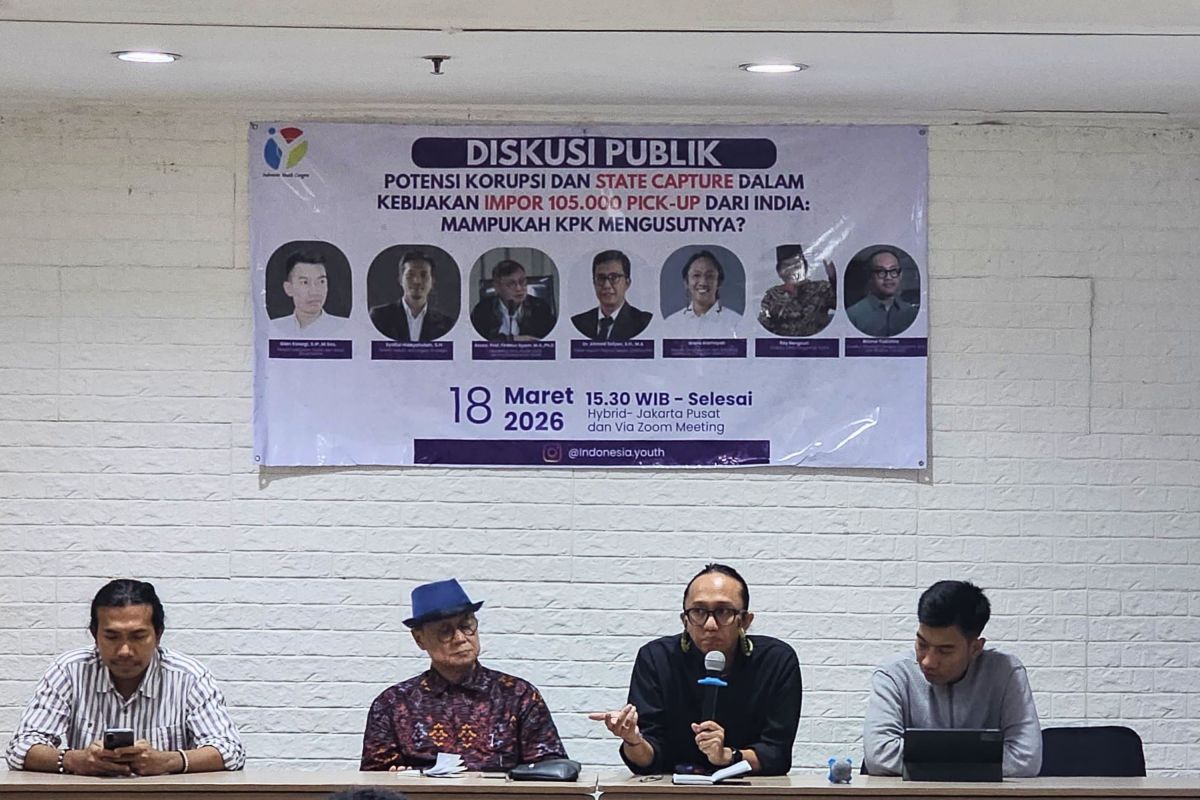
Jakarta (ANTARA) - Executive Director of the Indonesia Civil Circle Ray Rangkuti has suggested that the Corruption Eradication Commission (KPK) should intervene to examine the plan to procure 105,000 units of vehicles from India for the Red and White Village/Urban Ward Cooperative programme.
According to him, there is no reason for law enforcement agencies not to investigate the potential state losses in the project, as they are already evident from initial findings.
“The question now is, does the KPK dare to pursue it?” Ray said during a public discussion in Jakarta on Wednesday (18/3), as quoted from a statement in Jakarta on Thursday.
If the KPK cannot pursue it, he urged the Attorney General’s Office to take on the role.
Ray also questioned the reasons for choosing imports from India and the possible connections to government policy dynamics, including visits by high-ranking officials to that country.
He opined that government and PT Agrinas Pangan Nusantara (Persero) transparency is key to quelling public suspicions.
In the same opportunity, legal researcher and strategic litigation expert Syaiful Hidayatullah assessed that there are at least 10 legal entry points that the KPK can use to examine the project.
He said these entry points start from allegations of abuse of authority, potential state financial losses, to procurement engineering in the jumbo-value project.
“If policies are born not from public needs, but from power relations and certain interests, then they can fall under the corruption crime regime. The law is clear; it’s just a matter of enforcement courage,” Syaiful stated.
He added that the project’s financing scheme, whether through the State Revenue and Expenditure Budget (APBN), State-Owned Enterprises (BUMN), or other public instruments, opens up broad scope for legal audits.
He also touched on indications of tender conditioning, conflicts of interest between officials and business actors, and the use of intermediaries that could potentially “lock” competition from the start.
Furthermore, Syaiful explained that the Agrinas project shows symptoms of state capture, where public policies are hijacked by certain group interests.
These findings are reinforced by public policy researcher Gian Kasogi, who identified at least 20 serious issues in the import policy.
From a human rights perspective, he assessed that the project ignores public participation and potentially violates the principle of free, prior, and informed consent (FPIC).
Meanwhile, from a legal politics perspective, he said the decision-making is deemed non-transparent and lacks legislative oversight.
Then, within the development economics framework, he mentioned that the commercial vehicle import project risks causing distortions in the national automotive market, budget waste, and deepening import dependency.
“This is not just a vehicle project, but it could become a bad precedent in village development planning,” Gian said.
The public discussion was held by the Central Board of the Indonesia Youth Congress (DPP IYC), featuring speakers from academics, researchers, and anti-corruption activists.
The KPK previously stated that it is still monitoring the plan to procure 105,000 units of vehicles from India.
“Yes, our role is to observe, as long as it remains in the potential stage,” said KPK Chairman Setyo Budiyanto at the Ministry of State Apparatus Empowerment and Bureaucratic Reform Building, Jakarta, on Tuesday (24/2).
Setyo said the monitoring is carried out by the KPK through corruption risk assessment (RCA).
He explained that the assessment by the KPK is conducted in the context of corruption prevention, so that problems do not arise in the future.
Setyo said the KPK continues to monitor the next steps of Agrinas and the government after the House of Representatives (DPR RI) leadership suggested postponing the procurement of hundreds of thousands of vehicles first.