
Analyst: 15 Per Cent Free Float Requirement to Drive Fair Share Price Formation
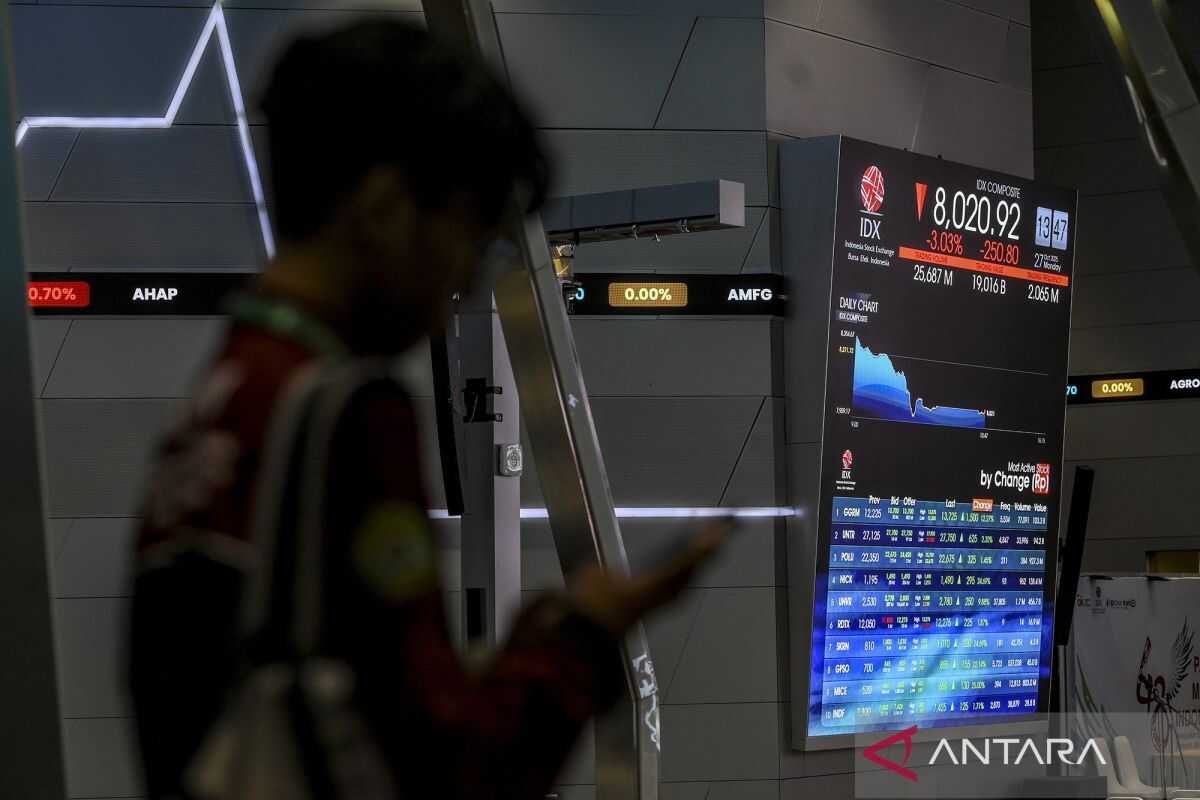
Jakarta (ANTARA) - Head of Research at PT Korea Investment And Sekuritas Indonesia (KISI) Muhammad Wafi has assessed that the 15 per cent minimum free float requirement will, in the medium and long term, drive fairer share price formation.
His reasoning is that a more dispersed share ownership structure would make price manipulation by market makers considerably more difficult.
“In the medium to long term, the fundamental impact will guarantee deeper trading liquidity. Price stability will also be far healthier, as a more dispersed ownership structure makes shares increasingly difficult to manipulate or unilaterally control by market makers, resulting in more optimal fair price formation,” Wafi told ANTARA in Jakarta on Tuesday.
On the other hand, in the short term, he said the 15 per cent minimum free float requirement has the potential to trigger volatility and selling pressure in the Indonesian stock market.
“The market will anticipate a flood of new supply that could depress the share prices of affected issuers,” Wafi said.
Wafi stated that the greatest challenge of the 15 per cent minimum free float requirement is the need for sufficient domestic market absorption capacity.
If corporate actions are carried out within close proximity of one another, he said, there is a risk of triggering a crowding out effect.
“Another structural challenge is the reluctance of controlling shareholders to undertake corporate actions due to various factors,” Wafi said.
The Indonesia Stock Exchange (IDX) itself has estimated that approximately Rp187 trillion in liquidity would need to be absorbed by the market for 267 listed companies to upgrade from the current 7.5 per cent free float to 15 per cent.
Wafi assessed that institutional investors would respond positively, as the policy addresses global standard demands that have long criticised the lack of investability and transparency in the Indonesian stock market.
“This is a catalyst for attracting capital inflow back,” Wafi said.
Meanwhile, he continued, retail investors would respond optimistically but cautiously, as they would be assisted by the Financial Services Authority’s (OJK) plan to assign special notations to issuers whose free float remains below 15 per cent.
“However, retail investors must also be able to calculate the potential dilution from the corporate actions of these issuers,” Wafi said.
Furthermore, for issuers, Wafi reminded them that they must design elegant corporate actions so that the addition of public shares does not damage their share prices on the secondary market.
The IDX itself is prioritising the initial implementation phase of the 15 per cent minimum free float for 49 large-capitalisation (big cap) issuers.
“The heaviest impact will be on their reputation and listing continuity,” Wafi said.
During the transition period, he warned that issuers slow to act would receive special notations, which would cause their shares to be avoided by institutional investors.
“The OJK and IDX have also prepared a firm exit policy for delisting,” Wafi said.
As is known, the IDX has made adjustments to Regulation Number I-A concerning the Listing of Shares and Equity Securities Other Than Shares Issued by Listed Companies.
One of the regulatory adjustments to be made by the IDX covers market deepening, with the formulation of a new policy raising the minimum free float threshold for listed companies to 15 per cent.
The implementation of these regulatory adjustments is planned for March 2026.
In conjunction with this, the OJK is preparing plans to assign special notations to issuers that have not yet met the 15 per cent minimum free float requirement.
Acting Chairperson of the OJK Board of Commissioners Friderica Widyasari Dewi, known as Kiki, explained that the special notation would serve merely as a marker, not meaning that issuers would be moved to a separate board, thereby making it easier for investors to select shares as a form of investor protection.