
Analysis and Causes of the Rupiah's Plunge, US Dollar Already Breaches Rp17,500
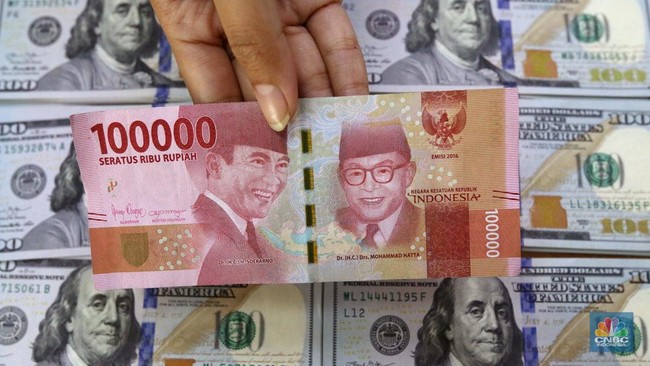
The rupiah exchange rate is once again facing heavy pressure against the US dollar. The Garuda currency has even breached a new psychological level of Rp17,500/US$ in today’s trading.
According to Refinitiv data, in Tuesday’s trading (12/5/2026) at 09:15 WIB, the rupiah was observed weakening to touch the Rp17,500/US$ level. This position simultaneously becomes the weakest intraday level of all time for the rupiah.
Pressure on the rupiah has actually been evident since the start of trading. At the market open this morning, the rupiah immediately plunged significantly by 0.43% to Rp17,480/US$.
This weakening continues the pressure that has occurred in recent times. The rupiah previously also breached the psychological level of Rp17,400/US$ last Tuesday (5/5/2026).
This means that in just about a week, two important psychological levels for the rupiah have been breached. After Rp17,400/US, themarketisnowwitnessingtherupiahweakeningfurthertobreachRp17, 500/US.
This condition indicates that demand for the US dollar is very high and selling pressure on the rupiah remains very strong.
What Causes the Rupiah to Breach Rp17,500?
External pressure in today’s trading can be said to be playing a significant role. This is evident from the movement of other Asian currencies, most of which are also weakening substantially against the US dollar.
The rupiah’s weakening to breach Rp17,500/US$ is inseparable from the re-escalating external pressures. The main factor pressuring the rupiah is the strengthening of the US dollar in the global market.
- Middle East Uncertainty Drives US Dollar and Oil Prices
Pressure on the rupiah primarily comes from increasing uncertainty in the Middle East. The US-Iran conflict, which has not truly subsided, is once again making global markets cautious.
Markets are again scrutinising statements from US President Donald Trump doubting the sustainability of the US-Iran ceasefire and rejecting Tehran’s latest peace offer.
Additionally, reports indicating that Trump will meet with his national security team to discuss the possibility of resuming military operations are adding to market concerns.
Plans to escort commercial ships through the Strait of Hormuz are also drawing attention.
The Strait of Hormuz is one of the world’s most important oil routes, so any tension in the region can directly trigger concerns over global energy supplies.
This situation then pressures the rupiah through two aspects.
First, demand for the US dollar as a safe-haven asset is increasing again. When global uncertainty rises, investors typically tend to seek assets considered safer, one of which is the US dollar.
This has caused the US dollar index (DXY) to strengthen again to 98.117 in this morning’s trading.
On the other hand, currencies of emerging countries like the rupiah become more vulnerable. With the strengthening of the US dollar in the global market, the room for emerging market currencies to strengthen becomes increasingly narrow.
Second, the unresolved conflict is also keeping global oil prices at high levels. In this morning’s trading, the benchmark Brent crude oil price rose 0.95% to US$105.2 per barrel, while WTI crude oil rose 1% to US$99 per barrel.
For Indonesia, this condition becomes an additional negative sentiment for the rupiah. High oil prices potentially increase the need for US dollars for energy imports.
At the same time, rising oil prices can also add inflation risks and fiscal pressures, especially if the burden of energy subsidies increases.
This fiscal pressure is important because the budget deficit is currently under significant scrutiny. In 2025, the budget deficit was recorded at Rp695.1 trillion, equivalent to 2.92% of gross domestic product (GDP).
This figure is still below the maximum budget deficit limit set in the law, namely 3% of GDP.
Entering 2026, fiscal pressures continue. In the first quarter of 2026, the budget deficit was recorded at Rp240.1 trillion, equivalent to 0.93% of GDP. This figure is higher compared to the same period the previous year, where in the first quarter of 2025 the budget deficit was Rp104.2 trillion or 0.43% of GDP.
This situation is what is causing market participants to begin questioning the government’s ability to keep the budget deficit below the 3% of GDP limit throughout 2026.
- Expectations of Prolonged High US Interest Rates
Pressure on the rupiah is intensifying because high oil prices can also influence the direction of US central bank policy, the Federal Reserve.
The surge in energy prices risks making US inflation difficult to decline again. If inflation remains high, markets will become increasingly convinced that US interest rates need to stay high longer.
This condition makes dollar-based assets remain attractive to global investors. As a result, capital flows to emerging countries may be held back. Currencies like the rupiah thus find it even harder to gain strengthening room.
Currently, investors are also awaiting the release of US consumer inflation data for April. That data will be one of the important indicators to see how far the Iran war is affecting the US economy and the future direction of Fed policy.
If the inflation data shows that price pressures remain strong, expectations for Fed rate cuts could be pushed back further. This has the potential to prolong pressure on emerging market currencies, including the rupiah.
- Domino Effect of Breaching Psychological Levels
In addition to global factors, the rupiah’s weakening is also exacerbated by market psychological factors. The breach of the Rp17,500/US$ level becomes a new signal that pressure on the rupiah has not subsided.
Psychological levels are very important in currency movements. When those levels are breached, market participants usually become more defensive.
Demand for the US dollar can increase, both for transaction needs, hedging, or as