
Analysis: AI Development in Indonesia Enters Acceleration Phase
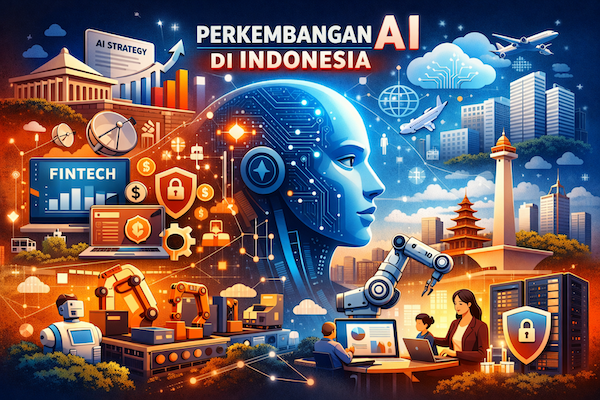
Jakarta. The development of artificial intelligence (AI) in Indonesia over the past few years has shown significant acceleration. From merely experimental technology, AI is now beginning to form the new foundation of the national digital transformation, both in the business sector, government, and everyday life.
Rapid Increase in AI Adoption
One of the clearest indicators is the increasingly widespread adoption rate. The latest survey shows that around 69% of workers in Indonesia have used AI in their jobs over the past year. This figure reflects that AI is no longer limited to large technology companies but has entered various sectors such as finance, marketing, and public services.
On the general public side, AI penetration is also continuously increasing. Almost all respondents in a survey admitted to being familiar with AI, with around 42% using it in daily activities or work. The younger generation, particularly Gen Z, is the largest user group, utilising AI for productivity, learning, and content creation.
This phenomenon indicates that Indonesia is not only becoming a technology consumption market but is starting to move towards mass adoption.
AI as a Driver of the Digital Economy
The role of AI in Indonesia’s digital economy is becoming increasingly strategic. The national digital economy value has surpassed USD 80 billion and is projected to grow significantly in the coming years. AI plays a major role as the primary accelerator in this growth, particularly through increased efficiency, automation, and data-based decision-making.
In the business context, AI has been used for personalising customer services, automating operational processes, and large-scale data analysis.
Technologies like generative AI are also beginning to change the way companies operate, especially in the marketing and creative sectors, with the ability to generate content automatically and quickly.
It is no exaggeration to say that AI is now referred to as the “new growth engine” for Indonesia’s digital economy.
Government Support and Investment
The Indonesian government is beginning to position AI as a strategic priority. Various initiatives are being prepared, including the drafting of a national AI roadmap to attract investment and strengthen the technology ecosystem.
In addition, there is an ambitious target to produce around 10.7 million digital talents by 2030. This step is important given the increasing demand for AI-based workforce.
From the investment side, Indonesia is also starting to attract attention from global companies. Major investments in cloud and AI fields show that Indonesia is viewed as a potential market as well as a technology development base in Southeast Asia.
Implementation in Various Sectors
AI adoption in Indonesia is not only occurring in the technology sector but is also spreading to various industries:
Banking and fintech: used for fraud detection and risk analysis
Education: helps in creating teaching materials and personalising learning
Government: supports data-based public services
Industry and manufacturing: improves operational efficiency
In the education sector, for example, AI is starting to be used by teachers to assist in lesson planning and material creation, although implementation is still uneven.
This shows that AI has entered the operational level, not just a concept.
Challenges: Talent, Infrastructure, and Regulation
Although its growth is rapid, AI development in Indonesia still faces several major challenges.
First, the shortage of digital talent. The availability of workforce with AI expertise is still limited compared to industry needs. Second, uneven infrastructure, especially outside major cities, hinders widespread technology adoption.
Third, regulatory and data security issues are also a concern. Risks such as data breaches, misinformation, and AI misuse are increasing along with wider adoption.
In addition, Indonesia is still in the early stages of AI development compared to other countries in the region, thus requiring a consistent long-term strategy.
Towards the Acceleration Phase
Overall, Indonesia is currently in a transition phase from “early adoption” to “accelerated adoption”. AI is no longer a future technology but has become part of business and societal reality.
The combination of increasing adoption, government support, and influx of global investment opens up great opportunities for Indonesia to become one of the major AI players in Southeast Asia.
However, to achieve that potential, focus is needed on talent development, infrastructure strengthening, and adaptive regulation. Without it, AI growth risks being suboptimal.
Looking ahead, the main question is no longer whether AI will develop in Indonesia, but how quickly and how great its impact on the national economy will be.