
Amran Reveals Conglomerates Secretly Buying Large Agricultural Lands, Why?
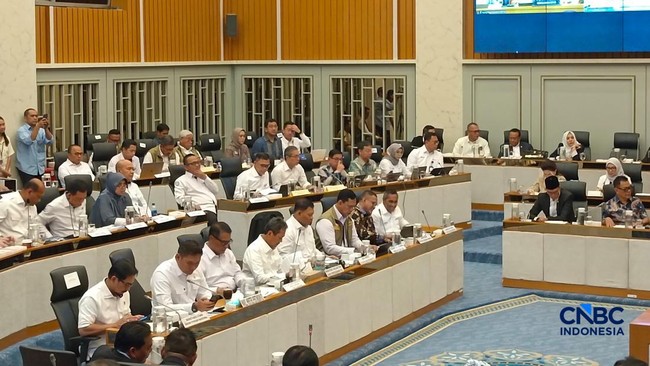
Jakarta, CNBC Indonesia - Agriculture Minister Amran Sulaiman revealed a new phenomenon in the food sector during a working meeting with House Commission IV. In the forum, Amran noted that many conglomerates are starting to quietly enter the agricultural sector, amid rising threats of a global food crisis.
In front of the commission’s leaders and members, Amran explained that the food sector is now increasingly viewed as strategic, not only from an economic perspective but also geopolitically.
“The global food crisis is becoming more apparent; the FAO (Food and Agriculture Organization) reports that 724 million people worldwide are experiencing hunger. This situation is exacerbated by the Middle East war, which threatens famine for 40 million people,” said Amran during the meeting at the parliamentary complex in Jakarta on Tuesday (7/4/2026).
“In the midst of this situation, conglomerates are starting to venture into the agricultural sector discreetly by purchasing large-scale agricultural lands, investing in agribusiness and the like, as well as building technology-based food ecosystems,” he continued.
He stated that this trend is driven by projections of the agricultural sector as one of the fastest-growing fields until 2030. Global demand for innovations such as data-based agriculture, biotechnology, and vertical farming—or tiered crop cultivation methods—has made food an increasingly attractive strategic asset worldwide.
What About Indonesia’s Food Situation?
On the other hand, Amran emphasised that Indonesia also faces internal challenges, particularly the threat of extreme drought known as the ‘Godzilla’ El Nino.
“BMKG data shows that drought predictions for 2026 will begin in April in East Nusa Tenggara (NTT) and spread to other regions, peaking in August,” he said.
Nevertheless, the government remains optimistic about national food security. Amran cited the achievement of self-sufficiency in a short time as concrete proof.
“Through the directives of the President, support from House Commission IV, and the hard work of all Indonesian farmers, we have successfully achieved self-sufficiency in one year, with a production increase of 4.07 million tonnes according to BPS data or 13.29 per cent; the Government Rice Reserves (CBP) today,” said Amran.
“As of this morning, 7 April 2026, the CBP has reached 4.6 million tonnes. Yesterday it was 4.5 million tonnes, now 4.6 million tonnes. This is the highest in history,” he added.
He assured that the national rice stock is currently sufficient to meet domestic needs for nearly a year ahead.
“The national rice stock condition in Indonesia is ensured to be safe for 10-11 months ahead, while El Nino is estimated to last 6 months,” he continued.
Amran also emphasised that supplies of main food commodities remain secure despite global conflicts beginning to affect supply chains.
“So, insya Allah, our food is safe even though the conflict in the Middle East is starting to disrupt the global supply chain; supplies of main food items such as shallots, garlic, chillies, chicken eggs, and caster sugar are sufficient,” he said.
To anticipate the drought’s impact, the Ministry of Agriculture has prepared various quick measures, from mapping drought-prone areas to optimising irrigation systems.
“The Ministry of Agriculture has instructed all governors and regents across Indonesia to map areas prone to drought and optimise early warning systems, water irrigation processing, and through rehabilitation of irrigation, reservoirs, shallow wells, and deep wells,” explained Amran.
In addition, the government is accelerating the distribution of agricultural tools and machines (alsintan) to keep production stable.
“As well as utilising pump irrigation piping, pumping to accelerate planting with drought-resistant priorities, regulating planting patterns, coordination, and synergy between government, regions, and stakeholders,” he said.
He detailed that the Ministry of Agriculture has prepared 171,000 units of agricultural tools and machines throughout 2024-2025, with an additional target of 37,000 units in 2026. In the irrigation sector, the government is also building and rehabilitating networks and preparing 94,000 water pump units in the same period.