
Amran Purchases Agricultural Machinery Manufactured at Indonesian Campuses, Including Tractor and Corn Dryer
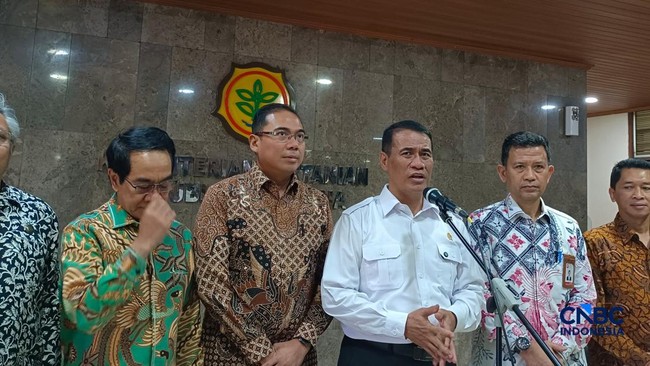
Jakarta, CNBC Indonesia - Agriculture Minister Amran Sulaiman received a visit from several university rectors and representatives of higher education institutions at the Ministry of Agriculture’s office in Jakarta on Thursday morning (12 March 2026).
The meeting discussed strengthening research collaboration and the utilisation of campus innovations to support farmers’ needs and agricultural sector development.
Amran stated that the Ministry of Agriculture has signed memoranda of understanding (MoU) with various universities and has begun directly utilising their research findings in the field.
“We have MoUs and many new discoveries from campuses. We buy them directly. So this is concrete action,” Amran said during a press conference at the Ministry of Agriculture’s office.
He emphasised that innovations from universities must not stop at the research stage; they must be directly utilised by farmers.
“We don’t just deal in imagination, but we buy directly according to the needs of Indonesian farmers,” he said.
During the meeting, the Ministry of Agriculture also decided to purchase several agricultural technologies developed through campus research for field testing. One of these is a coconut-climbing device from the Sepuluh Nopember Institute of Technology (ITS), designed to replace traditional methods.
“The first is from ITS, a coconut-climbing device, because coconut demand is currently high globally and our exports are rising. There’s a device, so we don’t use monkeys anymore, but have a new device; we immediately requested ten units for testing,” Amran said.
Additionally, ITS is also developing a floating tractor, which is currently in the testing phase.
“Then second, a tractor will follow; the floating tractor costs much less. But that’s still in the testing phase and we saw the field operations today. This is from ITS,” he said.
From Bandung Institute of Technology (ITB), the Ministry of Agriculture also purchased a portable corn-drying technology (dryer) that can be used directly in harvesting areas.
“From ITB, there’s a corn dryer, which apparently has existed for a long time. I got it and thought it was an imported product, but it turns out it was developed by ITB professors. ITB Rector, there were four units available; we immediately requested to buy them. This is portable; it can go around to farmers in the middle of fields, in the middle of corn plantations and so on,” he explained.
According to him, the technology will be tested first before being scaled up.
“This is very good. God willing, if it operates well, we will increase production next year. But for what is available now, I’m buying four units,” he said.
Beyond ITS and ITB, collaboration is also taking place with several other universities. Bogor Agricultural Institute (IPB) supplies innovations in corn and rice seeds, whilst Hasanuddin University is developing research on high-productivity local chickens.
“Then from IPB, we have an ongoing subscription. There’s corn and rice at 6,000 tonnes. If possible 60,000 times 10, Rector. We have the budget ready,” Amran said.
He views collaboration between government and universities as essential for accelerating innovation in the national agricultural sector.
“This is what we should actually be doing,” he said.
Amran also cited an example of research from Andalas University (UNAN) on gambir downstream processing, a commodity that has historically been exported mainly as raw material.
“From UNAN, gambir. God willing, the gambir factory; we control 80% of the world market. But we export raw materials. It should be downstream processing; that’s the President’s directive,” he said.
Furthermore, Amran stated that the development of downstream processing of agricultural commodities has the potential to increase added economic value domestically and create employment.
“The essence is that all domestic commodities, in the protein sector and other sectors, should be downstream processed so that this can lead Indonesia to become a superpower,” he concluded.