
Amran Makes Bold Moves to Reduce Soybean Imports, Impact Felt by 2029
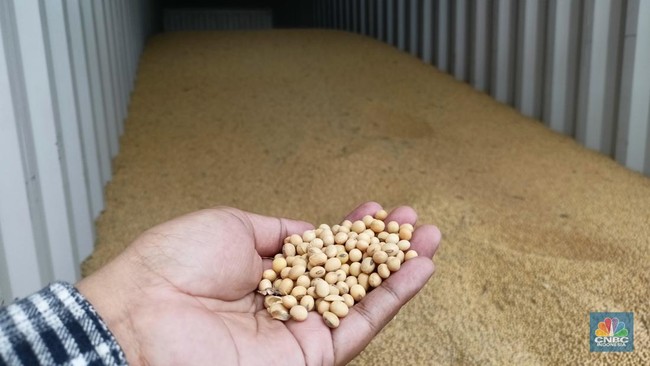
The government is beginning to formulate concrete steps to curb soybean import dependency by gradually increasing domestic production until 2029. The Ministry of Agriculture is preparing various interventions from upstream to downstream, ranging from land provision, superior seeds, to market guarantees for farmers.
Dyah Susilokarti, Director of Nuts and Tubers at the Ministry of Agriculture, stated that production increases are already being promoted this year, although their contribution to national needs remains limited.
“To support soybean production increases in 2026, seed aid is allocated for 37,500 hectares (ha), with a production target of 60,000 tonnes. This result is certainly still far from needs,” Dyah told CNBC Indonesia on Thursday (26/3/2026).
Dyah explained that the most fundamental factor for accelerating soybean production increases is the existence of a Government Purchase Price (HPP), as already applies to rice and corn.
“In addition, soybean trade must be managed by SOEs as competent stabilisers, both for imports and domestic soybeans. In the strategy to achieve soybean self-sufficiency, there are 10 requirements that must be met,” she said.
The ten main requirements for achieving soybean self-sufficiency, according to Dyah, range from land availability up to 1.8 million hectares, the use of superior seeds around 90,000 tonnes, to support for production facilities such as fertiliser, pesticides, agricultural machinery, and irrigation.
In addition, financing factors, human resource mentoring, downstream processing, market certainty, and protection from soybean imports are also primary prerequisites. Dyah emphasised that the entire programme design is structured to gradually reduce imports and strengthen domestic production.
“For the soybean self-sufficiency plan, we are designing soybean development based on national needs by reducing imports,” she said.
She added that the self-sufficiency target until 2029 is still in the planning stage and heavily depends on budget support and the farming business ecosystem.
“For the stages to achieve self-sufficiency by 2029, it is a plan that just needs to be supported by the full Saprodi budget package, as well as market and price guarantees at the farmer level, so that farmers are enthusiastic about planting,” she continued.
Gradually, national soybean production is targeted to increase significantly over the next five years. In 2025, production will only reach around 79,000 tonnes with import dependency up to 97% of consumption. This figure is targeted to rise to 425,000 tonnes in 2026, then jump to 1.53 million tonnes in 2027 and 2.52 million tonnes in 2028. The peak in 2029 projects production to reach 3.12 million tonnes, approaching national consumption needs of around 3 million tonnes, so imports are hoped to be reduced to zero.
Meanwhile, Wibowo Nur Cahyo, Secretary General of the Indonesian Tempeh and Tofu Producers Cooperative Union (Gakoptindo), supports the Ministry of Agriculture’s programme which is starting to refocus on increasing soybean production.
“Regarding domestic soybean supply, the government is currently preparing for that process. Of course, this starts from the beginning again, because for two consecutive years, 2024 and 2025, there was no soybean programme, and the soybean programme is only available in 2026, with a target area of 37,500 hectares,” Wibowo said when contacted separately.
In line with that, Wibowo highlighted soybean prices, especially imports, which remain a challenge for tempeh and tofu artisans.
It should be noted that soybean prices in Indonesia have risen at the artisan level for tempeh and tofu. As of 18 March 2026, based on data managed by Gakoptindo, soybean prices at the artisan cooperative level were recorded in the range of Rp9,700 to Rp12,000 per kg, with the majority in the Rp10,000-Rp10,800 per kg range.
For example, in West Java, soybean prices range from Rp10,100-Rp10,400 per kg, while in Jakarta they reach Rp10,400-Rp10,700 per kg. In some regions like West Sumatra, they even touch Rp12,000 per kg.
“Well, of course, regarding the increase in imported soybean prices, it has indeed increased. The possibility of another price increase could happen. It could happen,” he said.
According to him, the price increase is influenced by various global and domestic factors, from prices at the Chicago Board of Trade (CBOT), exchange rates, to geopolitical conditions and supply-demand balance.
“Looking at the current situation, both geopolitics, our national economy, and soybean conditions. If there is an increase, there will be an increase, that’s what will happen,” he explained.
Nevertheless, tempeh and tofu artisans are said to be accustomed to dealing with price fluctuations with various field adjustments.
“But we are used to dealing with it, our artisans are used to dealing with such things,” Wibowo said.
The government’s efforts to promote domestic production are seen as an important step to reduce pressure from global price volatility. However, the success of this programme will be greatly determined by policy consistency, budget support, and price and market guarantees for farmers.