
AMPHURI Iftar, Umrah Mitigation Amid Middle East Conflict and Constitutional Jihad to the Constitutional Court
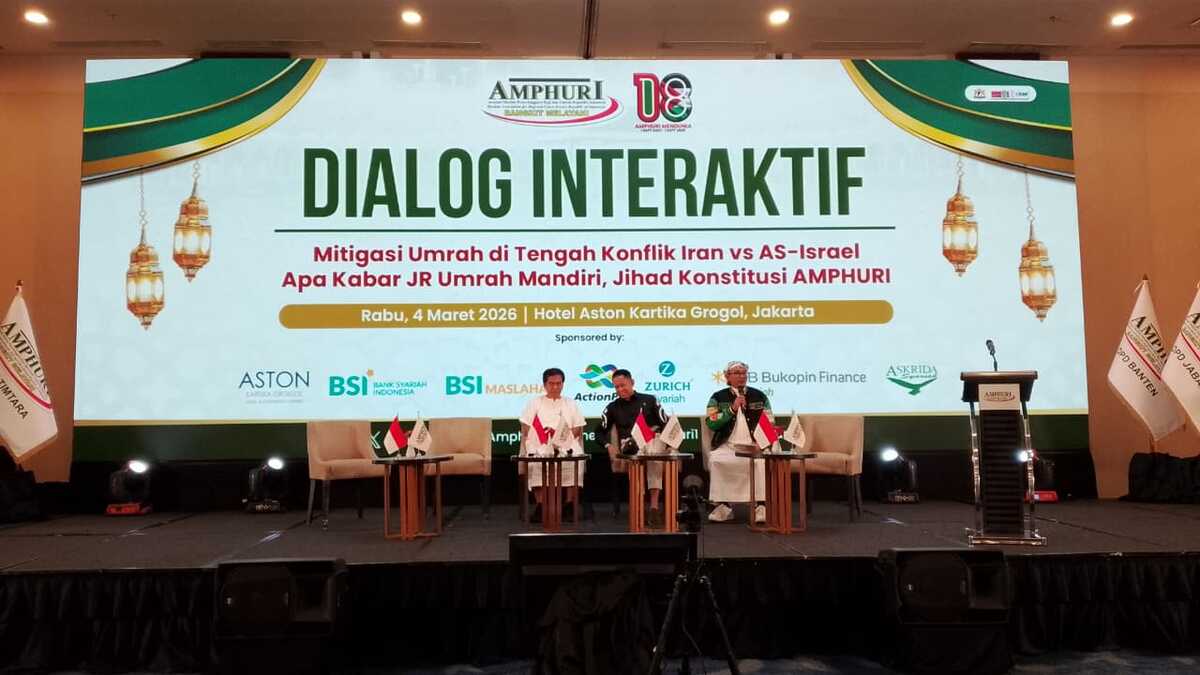
In the midst of the growing trend of ‘independent’ Umrah which poses a challenge to the existence of the Penyelenggara Perjalanan Ibadah Umrah (PPIU), the sector must face the bitter reality with the outbreak of war in the Middle East. The escalation of the conflict between the United States-Israel and Iran has forced several countries to close airspace, causing some airlines to reroute, delay, or halt schedules.
This was stated by Firman M Nur, the Head of the Central Board of the AMPHURI (Asosiasi Muslim Penyelenggara Haji dan Umrah Republik Indonesia), at an Interactive Dialogue titled Mitigasi Umrah di Tengah Konflik AS-Israel vs Iran, dan Apa Kabar JR Umrah Mandiri, Jihad Konstitusi AMPHURI, held alongside the General Meeting and Breaking Fast Together in Jakarta on Wednesday afternoon (4 March 2026).
According to Firman, the situation also affects the departure and return schedules of Indonesian Umrah pilgrims, both those currently in Saudi Arabia and those at home awaiting departure. Although the Kingdom of Saudi Arabia has assured that the situation in its territory remains safe and under control, it continues to exercise caution in line with applicable security standards.
“What steps will the government take to protect Indonesian citizens who will undertake or are currently undertaking Umrah rituals, including those involved in Umrah travel businesses or PPIUs, as regulated in Law No. 14 of 2025? Especially for those who have been travelling independently, who clearly operate without legal protection as citizens in the event of unwanted incidents stemming from war caused by the AS-Israel vs Iran conflict,” Firman stressed.
Firman explained, as stated in Law No. 14 of 2025 Article 96(5),: (a) Indonesian citizens; (b) law; (c) safety; (d) accommodation, consumption and transportation services, except for independent Umrah pilgrims; and (e) life, accidents and health, except for independent Umrah pilgrims.
“Meaning, how will they (independent Umrah pilgrims) fare when there is unilateral cancellation by transport providers, flights, or hotels, where clearly there is no protection from the State. This includes denial of life, health or travel insurance claims due to force majeure. This differs from Umrah through PPIUs, where all are protected as stated in Article 96(5),” Firman noted.
Meanwhile, the speaker and AMPHURI legal counsel, Firman Adi Candra, in his briefing stated that AMPHURI has recently filed a material test (Judicial Review or JR) of Law No. 14 of 2025 on the Management of Hajj and Umrah before the Constitutional Court (MK). He said the filing is part of constitutional participation by the public to strengthen the governance of Umrah that is safe, fair, and aligned with the mandate of the 1945 Constitution.
“Constitutional jihad is not aimed at opposing the state, nor to limit citizens’ right to undertake independent Umrah, and not based on industry or economic interests,” he emphasised.
Firman, who is also the Head of Legal Affairs at DPP AMPHURI, explained that AMPHURI is challenging several provisions within the aforementioned law related to independent Umrah travel, namely Article 86(1)(b), Article 87A, Article 88A, Article 96(5)(d) and (e), Article 97(1)(a) and (b), and Article 110(1) and (2)(b) and (d).
“These provisions need to be assessed constitutionally to ensure there is no fragmentation of legal protection, ambiguity of state responsibility, and unequal protection standards for pilgrims,” he said.
Firman Candra further asserted that the material test uses constitutional benchmarks outlined in the 1945 Constitution such as Article 27(1) on equality before the law; Article 28D(1) on the right to legal certainty; Article 28G(1) on the right to protection and security; Article 28I(4) on the state’s responsibility in protecting human rights; and Article 29(2) on guarantees of freedom of worship.
The test of the Law No. 14 of 2025 is intended, Firman Candra continued, to help the State ensure equal legal protection for all pilgrims, while strengthening the certainty of the national Umrah governance system.
“In other words, the filing stems from a desire to reaffirm the State’s role in protecting pilgrims without exception. Hence, the structure of national Umrah governance that is developing must remain within a governance framework that guarantees safety, legal certainty and protection of citizens’ rights, especially when pilgrims are outside Indonesia,” he added.
Sekretaris Jenderal DPP AMPHURI Zaky Zakariya Anshary, who moderated the dialogue, stated that as an association which has long contributed to national Umrah management, AMPHURI positions itself as a strategic partner of the State in building a syar’i, constitutional, and pilgrim welfare-oriented system.
“Through the JR mechanism, AMPHURI hopes the MK can give a comprehensive assessment of the design of State protection in Umrah management so that a stronger, clearer and more just governance can be created,” he said.
The JR request, according to Zaky Zakariya, is also part of AMPHURI’s commitment to continue constructive contributions to strengthening the national legal system and the constitutional rights of citizens in performing their duties.