
Amnesty International: Violence in Tual Reflects Systemic Issues within the National Police, Not Just Individual Actions
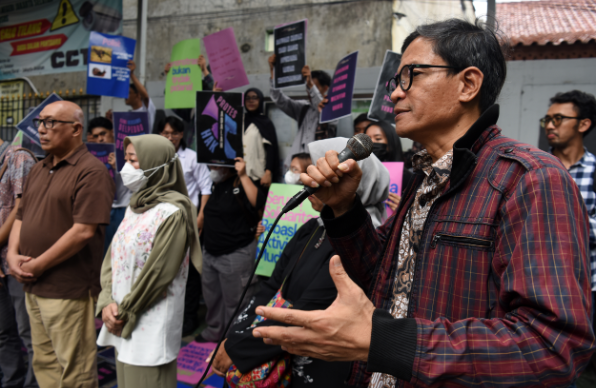
The Executive Director of Amnesty International Indonesia, Usman Hamid, responded to the Indonesian National Police’s claim that the violent incident in Tual, Maluku, which resulted in the death of a junior high school student, was purely the act of an individual or a member of the Mobile Brigade (Brimob), identified as Bripda MS. Usman believes that this brutal act reflects systemic problems within the National Police institution.
According to Usman, every action taken by officers in the field is based on legal reasoning and an understanding of the history of discipline within the institution. If officers dare to commit violence, it is triggered by the perception that such actions will be tolerated or even defended by the institution.
“The question is not just whether the Brimob officer did it because of individual behaviour, but whether his individual behaviour reflects the institution. If the institution allows it or provides justifying narratives, then the institution is institutionalising the violence,” Usman said during a discussion titled ‘The Tual Tragedy, an Alarm for Police Reform’ in Jakarta, Wednesday (25/2).
Usman highlighted a recurring pattern where the police structure often provides explanations that blame the victim in order to protect its members. He compared the Tual case with the shooting of a student named Gamma in Semarang and the case of violence against Afif Maulana in Padang.
“In the Gamma case, the police structure provided false explanations that the victim was involved in a brawl with sharp weapons, even though CCTV proved otherwise. In Tual, a similar narrative emerged with the pretext of cracking down on illegal racing. If the structure also defends with false narratives, the public will ask whether this is individual behaviour or an institutional problem?” he emphasised.
Usman urged the police to demonstrate a commitment to not tolerating violence by bringing the perpetrator to justice through criminal proceedings, rather than just internal disciplinary measures. He stressed that the police, as an institution, should stand on the side of the victims, not the perpetrators.
“The police only need to provide a lawyer for the perpetrator, let the lawyer defend him. The task of the police institution is to defend the victims and their families, protect the victims’ siblings and father so that they are safe when testifying in court. The institution should not also defend the perpetrator,” he added.
Furthermore, Usman said that the series of violent incidents involving law enforcement officers, from the handling of protesters in August 2025 to the Tual incident, is a strong signal of the need for systemic reform within the police force. He warned that without transparency in the legal process and a commitment to the victims, the image of the police as protectors of the community will continue to be eroded by recurring deviant actions.
“If the institution wants to say that this is not institutional behaviour, then it must be punished fairly. There must be no more recurring incidents,” he concluded.
CSIS researcher Nicky Fahrizal said that the culture of violence in the police is rooted in a still militaristic education curriculum. A total deconstruction of the Police Training Centre (SPN) and a meritocratic system is needed.
Sarah Nuraini Siregar from BRIN highlighted the use of the term “individual” for police officers, arguing that individual actions reflect the institution.
Usman Hamid believes that the Brimob violence case in Tual reflects weak accountability and supervision within the police force.
Member of Commission III of the DPR, I Wayan Sudirta, said that the death of a student in Tual is a momentum for reforming the police culture. See the full review here.
UI expert Rissalwan Habdy Lubis revealed the causes of police violence continuing to recur. From the concept of Habitus to misguided motivations during recruitment. See the review.
Usman Hamid believes that the Brimob violence case in Tual reflects weak accountability and supervision within the police force.
Amnesty International Indonesia believes that the death of a 14-year-old student in Tual, Maluku, prolongs suspicions of extrajudicial killings by law enforcement officers and calls for structural reform of the police.
A student from an elementary school in East Nusa Tenggara (NTT) with the initials YBS, who committed suicide because he allegedly could not afford to buy notebooks and pens, is considered as clear evidence of state failure.
Similar regulations in various countries are often misused to restrict civil liberties.
Amnesty International Indonesia believes that the guilty verdict for Laras Faizati in the case of incitement related to the August 2025 demonstration is a form of criminalisation of freedom of expression.