
Amikom Promotes Research and Creativity Through Dies Natalis Themed 'Creativity for Society'
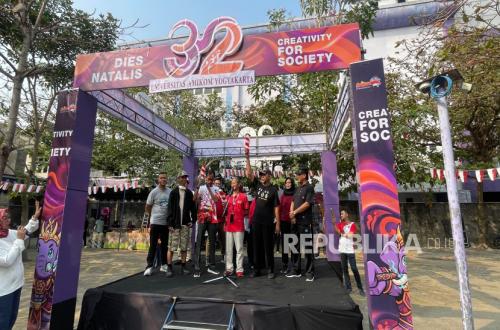
Universitas Amikom Yogyakarta held the grand launching of its Dies Natalis at the field of Building VI Amikom on Wednesday (19/8/2026). Carrying the theme ‘Creativity for Society’, this year’s Dies Natalis series brings the spirit of providing impact to society through creativity and various activities involving the community.
Chairman of the 32nd Amikom Dies Natalis, Bernadhed, said the theme was chosen because Amikom wants to make creativity a means of providing benefits to society. “Our concern is how we provide impact to society with one of our strengths, namely creativity,” Bernadhed said.
He explained that the series of Dies Natalis activities will target the academic community as well as the external public. A number of internal activities such as badminton and safe running have been prepared as part of the event series.
Meanwhile, external activities will target high school students through Mobile Legends (ML) and Free Fire (FF) game competitions. In addition, Amikom has also prepared a dance competition and a number of creative activities to be held at the Jogja Expo Center (JEC).
“For external, we have games for high school students, so there are ML and FF. Later we will also have activities at JEC, there is a dance competition there,” he said.
The series of activities will be continued with a number of other agendas involving the community and communities in Yogyakarta. These activities are scheduled to take place throughout September.
Meanwhile, Rector of Universitas Amikom Yogyakarta, Prof Suyanto, said the grand launching of the Dies Natalis is a momentum to be grateful for various achievements that have been attained while strengthening the direction of campus development.
Suyanto assessed that higher education institutions need to begin changing their dependence on income from students by strengthening research results. Amikom, he said, is targeting at least 30 percent of campus income to come from research.
“At least 30 percent of Amikom’s income is from research. We expect 30 percent to 70 percent,” Suyanto said.
According to him, strengthening research is important so that higher education institutions are able to have a more sustainable source of income while producing impactful innovations.
“We must change how research income is more important in the long term compared to income from students,” he said.
Suyanto also conveyed Amikom’s achievement in the World University Rankings for Innovation (WURI). He said Amikom is ranked 67th in the world, placing it among the top 100 universities in the world in that ranking.
In addition, Amikom recorded a number of achievements in other categories, including Visionary Leadership, Entrepreneurial Culture and Ecosystem, Cost-Effective Management, and Brand and Reputation.
Suyanto said these achievements are capital for Amikom to continue developing strategic research. One of them is by elevating local stories so they can be recognised at the global level.
“How local stories become world-class stories,” he said.
He cited the development of the film “Ajisaka: The Kingdom of the Flower of Life” as one of Amikom’s strategic research projects. The film, according to Suyanto, involves a number of international actors and is part of Amikom’s efforts to develop the creative industry.