
Amid Global Turmoil, Indonesia Secures Rp 574 Trillion in Investment Commitments from Japan and South Korea
The still-high global economic pressure makes improving the investment climate key to driving economic growth.
By Dimas Waraditya Nugraha
03 Apr 2026 16:13 WIB · English
JAKARTA, KOMPAS — The government recorded investment commitments from Japan and South Korea amounting to approximately Rp 574 trillion during the series of visits by the President to the two countries. This substantial figure is considered a strong signal that Indonesia remains a primary investment destination amid global geopolitical and economic uncertainties.
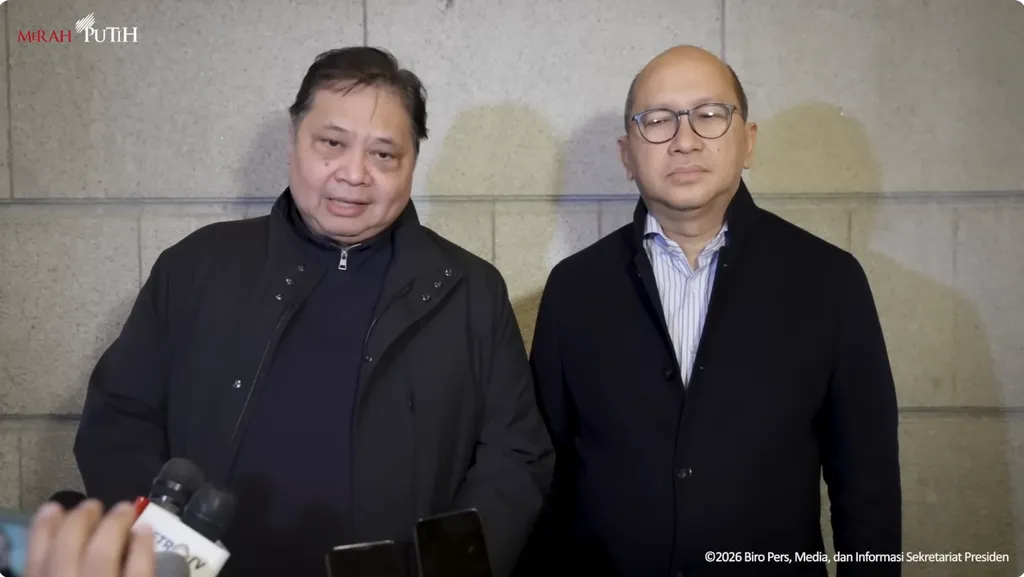
Coordinating Minister for Economic Affairs Airlangga Hartarto stated that the commitment stems from the signing of several memorandums of understanding (MoUs) in Japan and South Korea.
“If we look at the President’s visit to Japan and Korea, the total (investment commitment) reaches around Rp 574 trillion. This is a very significant figure,” said Airlangga in South Korea, as quoted from the Presidential Secretariat’s YouTube channel, Friday (3/4/2026).
In South Korea, Indonesia signed 10 MoUs with an investment value of approximately 10.2 billion US dollars or equivalent to 173 trillion IDR. Meanwhile, from Japan, there were 9 MoUs recorded with a value reaching 23.6 billion US dollars or around 401 trillion IDR.
According to Airlangga, the investment is spread across various strategic sectors, ranging from energy and energy transition, manufacturing industry, to the digital sector and artificial intelligence (AI).
In the energy sector, cooperation includes the development of renewable energy, solar power, and carbon capture and storage (CCS) technology. Meanwhile, in the industrial sector, investment is directed towards the development of steel, batteries, and environmentally friendly transportation.
In addition, there is also investment in the property and infrastructure sectors, including the development of areas in Bumi Serpong Damai, as well as collaboration among business associations to encourage the realization of investments.
Airlangga believes that this achievement demonstrates Indonesia’s continued high attractiveness in the eyes of global investors, despite the world being enveloped in uncertainty.
“In this uncertain geopolitical situation, Indonesia remains attractive to investors, both from Japan and Korea,” he said.
Minister of Investment and Downstreaming/Head of BKPM Rosan Roeslani added that investor interest from the two countries remains strong, and even tends to increase.
During the visit, the government also held a direct meeting between the President and major business actors. In Japan, the meeting was attended by approximately 300 entrepreneurs, while in South Korea, it involved at least 11 large companies.
“Amid global turmoil, investor confidence from Japan and Korea remains very strong. In fact, some have expressed interest in entering the second phase of investment,” said Rosan.
Several companies such as POSCO and KCC Glass are reported to have considered expanding their investments. This is seen as an indication that the ongoing projects are yielding positive and stable returns.
“If they see good and stable returns, they’ll increase their investments. That’s what we hope,” said Rosan.
He also emphasized that the influx of investment would have a significant impact on job creation.
Nevertheless, the government acknowledges that there are still several obstacles faced by investors, particularly regarding the inter-ministerial licensing process, which is considered time-consuming. To address this issue, the government is preparing debottlenecking measures or solutions to investment barriers, including the establishment of a special task force.
“We are preparing debottlenecking so that the problems faced by the business world can be resolved,” said Airlangga.
In addition, the government has implemented a positive fictitious mechanism, which automatically grants permits if the relevant agencies fail to meet the service deadline. Rosan said this policy has received a positive response from investors because it reduces uncertainty.
“They stated that the risk is not an issue as long as it can be quantified. The difficult part is the uncertainty. That is what we are trying to mitigate,” he said.
In the bilateral meeting, South Korea also expressed interest in strengthening energy cooperation with Indonesia, including the supply of liquefied natural gas (LNG) and coal. This aligns with South Korea’s needs, as a significant portion of its energy supply still relies on the Middle East region.
However, the Indonesian government emphasizes that the cooperation will take into account the increasingly rising domestic needs. “We will discuss the demand for LNG and coal further, as domestic needs are also increasing,” said Airlangga.
The government considers political and economic stability to be the main factors that maintain investor confidence in Indonesia. According to Rosan, the President emphasized that Indonesia has advantages in maintaining stability and peace, which are important foundations for long-term investment.
“Peace and stability are the primary investment capital. This is what investors recognize,” he said.
With various investment commitments coming in, the government is optimistic that investment realization will continue to increase and provide a positive impact on national economic growth in the medium to long term.
The Head of the Macroeconomics and Finance Center of Indef, M Rizal Taufikurahman, assesses that the high pressure of the global economy makes improving the investment climate key to driving Indonesia’s economic growth out of the stagnant range of 5 percent.
According to him, without structural improvements, the economic strengthening that occurs is considered to be only temporary. He also reminded that the main challenge for the Indonesian economy at present is not merely to maintain growth, but to avoid the trap of stagnant growth.
“Without serious improvements in the investment climate and productivity of the real se