
Amid Global Turmoil, Indonesia Secures Investment Commitments from Japan and South Korea Worth Rp 574 Trillion
High global economic pressures make improving the investment climate key to driving economic growth.
JAKARTA, KOMPAS — The government has recorded investment commitments from Japan and South Korea amounting to around Rp 574 trillion as part of the President’s visits to the two countries. This substantial figure is seen as a strong signal that Indonesia remains a primary investment destination amid geopolitical and global economic uncertainties.
Coordinating Minister for the Economy Airlangga Hartarto stated that these commitments stem from the signing of several memoranda of understanding (MoUs) in Japan and South Korea.
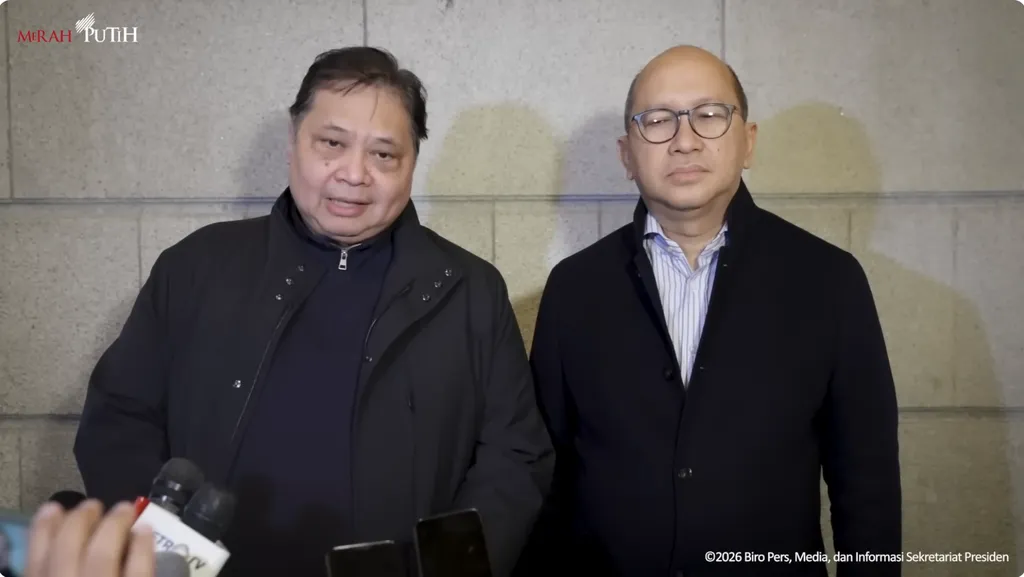
“If we look at the President’s visits to Japan and Korea, the total investment commitments reach around Rp 574 trillion. This is a very significant figure,” Airlangga said in South Korea, quoted from the Presidential Secretariat’s YouTube channel on Friday (3/4/2026).
In South Korea, Indonesia signed 10 MoUs with an investment value of around US$10.2 billion or equivalent to Rp 173 trillion. Meanwhile, from Japan, there were 9 MoUs with a value of US$23.6 billion or around Rp 401 trillion.
According to Airlangga, the investments are spread across various strategic sectors, from energy and energy transition, manufacturing industry, to digital sectors and artificial intelligence (AI).
In the energy sector, cooperation includes the development of renewable energy, solar power, and carbon capture and storage (CCS) technology. Meanwhile, in the industrial sector, investments are directed towards the development of steel, batteries, and environmentally friendly transportation.
Additionally, there are investments in the property and infrastructure sectors, including the development of areas in Bumi Serpong Damai, as well as business association collaborations to encourage investment realisation.
Airlangga assessed that this achievement shows Indonesia still has high attractiveness in the eyes of global investors despite the world being shrouded in uncertainty.
“In an uncertain geopolitical situation, Indonesia remains attractive to investors, both from Japan and Korea,” he said.
Minister of Investment and Downstreaming/Head of BKPM Rosan Roeslani added that interest from investors in both countries remains strong and is even tending to increase.
During the visits, the government also held direct meetings between the President and major business players. In Japan, the meeting was attended by around 300 businesspeople, while in South Korea it involved at least 11 major companies.
“Amid global turmoil, confidence from Japanese and Korean investors remains very good. In fact, some have expressed interest in entering the second phase of investment,” said Rosan.
Several companies, such as POSCO and KCC Glass, are said to be considering investment expansion. This is seen as an indication that ongoing projects are providing positive and stable returns.
“If they see good and stable returns, they will expand their investments. That’s what we hope for,” said Rosan.
He also emphasised that the influx of these investments will have a significant impact on job creation.
Nevertheless, the government acknowledges that there are still several obstacles faced by investors, particularly related to cross-ministerial permitting processes that are considered time-consuming. To address this, the government is preparing debottlenecking measures or resolving investment barriers, including through the formation of special task forces.
“We are preparing debottlenecking so that business issues can be resolved,” said Airlangga.
Additionally, the government is implementing a positive fictitious mechanism, namely the automatic granting of permits if the service time limit is not met by the relevant agencies. Rosan said this policy has received a positive response from investors because it can reduce uncertainty.
“They said that risk is not a problem as long as it can be calculated. What is difficult is uncertainty. That’s what we’re trying to reduce,” he said.
In bilateral meetings, South Korea also expressed interest in strengthening energy cooperation with Indonesia, including supplies of liquefied natural gas (LNG) and coal. This aligns with Korea’s needs, where most of its energy supply still depends on the Middle East region.
However, the Indonesian Government emphasised that such cooperation will consider increasing domestic needs. “LNG and coal demands will be discussed further because domestic needs are also increasing,” said Airlangga.
The government assesses that political and economic stability is the main factor maintaining investor confidence in Indonesia. According to Rosan, the President emphasised that Indonesia has advantages in maintaining stability and peace, which is an important foundation for long-term investment.
“Peace and stability are the main capital for investment. This is recognised by investors,” he said.
With various incoming investment commitments, the government is optimistic that investment realisation will continue to increase and provide positive impacts on national economic growth in the medium to long term.
Head of Macroeconomics and Finance at Indef, M Rizal Taufikurahman, assessed that high global economic pressures make improving the investment climate key to driving Indonesia’s economic growth out of the stagnant 5% range.
According to him, without structural improvements, the economic strengthening that occurs is seen as only temporary. He also warned that Indonesia’s main economic challenge currently is not just maintaining growth, but avoiding the middle-income trap.
“Without serious improvements in the investment climate and real sector productivity, the strengthening at the end of the year risks being only temporary and not sufficient to support future growth,” said Rizal when contacted in Jakarta on Tuesday.
According to him, amid unce