
America's Crusade
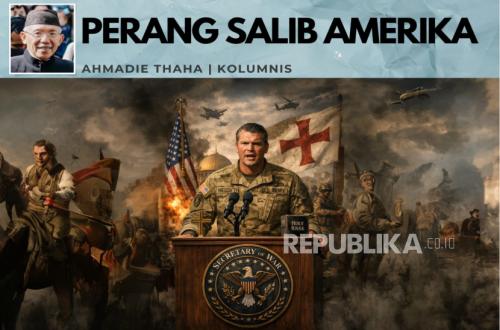
Something has changed at the Pentagon. It is not just the war map growing fuller with red lines, nor the radar screens flashing like disco lights on a Saturday night. There is something quieter yet more clamorous: prayer.
At a monthly Christian service in the heart of the American military on 25 March 2026, Pete Hegseth stood not merely as the Secretary of War in Donald Trump’s regime, but as a kind of war priest. He prayed in congregation, beseeching God.
He asked for bullets to find their targets. He asked for violence to be effective. He even slipped in a phrase that might make the angel recorder of deeds pause: “overwhelming violence… against those who deserve no mercy.”
In simple terms, this sentence can be understood as a plea for the military forces to be granted the ability to inflict extremely strong, decisive, and effective violence against parties deemed unworthy of mercy.
That sentence, if read on a 12th-century battlefield, might have earned applause from knights in rusty armour. But this is the 21st century. We have AI, satellites, and an interconnected global economy. Yet, apparently, in the minds of some power elites, we still live in the era of “Deus vult!” — God wills it.
In military parlance, the phrase “overwhelming violence of action” is no trivial term. It refers to a combat operations principle. The intent is to attack with full force, leaving no room for the enemy to rise or counter. This is the logic of total domination, not just winning, but ensuring the opponent is utterly paralysed.
What makes it far more sensitive, however, is the following part: “those who deserve no mercy.” Here, the enemy is not merely positioned as a strategic adversary, but as an entity morally deemed to have forfeited the right to pity. This is no longer just interstate or inter-army conflict, but touches on absolute ethical judgment: who deserves to live, and who does not.
This sentence grows more complex because it was uttered in the context of a prayer, even paired with scriptural language akin to the Book of Psalms in the Bible. Thus, the violence requested is not merely understood as a military action, but as something seemingly aligned with divine will. It is here that the boundary between strategy and belief blurs.
Moreover, this prayer emerges amid rising tensions between the United States and Iran. In such situations, language is usually kept cautious and measured. Yet that phrase moves in the opposite direction: firm, absolute, and laden with moral weight. It not only describes a desire to win, but a conviction that victory lies with the morally righteous side.
It is unsurprising that this sparks criticism. In the tradition of modern laws of war, even enemies retain certain protections. The concept of “no mercy” clashes with humanitarian principles that have long underpinned rules for armed conflict.
Additionally, in a country like the United States, which constitutionally establishes no official religion, the use of highly specific religious language in an official state forum raises serious questions about the boundary between personal belief and public policy. Organisations like Americans United for Separation of Church and State have even sued over such practices, deeming them a mixing of state power with certain religious preferences.
Interestingly, this is no slip of the tongue. It is no misread script. It is consistent. Its ideological roots can even be traced to Hegseth’s own book: American Crusade: Our Fight to Stay Free (2020). A book that, if likened to food, is a mixture of political rhetoric, cultural paranoia, and ideological sauce so spicy that facts themselves get burned.
In that book, Hegseth does not merely use the word “crusade” as a metaphor. He revives it as a framework of thought. The world is divided simply: us versus them, light versus darkness, America versus “the other”.
Islam, in his narrative, is not merely a religion, but a civilisational threat. He writes with near-theological conviction that the West is besieged, and the only path is total resistance. From the start, he has sought a modern “holy war”.
In the landscape of Hegseth’s thinking, Islam is not placed as a religion in a full theological sense, but as a problematic geopolitical entity from its roots. In his book, he explicitly states that Islam “is not a peaceful religion” and has never been so historically.
This statement forms the foundation of his broader worldview, seeing the world as an arena of civilisational clash between what he calls the “Judeo-Christian West” and expansive Islamic forces.
He links Islam to what he terms a global domination project, through political, cultural, and demographic power. In his narrative, Muslim population growth in Europe and the West is not viewed as an ordinary social phenomenon, but as part of a long-term strategy to “take over” Western civilisation.
The concept he uses, like “hegira” — meaning “hijrah” — he interprets politically as a form of gradual infiltration, not merely a historical term in Islamic tradition. With this framework, Islam is no longer understood as a religion with internal diversity, but as a monolithic bloc inherently opposed to Western values.
This view extends to his attitude towards the Crusades. Unlike many modern historians who see the Crusades as a complex episode full of violence, political ambition, and cross-interest conflicts, Hegseth instead interprets them as