
America Spends Rp17,000 Trillion on Military: Who Benefits?
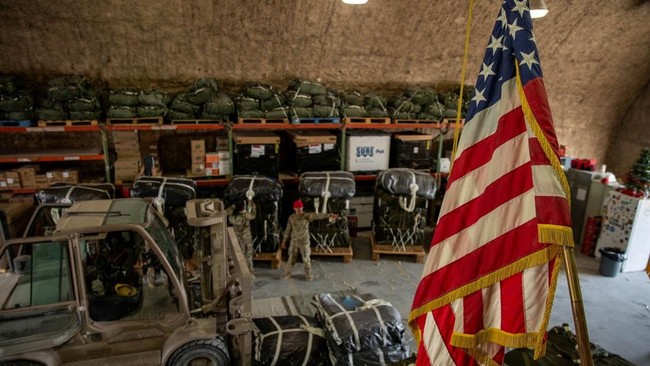
The war between the United States (US) and Israel against Iran once again highlights the exorbitant cost of a conflict. In just a few days, the expenses that Washington must incur have reached billions of US dollars, from ammunition, military operations, logistics, to maintenance of major weapon systems. In the first six days of the war alone, the costs estimated to have been spent by the Donald Trump administration are said to exceed US$11.3 billion.
Amid this situation, the US defence budget is once again in the spotlight. Trump has even stated his intention to push the US military budget for fiscal year 2027 to around US$1.5 trillion, or approximately Rp25,462.5 trillion (US$1 = Rp16,975), a surge from the US$900 billion or approximately Rp16,329.9 trillion approved for 2026.
This plan still requires Congressional approval, but it nonetheless provides an indication that Washington wishes to maintain its military capacity at a very high level amid increasingly heated global situations.
The sheer scale of these figures then raises an intriguing question: where exactly has the flow of the US defence budget been directed all this time?
This is because US military funds are not only depleted on wars or purchasing new weapons. The money also flows to daily operational costs, maintenance of major equipment, personnel salaries, technology research, military facility construction, and jumbo contracts to government partner companies.
Operations and Personnel Costs Remain the Largest Budget Items
Based on data from the US Department of Defense (DoD) for fiscal year 2025, now also known as the Department of War, the largest flow of the defence budget actually goes to operations and maintenance, amounting to around US$337.92 billion or approximately Rp5,736.19 trillion.
This becomes the largest item compared to other spending components. After that, spending on personnel ranks second with a value of around US$181.88 billion.
The large operational and maintenance budget demonstrates that keeping the US military strength combat-ready requires enormous costs.
This item generally covers maintenance of warships, fighter aircraft, military vehicles, bases, training, fuel, and various other supporting needs to keep the entire defence system running.
Meanwhile, personnel spending reflects the high cost of supporting millions of people in the US defence system, from salaries, allowances, facilities, to various other needs inherent to active military strength.
Beyond these two largest items, the US defence budget for 2025 also flows to procurement at US$167.55 billion, then research and development at US$143.16 billion. There is also a budget for military construction at US$15.56 billion and other items around US$1.98 billion.
Which Companies Receive the Largest Contracts?
If traced further, the US defence budget ultimately also flows to large companies that serve as the government’s main partners. In 2025, Lockheed Martin Corporation is recorded as the largest contract recipient with a value of around US$70.85 billion.
After that, RTX Corporation receives contracts worth around US$31.34 billion, followed by General Dynamics Corp at US$26.92 billion and The Boeing Company at around US$23.76 billion. Another major name that also enters the top list is Northrop Grumman Corporation with a contract value of around US$17.38 billion.
In addition to well-known major defence companies as makers of fighter aircraft, missiles, warships, and various weapon systems, there are also several other companies that receive jumbo-value contracts.
Optum360, LLC receives around US$16.22 billion, then Leidos Holdings, Inc at US$10.81 billion, Huntington Ingalls Industries, Inc at around US$10.29 billion, and McKesson Corporation at around US$10.25 billion.
This list shows that the US defence budget does not only flow to weapons producers. But it also enters technology companies, shipyards, support services, to healthcare and logistics services.
In other words, US defence spending has thus far also supported a very broad industrial ecosystem, not just combat needs on the battlefield.