
America is Actually Making China's Yuan Stronger: Is Trump Wrong on Strategy?
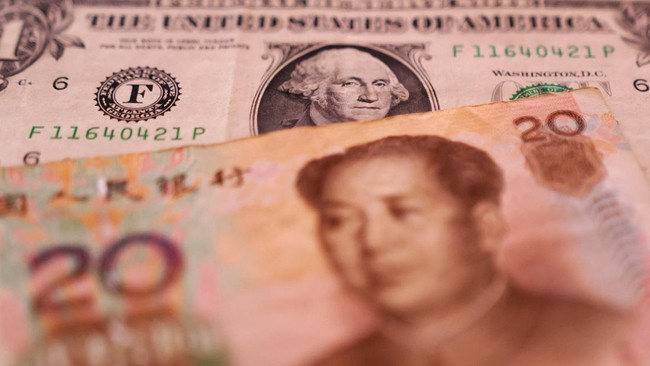
The US dollar remains the world’s most dominant currency. However, the US-Iran conflict, sanctions, and geopolitical uncertainties are prompting many countries and companies to seek alternatives to reduce reliance on the dollar.
One currency gaining attention is China’s yuan. According to The Economist, Chinese President Xi Jinping’s ambition to strengthen the yuan has gained new momentum. The yuan is still far from the US dollar’s position, but its use in cross-border transactions is showing an increase.
In Hong Kong, a glimpse of the yuan’s expanding use can be seen at the Tasty Congee & Noodle Wantun Shop. This restaurant serves warm rice porridge with spring onion toppings to locals, visitors from mainland China, and foreign tourists familiar with the dish.
Payments at the restaurant can be made in Hong Kong dollars or yuan from mainland China.
The congee restaurant also accepts e-CNY, the digital currency issued by China’s central bank.
Nevertheless, the maître d’ admits to never having seen a customer actually use it. Currently, more than 5,000 merchants in Hong Kong already accept this new form of digital money.
China’s Yuan Increasingly Used
Chinese leaders now appear more optimistic about the yuan’s prospects outside mainland China.
For years, Beijing has sought to reduce dependence on the US dollar in international transactions. However, progress has not always been smooth.
In recent years, China has built its own payment channels, both conventional and digital.
The aim is to bypass the global financial infrastructure, which has long been heavily centred on the US dollar. At the same time, with weak domestic loan demand, China can also offer lower interest rates to foreign parties.
Chinese President Xi Jinping has stated that his country must have a “strong” currency.
The yuan is still far from that position. However, it is beginning to feel like a more reassuring option for countries and companies anxious about how the US manages the dollar, the currency that truly remains the world’s most powerful.
In pursuing ambitions to make the yuan bigger in the international arena, China is sometimes seen as talking too much compared to reality, according to Josh Lipsky from the Atlantic Council, a Washington-based think tank.
However, he says recent data shows reality is slowly catching up with the rhetoric.
Some of the best data on global yuan use has emerged in the last six to seven weeks.
One of the most prominent is CIPS, or the Cross-Border Interbank Payment System, China’s alternative cross-border payment channel. CIPS activity surged in March, with transactions around 920 billion yuan or US$134 billion per day, much higher than last year’s daily average of 680 billion yuan.
On 2 April, transaction values through CIPS even broke through 1.2 trillion yuan.
The exact cause of this surge is not yet known. New rules effective since February have made the system more flexible. However, the timing suggests the Iran war likely played a role.
Iran has long been willing to accept yuan payments for its oil, much of which is shipped to independent refineries in China, commonly known as teapot refineries. Although Iran’s crude oil export volumes have declined, the value per barrel has surged sharply.
Iran may also accept yuan in exchange for allowing ships to pass through the Strait of Hormuz. Among financial experts and prominent figures at the IMF meeting in Washington this month, there is a view that most of the money entering from Tehran’s toll points is in yuan, not crypto, said Lipsky.
Many Reasons for the Yuan’s Growing Popularity
However, the CIPS activity surge is so large that oil payments and ship access fees alone cannot explain it.
These transactions likely also include capital flows, some from China, exiting the Gulf region. Additionally, they may reflect broader financial turbulence due to the crisis.
According to Chinese banking data, cross-country sales and purchases of bonds, stocks, and other portfolio investments reached US$712 billion in March. This figure is 40% higher than last year’s monthly average.
Not all of these investments and divestments are settled using Chinese currency.
However, the yuan’s share in China’s overall international transactions, including goods trade, services, and assets, rose to more than 56% in March, after stagnating for much of 2025.
China’s Digital Payments Gaining Attention
CIPS is not the only Chinese payment channel seeing increased use. Project mBridge, a more experimental platform for cross-country payments using digital currencies, is also showing rising activity.
According to Karen Ng from Standard Chartered, mBridge has moved beyond the concept stage and is becoming a viable commercial option. In November, the deputy head of China’s central bank said transactions equivalent to US$55.5 billion, spread across 4,047 transactions, had passed through the network.
Although the central banks of Saudi Arabia, Thailand, and the United Arab Emirates are also part of the project, more than 95% of transactions were conducted in e-CNY. These transactions can be settled very quickly.
“Some say ten seconds, or seven seconds,” said Ng, quoted from The Economist.
Although growing, CIPS and mBridge are still much smaller than dollar-dominated global payment platforms.
The US-based CHIPS network processed more than US$2 trillion per day in 2025. The