
Aluminium Downstreaming Accelerated, Inalum Speeds Up Downstreaming and Refinery Projects Until 2029
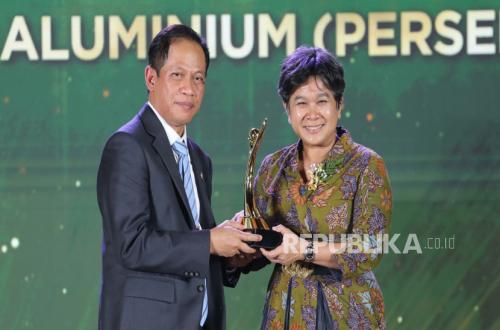
PT Indonesia Asahan Aluminium (Inalum) is accelerating the downstreaming agenda for bauxite and aluminium to strengthen national industrial self-reliance amid pressures from global volatility.
Inalum’s President Director, Melati Sarnita, stated that 2025 will be a phase of consolidation as well as operational acceleration, serving as the foundation for future expansion.
“Our focus is on increasing production, operational efficiency, and strengthening business fundamentals. This will provide a strong basis for expansion,” Melati said during a Hearing with Commission XII of the House of Representatives (DPR RI) on Monday (13/4/2026).
In terms of performance, Inalum recorded positive growth throughout 2025. Revenue grew consistently, EBITDA increased significantly, and net profit rose 15 percent year-on-year to US$142.8 million. Meanwhile, profitability ratios also improved, with ROA reaching 6 percent and ROE at 7 percent.
According to Melati, this growth was not solely influenced by commodity prices but was also driven by operational efficiency and business process optimisation.
Entering 2026, Inalum is shifting its focus from planning to executing downstreaming projects. All of the company’s strategic projects have been included in the National Strategic Projects (PSN) through the Coordinating Minister for the Economy Regulation Number 4 of 2026.
One of the main projects is the Smelter Grade Alumina Refinery (SGAR) Phase 1 in Mempawah, West Kalimantan, where construction progress has reached 98.56 percent and is targeted to be fully operational in 2026. This project has an annual alumina production capacity of 1 million tonnes with an investment value of around US$941 million.
However, several challenges remain, particularly regarding bauxite supply, tailing landfill capacity, and the construction of hauling road infrastructure hampered by land acquisition issues.
To strengthen the domestic supply chain, Inalum is also preparing the development of SGAR Phase 2 with an additional capacity of 1 million tonnes of alumina. The project is currently in the feasibility study preparation stage and finalisation of investment decisions.
In addition, Inalum is working on the Aluminium Smelter II project in Mempawah, which will increase national aluminium production capacity from 275,000 tonnes to 900,000 tonnes per year. This project requires an investment of around US$2.4 billion with a target operation in 2029.
“The key to this project is long-term energy certainty. We are planning the use of a coal-fired power plant for 30 years with competitive electricity tariffs,” Melati explained.
She added that the company is currently reviewing the electricity supply cooperation scheme with PT Bukit Asam and MIND ID.
Inalum also emphasises the importance of government and DPR support, particularly in strengthening regulations, governance oversight, and facilitating energy provision.
According to the company, accelerating aluminium downstreaming has the potential to provide significant economic value addition of more than 70 times compared to raw material exports, while reducing import dependency and strengthening the national industrial structure.
With various ongoing projects, Inalum targets building an integrated aluminium supply chain from upstream to downstream, while propelling Indonesia to become a global player in the aluminium industry.