
Already Delayed! Here's Why There Are Plans to Increase Nickel Royalties
Jakarta, CNBC Indonesia — The government has officially postponed changes to the increase in royalty tariffs and the imposition of an export duty (BK) in the mineral sector, following a meeting between Energy and Mineral Resources Minister Bahlil Lahadalia and Finance Minister Purbaya Yudhi Sadewa at the Ministry of Energy and Mineral Resources.
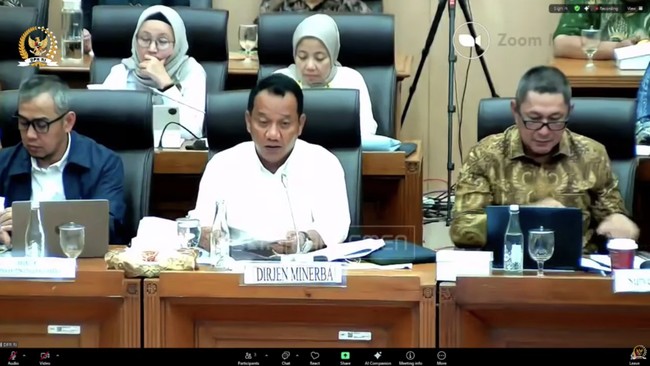
Tri Winarno, Director General of Minerals and Coal (Dirjen Minerba) at the Ministry of Energy and Mineral Resources, explained the reasons behind the planned royalty rate changes. The move is intended to capture higher corporate profits resulting from rising commodity prices.
According to Tri, the royalty policy change would focus mainly on minerals rather than coal. This followed a government assessment of the coal industry conditions.
“Why minerals? Because coal, after we have done the calculations, if we raised it, the companies would begin to incur losses, so for coal, no,” Tri told a meeting with Commission XII of the House of Representatives on Tuesday, 19 May 2026.
Tri disclosed that before the postponement, the authorities had actually held a public test last week regarding the proposed royalty rates. The scheme prepared is progressive, following price movements in the market.
For example, for nickel. Previously, the royalty was 14% for nickel priced below US$18,000 per tonne. In the latest proposal, that threshold is moved to below US$16,000 per tonne with a fixed 14% rate. “Then US$18,000–US$21,000, which previously was 15%, is harmonised to the US$16,000–US$18,000 band. The value is 15%. So indeed we have made the scheme progressive; the point is that when a company makes profits, the state also benefits from those profits,” Tri said.
Earlier, Minister of Energy and Mineral Resources Bahlil Lahadalia confirmed that the proposed royalty rate increases for mineral commodities, including gold, copper, nickel, and tin, remained at the public test stage and had not yet become a government decision.
Bahlil acknowledged that in recent days his team had conducted exercises and socialisation to gather input from business players before the official rules are issued.
“So, I want to say that a few days ago the team carried out an exercise. The mandate of the law is that every regulation we make begins with an exercise and socialisation to obtain feedback from stakeholders,” he said at the Ministry of Energy and Mineral Resources, on Monday, 11 May 2026.
He noted that the government has received various responses from entrepreneurs and the public regarding the plan. Therefore, Bahlil will reassess the policy formulation to avoid burdening businesses.
“If there are responses that may not be appropriate or need to be balanced, we will reassess the formulation; and that is not a final decision,” he added.
He also affirmed that the government would pause further discussions to seek a formulation more suitable for all parties. This also answers whether the rule would be applied in June.