
Almuslim University Builds Food-Resilient Village Following Aceh Disaster
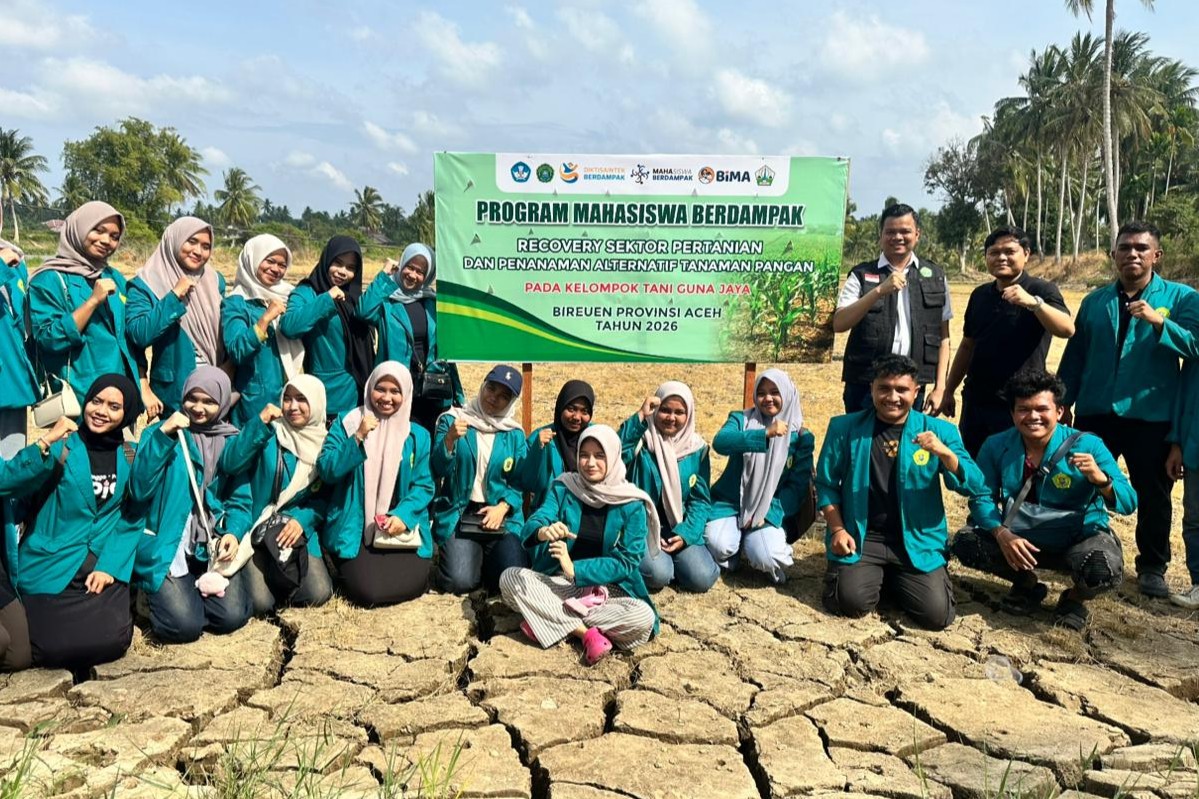
Dozens of students from Almuslim University are directly assisting the community in restoring the agricultural sector following floods in Aceh, specifically in Tanjong Nie Village, Bireuen Regency. This activity is part of the Student-Led Disaster Recovery Programme for Sumatra, which aims to accelerate economic recovery and strengthen food security for affected communities.
The programme, titled Building a Food-Resilient Village Following Disaster: Synergy Between Students, Farmer Groups, and Community Organisations in Production Recovery and Flash Flood Mitigation in Aceh, runs from 29 January to 5 March 2026. A total of 50 students from three study programmes—Development Economics, Retail Management, and Geography Education—are directly involved in the activities.
The programme is led by Muhammad Rizal, a lecturer from the Faculty of Economics at Almuslim University, alongside team members including Dr Hariki Fitrah, a Geography Education lecturer with expertise in disaster mitigation. Students remain on-site throughout the programme to support the community in various recovery activities.
The flash floods previously caused significant damage to village infrastructure, including agricultural irrigation networks. Many rice fields were buried under mud sediment, rendering them unusable for rice cultivation for extended periods. These conditions resulted in a sharp decline in local food production.
To assist agricultural recovery, student teams working alongside the community have constructed boreholes as an alternative water source to irrigate damaged farmland. They have also expedited agricultural land recovery and planted maize as an alternative staple crop to replace rice production.
Activities extend beyond food production recovery. The team has provided disaster mitigation training to residents to increase preparedness against potential future flash floods. Additionally, entrepreneurship training has been offered to strengthen the village economy.
Students have also engaged in various community activities, including mutual assistance projects, drainage channel cleaning, posyandu (community health centre) support, and participation in other village community initiatives.
Fakhrizal, Head of Tanjong Nie Village, expressed appreciation for the presence of Almuslim University students and lecturers who have assisted the community in recovering from the disaster’s impact.
“We are deeply grateful that our village was selected for this programme. The presence of students has given our community fresh courage to recover more quickly. Land that we previously thought was lost can now be cultivated again and is beginning to yield results,” he said.
Muhammad Rizal, head of the lecturer team, stated that the programme was designed to build community capacity in managing disaster impacts whilst strengthening village food resilience.
“Through this programme, we aim to provide solutions for the community, both in terms of social welfare and economic improvement. We also want to increase community knowledge in managing the risks posed by flash floods,” he said.
He also expressed appreciation to the Directorate of Research and Community Service at the Ministry of Education, Culture, Research, and Technology, which provided support through the Student Impact programme, as well as to Almuslim University for supporting the implementation of these activities.
Through collaboration between students, lecturers, village government, farmer groups, and community organisations, the programme is expected to accelerate food production recovery whilst strengthening community resilience in facing potential future disasters.