
All Currencies Weaken Against the Dollar, It Would Be Odd If the Rupiah Strengthens Alone
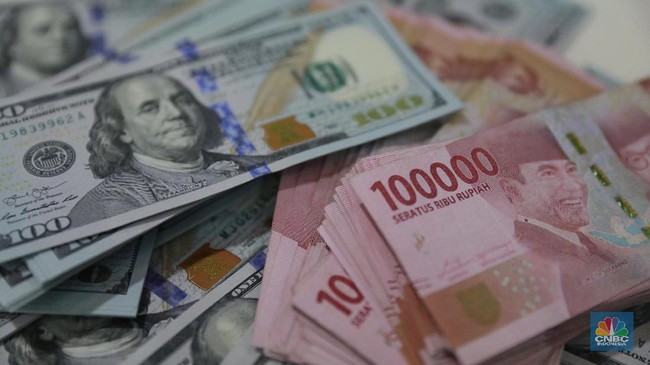
Jakarta, CNBC Indonesia - The rupiah’s exchange rate against the US dollar has weakened this month, comfortably settling above Rp17,000/US.BankIndonesia′s(BI)JakartaInterbankSpotDollarRate(Jisdor)referencerateon1AprilshowedtherupiahtradingatanaverageofRp17, 002againstthedollaramongbanks.Sincethen, JisdorhasnotrecordedthegarudacurrencymovingbelowRp17, 000, evencontinuingtorisetoRp17, 122/US on 13 April 2026. Head of BI’s Monetary and Securities Asset Management Department, Erwin Gunawan Hutapea, explained that the rupiah’s exchange rate condition is inseparable from negative sentiment among financial market players towards developments in the war in the Middle East region between the United States and Israel with Iran, causing the dollar’s exchange rate against various world currencies to strengthen, including the rupiah. That conflict has triggered risk-off sentiment or avoidance of risk factors amid global investors, so they are releasing their investments in portfolio instruments of developing countries, including Indonesia, to buy US securities along with dollars. As a result, the dollar index against several major world currencies (DXY) has strengthened. “That’s why it’s a bit odd if, in a situation where all countries’ currencies are weakening against the US dollar, suddenly the rupiah strengthens. That would be an anomaly because all movements are weakening,” Erwin said at the Central Banking Forum 2026 CNBC Indonesia event in Jakarta, quoted on Tuesday (14/4/2026). At the opening of trading in Indonesia’s financial markets yesterday, the rupiah was immediately pressured to Rp17,100/US$ or depreciated by 0.09% compared to last weekend’s trading, while the DXY was indeed experiencing a strong strengthening to 99.01 based on Revinitif data at 09:00 WIB. The DXY was observed strengthening by 0.37% at that time. As a result, not only the rupiah is pressured against the US dollar. Several currencies of developing countries with economic capacities equivalent to Indonesia are also experiencing currency weakening, even worse than Indonesia. Based on Bank Indonesia’s records, the rupiah volatility index is still the lowest compared to 7 other countries, at 4.75. Meanwhile, the other 7 countries like the Indian rupee at 8.92, Philippine peso 10.55, Thai baht 12.40, Mexican peso 13.20, Brazilian real 13.69, Argentine peso 14.50, and South African rand 16.34. The rupiah’s depreciation or weakening is still better than many countries, even though its value has comfortably settled at Rp17,100 per US dollar. BI recorded that the depreciation up to the week from the beginning of the year is only 2.91%, whereas the Korean won reached 2.85% against the US dollar, Indian rupee 3.08%, and Turkish lira 3.69%. “Yes, we are weakening, but if possible, we weaken in a measured way. Of course, we hope that through synergy and collaboration with authorities and you as market players, economic actors, we are part of efforts to ensure the rupiah’s volatility can be managed,” Erwin said. BCA Chief Economist David Sumual also shares a similar view to Erwin. He emphasised that currency trading between countries, especially against the US dollar, cannot be one-way. For example, when the dollar strengthens, the rupiah exchange rate follows suit. So, when the dollar strengthens, the rupiah tends to depreciate, and vice versa. “It can’t be, for example, if the dollar strengthens by 3%, we strengthen by 10%. It can’t be like that. It really looks like surfing; whatever direction the wave goes, we manoeuvre with the occurring wave,” David said. Therefore, David believes that to reduce the risk of pressure on dollar exchange rate movements, the central bank should appropriately reduce Indonesia’s transaction dependency on the dollar in the global market, both financial markets and international trade. The way is to thicken swap agreements with other countries’ currencies. “We already have with Singapore, China, Japan, Australia, South Korea, that’s about US$90-100 billion, please correct if I’m wrong. That’s like insurance or a secondary buffer. We might still be traumatised by the 1998 crisis conditions; we didn’t have such agreements then. It should also be conveyed that the foreign exchange position has a secondary buffer of US$100 billion; this can safeguard volatility if needed,” he explained. The second way, he believes BI is right to tighten cash dollar transaction requirements abroad for transactions without underlying in the spot market. “That requirement for underlying for transactions has been raised to US$10 million. This is to reduce pressure in the spot market. Because most of our transactions are still concentrated in the spot market. So we need to spread them; we need to distribute to the NDF market, so they don’t pile up in the spot market,” David explained. “The needs that are only 2-3 months away are happening now. We must reactivate hedging transactions going forward,” he stressed.