
Ali Khamenei's Legacy: Three Decades as Guardian of the Islamic Revolution
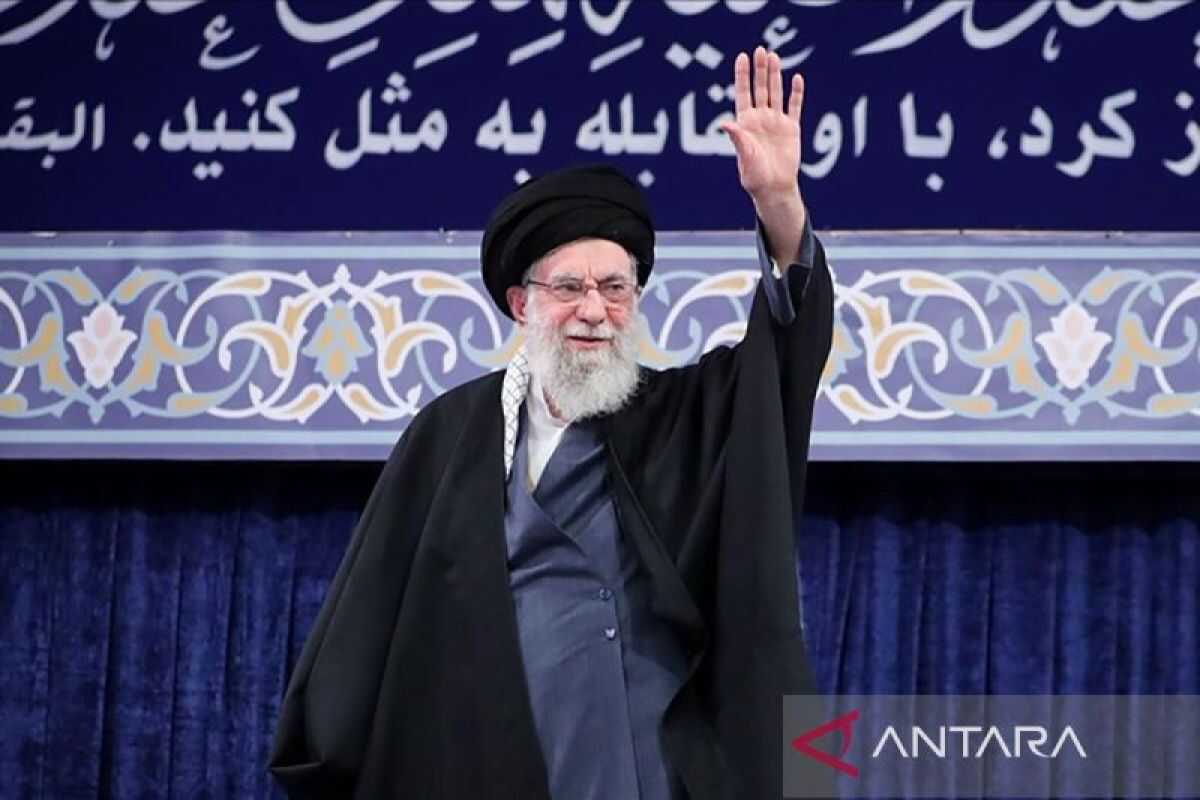
Jakarta (ANTARA) — Iran has announced a period of national mourning following the confirmed death of Ayatollah Ali Khamenei, Supreme Leader of the Islamic Republic of Iran, who was killed in a US-Israel attack on Saturday morning.
The attack that killed Khamenei was one of a series of massive US-Israeli strikes on several regions of Iran, including the capital Tehran, resulting in infrastructure damage and civilian casualties.
Initial reports about Khamenei’s death were contradictory, with conflicting information emerging from Iranian and Western media. Until Saturday, Iranian officials asserted that the Supreme Leader was in good health and firmly maintaining command of military operations. However, on the same day, US President Donald Trump proudly announced that Khamenei had died in the strike he had “given the green light” to. “Khamenei, one of the most evil people in history, is dead,” Trump wrote on social media.
Following Khamenei’s death, the Iranian government declared 40 days of national mourning and one week of national holidays. The Islamic Revolutionary Guards Corps (IRGC) and the Iranian Army vowed to avenge Khamenei’s death, with Shia cleric Ayatollah Makarem Shirazi calling for “holy war” against the US and Israel.
Khamenei’s death is certain to mark a new era for the Islamic Republic of Iran, given that he was the longest-serving state leader in the Middle East, with a tenure reaching 45 years.
He became Iran’s Supreme Leader in 1989, succeeding Ruhollah Khomeini, the architect of the Islamic Revolution, having previously served as President of Iran from 1981 to 1989.
Ali Khamenei was born in Mashhad, north-east Iran, on 19 April 1939, and deepened his Islamic studies in Qom, where he attended classes taught by Shia clerics, including Ruhollah Khomeini, who would later become the architect of the Islamic Revolution.
After the Islamic Revolution successfully toppled Shah Reza Pahlavi and ended Iran’s monarchical system in 1979, Ali Khamenei rose to power through his proximity to Ruhollah Khomeini.
On 27 June 1981, Ali Khamenei survived an assassination attempt while delivering a sermon in a Tehran mosque. He was injured by an explosive device placed on the pulpit, resulting in permanent paralysis of his right hand.
He was subsequently elected President of Iran in the general election in November 1981. During his presidency, Khamenei led Iran during its war against Iraq.
Following Ruhollah Khomeini’s death in 1989, the Assembly of Experts agreed to appoint Ali Khamenei as Iran’s new Supreme Leader.
Khamenei successfully consolidated political and religious power and asserted strong influence over the military, judiciary, and foreign policy.
He was a pioneer of the “Axis of Resistance” to counter the US and Israel. By allying with armed groups such as Hezbollah in Lebanon and the Houthis in Yemen, Ali Khamenei became a key figure determining Iran’s position in Middle Eastern conflicts.
To address economic problems caused by heavy Western sanctions, Khamenei promoted the concept of “resistance economy” encompassing increased domestic production, reduced dependence on oil exports, and encouraging self-reliant development independent of Western influence.
Khamenei continued to support Iran’s nuclear development as a symbol of scientific sovereignty and national power, whilst rejecting nuclear weapons and issuing a fatwa prohibiting Iran from developing nuclear weapons.
To ease international sanctions, Iran, together with five permanent members of the UN Security Council and the European Union, successfully agreed to the Joint Comprehensive Plan of Action (JCPOA) in 2015, which confirmed the lifting of Western sanctions in return for Iran’s commitment to reducing the intensity of its nuclear development.
However, the agreement collapsed when the US, under Trump’s first administration, withdrew in 2018 and reimposed full sanctions on Iran. In 2025, the Iranian government announced its withdrawal from the JCPOA.
Khamenei’s leadership was also marked by civil unrest, including post-2009 election protests, 2019-2020 demonstrations, the 2022 Mahsa Amini protests, and the latest protests that began in December 2025.
The Iranian government’s decision to give the green light to suppressing protests through violence drew widespread criticism from various parties, particularly Western nations.
Amid Western sanctions causing economic uncertainty and civil unrest, many actors, including the US and Israel, sought to exploit opportunities to undermine Khamenei’s power, launching a 12-day assault on Iran in mid-2025.
The US-Israeli strikes, directed at Iran’s highest echelon of power, were reportedly intended to destabilise the Islamic Republic by creating a leadership vacuum.
Nevertheless, Khamenei’s death is not expected to shake Iran’s political system, with leadership transition proceeding smoothly, according to Dina Sulaeman, an academic and Middle East observer at Padjadjaran University.
She explained that Iran’s ideological and institutional system, which has operated for four decades, is mature and possesses a layered power structure. The Islamic Republic does not function as a “personalist regime” dependent on a single figure.
“The experience of Imam Ruhollah Khomeini’s death in 1989 demonstrates that transition can proceed without shaking the foundations of the state,” said Dina.
Regarding the successor to Ali Khamenei, Dina noted that the individual must be a cleric holding the rank of Ayatollah, the highest title in Islamic scholarship in Iran. “Iran has many Ayatollahs,” the academic emphasised.
With the position of Supreme Leader vacant, the Assembly of Experts, composed of religious scholars, will oversee the succession process.