
Aisyiyah Aims to Enrol All TK ABA Teachers in DIY in BPJS Ketenagakerjaan
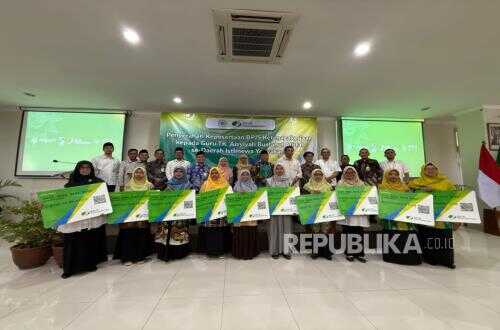
A total of 897 teachers at Aisyiyah Bustanul Athfal (TK ABA) kindergartens in DIY have registered as participants in BPJS Ketenagakerjaan’s social security programmes. That number is only part of the roughly 3,000 teachers employed across these educational institutions. Widiastuti, chair of the DIY Regional Leadership of ’Aisyiyah (PWA) for 2022–2027, explained that there are 1,046 TK ABA units spread across the DIY region. From these, thousands of teachers are actively teaching under the organisation. “From around 3,000 teachers, only 897 have joined BPJS Ketenagakerjaan, in both the work accident protection programme (JKK) and the death benefit (JKM),” she said during the BPJS Ketenagakerjaan membership handover to TK ABA teachers throughout DIY, on Wednesday, 4 March 2026. Widiastuti said the organisation aims for all TK ABA teachers in DIY to become BPJS Ketenagakerjaan participants progressively. She noted that protection through social security is very important for educators. “We plan for all teachers to become BPJS Ketenagakerjaan participants gradually. The benefits are substantial. The JKK and JKM programmes are fundamental needs because accidents at work or death can happen at any time, and no one can know when,” she said. With such protection, the teachers can work with greater peace of mind and help prevent the emergence of new poverty due to work-related risks. “We are very grateful to BPJS Ketenagakerjaan for this collaboration. We hope the number of teachers taking part in social security protection will continue to rise,” she added. Meanwhile, Agung Nugroho, Director of Membership at BPJS Ketenagakerjaan, said participation in social security programmes is a constitutional mandate. He explained that Article 28H(3) of the 1945 Constitution affirms that every citizen has the right to social security. “BPJS Ketenagakerjaan covers five programmes: work accident protection (JKK), death protection (JKM), pension protection, old age protection, and unemployment protection. This social security acts as a cushion so families do not fall into poverty,” Agung said. He added that BPJS Ketenagakerjaan membership is compulsory for workers. Therefore, the agency continues to engage with various stakeholders to expand coverage for workers in Indonesia. “So it is compulsory, not a sunnah and not optional. Hence we will continue to engage stakeholders to encourage workers to become BPJS Ketenagakerjaan participants,” he said. Agung noted that the number of workers in Indonesia eligible for membership is about 131 million. However, by the end of December 2025, only about 38.6 million workers were recorded as BPJS Ketenagakerjaan participants, around 34 percent. Of the roughly 75 million informal workers in Indonesia, only about 14 million had registered as participants. To improve coverage, BPJS Ketenagakerjaan is also promoting collaboration with local governments to achieve universal coverage targets for Social Security Protection for Labour (UCJ). “The UCJ target for 2026 is 49.35 percent of the total 131 million workers,” he said. Agung added that achieving this target requires the support of various parties, from local governments, to corporate social responsibility (CSR) programmes, to strengthening village ecosystems. With such collaboration, the government aims that by 2045 about 99 percent of workers in Indonesia will be BPJS Ketenagakerjaan participants. Next, Hesnypita, Head of BPJS Ketenagakerjaan’s Regional Office for Central Java and DIY in Yogyakarta, said that social security protection for teachers is an important part of expanding coverage for workers in the education sector. According to him, collaboration with community organisations such as ’Aisyiyah is a strategic step to boost BPJS Ketenagakerjaan participation. “Teachers play a crucial role in shaping the next generation. Therefore they should receive social security protection so they can work more safely and with peace of mind,” Hesnypita said. He added that BPJS Ketenagakerjaan Jateng DIY will continue to strengthen synergy with various educational institutions and local governments to broaden protection for workers. Meanwhile, Rudi Susanto, Head of BPJS Ketenagakerjaan’s Yogyakarta Branch, praised ’Aisyiyah’s commitment to advancing social security protection for TK ABA teachers in DIY. “Teachers also face risks in carrying out their duties. Through the JKK and JKM programmes, we want to ensure TK ABA teachers receive protection so they can carry out their teaching duties with greater safety and tranquillity,” he said. Rudi hoped that the collaboration between BPJS Ketenagakerjaan and ’Aisyiyah can be strengthened so that, progressively, all TK ABA teachers in DIY will be protected by the social security programme.