
Airlangga Details Rupiah Depreciation History Through Crises
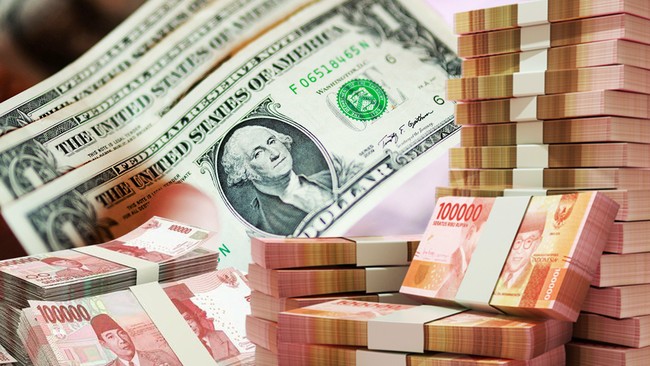
Jakarta, CNBC Indonesia - Coordinating Minister for Economic Affairs Airlangga Hartarto outlined the historical movement of the rupiah over the years, having weathered multiple crises.
Airlangga noted that between 2004 and 2014, the rupiah depreciated by 40%, driven by a 17% inflation rate in 2005 due to oil prices surging to $140 per barrel.
“I merely wish to state that the rupiah depreciated by 40% over the decade from 2004 to 2014, with inflation reaching 17% in 2005 due to oil prices rising to $140 per barrel,” Airlangga said during his speech at the National Conference on Regional Economic Development at Balai Kartini, South Jakarta, on Monday (25 May 2026).
For the period 2014 to 2024, Airlangga stated that the rupiah depreciated by 30.6% with 3% inflation.
This reflects the current difference in conditions, with rupiah depreciation and inflation currently kept within reasonable limits.
“So there’s a difference in quality over the past two decades; today, we maintain inflation at 2.4% and rupiah depreciation at 5%,” Airlangga concluded.
He also stressed the importance of considering the broader context, noting the robust performance of the banking sector and corporate entities.
“It must be viewed in context. Our banking sector is strong, and corporates are also solid overall. As I have always stated, our economy remains resilient,” Airlangga said.
This situation provides momentum for Indonesia’s economy to grow towards 8%. According to Airlangga, economic growth needs to be supported by regional economies.
“For the 8% target, regions must continue to drive growth as the national figure is an aggregate of regional performance. If regions lag behind the national average, they will drag down the overall growth,” he added.
He noted that several regions have achieved high economic growth due to government policies on downstreaming or industrialisation.
“North Maluku’s growth far exceeds the national average at nearly 19%, while Gorontalo, Central Sulawesi, and NTB also show strong growth due to extractive industries,” Airlangga said.
The rupiah opened stronger against the US dollar on Monday (25 May 2026), the start of the week, as the greenback weakened in global markets.
According to Refinitiv data, the rupiah opened in positive territory, appreciating 0.06% to Rp17,680 per US dollar.
This reverses the rupiah’s position from last week’s trade. On Friday (22 May 2026), it closed weaker by 0.28% at Rp17,690 per US dollar.