
Aipda Mariono: The Police Officer Driving Education in Rural Riau
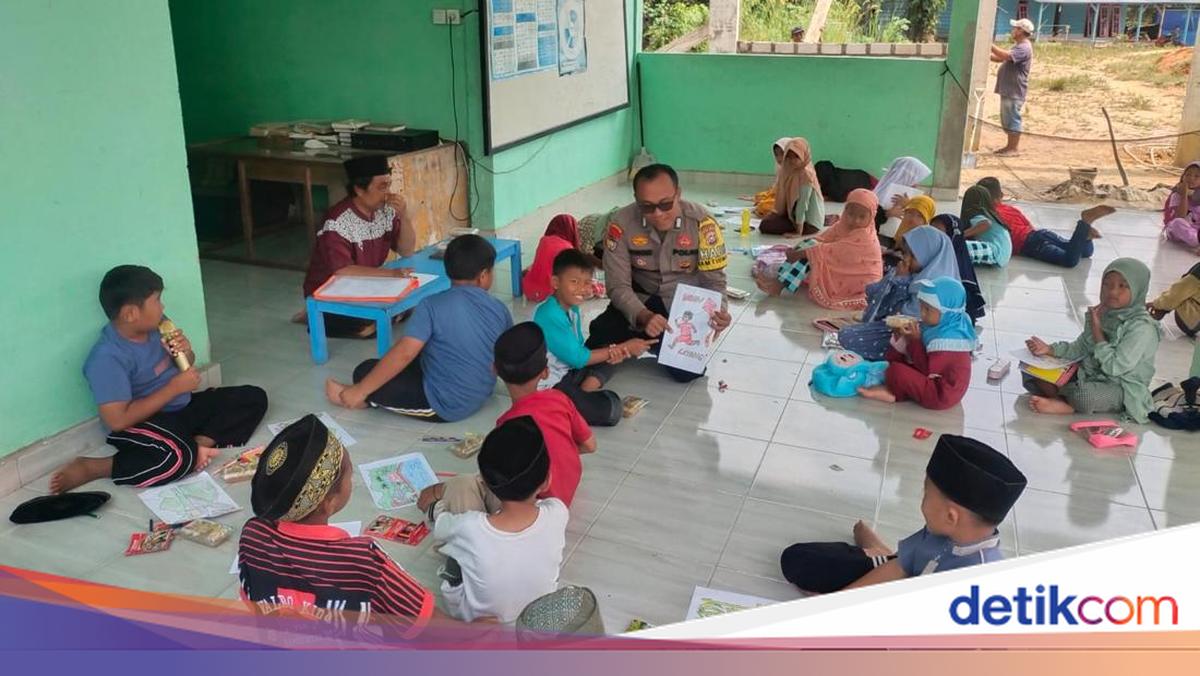
Aipda Mariono is determined to ensure that children in transmigration areas of Kuantan Singingi (Kuansing), Riau, receive quality education. The village community police officer (Bhabinkamtibmas) of Sungai Langsat has established remote primary school classes and an Islamic boarding school for Qur’anic memorisation (tahfiz).
For his dedication to education, Aipda Mariono has been nominated by Kuansing resident Juprison for the Hoegeng Awards 2026. Juprison explained the nomination’s rationale: Mariono established a remote primary school class in 2010 and received a provincial-level award for his educational initiatives. In 2021, he innovated further by founding an Islamic boarding school for Qur’anic memorisation, which currently operates with 65 students enrolled in pre-Qur’anic classes. He has also supported the Green Policing programme and received recognition from the Riau Police Chief.
Juprison (42), a businessman, explained that Aipda Mariono initiated the establishment of a remote primary school class in Sawah Godang, Logas Village, Kuansing. “The children there are far from town, located in palm plantation areas, making it extremely difficult to reach the main primary school. That’s why Pak Mariono established a remote school class within the plantation,” Juprison told detikcom on Monday, 2 March 2026.
This remote class operates under Logas State Primary School No. 2. When first established, the class had two year groups with around a dozen students. Today, it offers classes 1 through 6.
Juprison noted that Aipda Mariono also cares deeply about religious education for local children. He has established an Islamic boarding school for Qur’anic memorisation in Sungai Langsat village. “He integrates with the community, and from nothing he helped establish and support the boarding school. I’ve visited several times and seen it grow from dozens of students,” he explained.
In sports, Aipda Mariono also encourages local children to join a volleyball academy. He built the volleyball court himself. “He is an active police officer who mingles with the community and provides mutual support. In sports, he coaches volleyball and football clubs, and he also supports local traditional activities like pacu jalur boat racing,” Juprison said.
Juprison has known Aipda Mariono since 2009. The entrepreneur describes him as a community police officer who is very close to the residents he serves. “He treats everyone equally regardless of status—whether wealthy, poor, farmers or officials. He knows how to conduct himself; when he’s with farmers, he becomes a farmer. He doesn’t hesitate to get his clothes dirty working alongside them,” he remarked.
Mariono is also known as someone who cares deeply about the environment. He established a tree bank in Sungai Langsat village starting in 2021 and received recognition from the Riau Police Chief for supporting the Green Policing programme. “Green Policing is the flagship programme of the Riau Regional Police. Every officer participates actively—for example, when an officer or community member has a birthday, the gift must be a tree. He actively promotes tree-planting activities and has even received an umrah pilgrimage as a reward,” Juprison explained.
Establishing a Remote Primary School in Remote Areas
Aipda Mariono began developing this remote school class in 2010 while serving as a member of the Intelligence and Security Unit at Logas Tanah Darat Police Precinct. A new residential area was being opened in Sawah Godang Hamlet at the time. “When the new settlement opened, we noticed children were dropping out of school because their parents worked in plantations. They wanted to follow their parents to work but going to the distant primary school was impossible—it would take hours of travel, which wasn’t feasible for school-age children,” Mariono explained to detikcom.
Mariono discussed his idea with local residents. He built the remote primary school class on his own land and a friend’s land, which was later donated. “We built it from wood, constructing three structures—two for classrooms and one for the teacher’s office. Now it’s permanent, built after I was transferred, and it’s managed independently by the local community with government education operational funding,” Mariono said.
The remote school class operates under the auspices of Logas State Primary School No. 2. Children will receive a primary school diploma upon graduation. When first established, the remote class had only 15 students in years 1 and 2. “It was like the film ‘Laskar Pelangi’ at that time. I assured the parents: ‘Don’t worry because our graduates are state-recognised. They’ll take state exams and receive state diplomas. Wherever they continue their education, they’ll be accepted because we’re a state school,’” he said.
In developing the school, Mariono also collaborated with the Head of the Education Office Branch for Logas Tanah Darat District. Today, the remote school class is managed independently and has six year groups. “Initially, some teachers were volunteers paid through education funding and parental contributions of around 50,000 rupiah—I’m not entirely sure of the exact amount. After the activities were running, I was transferred and handed over management to the community. Initially there were 2-3 teachers, but now it has progressed significantly with many graduates,” he said.
Establishing Remote School Classes with Personal Funds
Aipda Mariono established this remote primary school class using his own funds. In the initial construction phase, he spent approximately 15 million rupiah. “Initially it was personal funding. Back then, wood was easier to find. I spent around 10 million rupiah just on wood, and the rest was gathered gradually. There was also community mutual assistance, but it didn’t exceed 15 million rupiah in total,” he explained.
The remote school class is located in the rural interior of Kuantan Singingi. Access to the location is quite distant, and the road remains unpaved. “It’s very remote. Getting there requires time, especially during the rainy season. It’s truly isolated—not mountainous but the roads become impassable when it rains.”