
AI Warned as a National Security Risk
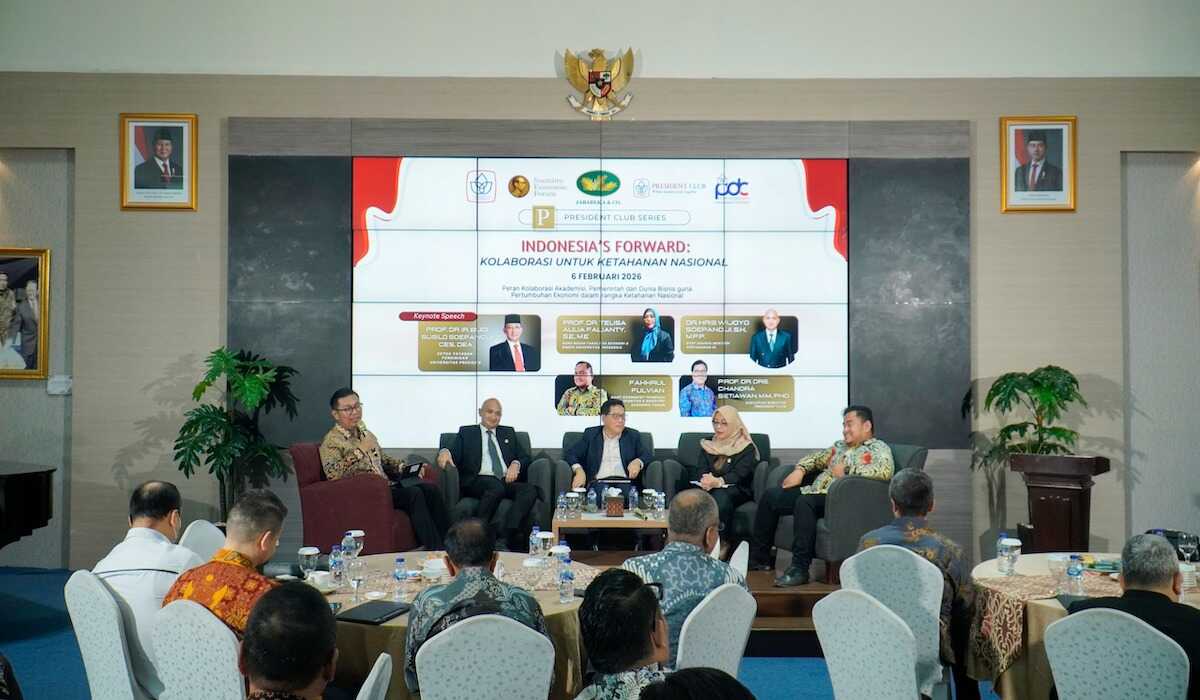
The world is said to be entering a period of major change that brings social, economic consequences, and even threats to national security.
In a Soemitro Economic Forum discussion, Chief Economist of Trimegah Sekuritas & Soemitro Economic Forum, Fakhrul Fulvian, highlighted the acceleration of technological transformation in the last decade from semi-digital to fully digital, which is now continuing with the wave of artificial intelligence (AI).
Fakhrul believes that AI opens up opportunities for productivity, but also carries serious risks, especially the potential for leaks of personal data and institutional data that can impact national security.
“The world today is totally different from what we used to know,” he said, yesterday.
Amid these pressures, Fakhrul encouraged the country to strengthen fiscal and monetary policy coordination and take appropriate steps to keep the business world moving and the economy able to grow towards the 8% target.
He emphasized that opportunities can only be seized if Indonesia prepares a value-added strategy as well as an adequate resilience framework.
The Special Staff of the Indonesian Minister of Defense, Kris Wijoyo Soepandji, said that the 8% growth target is not easy, but can be achieved if all elements are consolidated with the spirit of mutual cooperation.
“The second point of President Prabowo Subianto’s Astacita, which carries the concept of defense supports economy, namely the development of defense and security systems that support the economy through food, energy, and water independence,” he said.
He describes the relationship between defense and the economy as “two sides of the same coin”, namely sovereignty and welfare. According to him, sovereignty is the foundation that must be maintained so that the welfare agenda runs.
From the perspective of growth strategy, Professor of FEB, University of Indonesia, Telisa Aulia Falianty, stated that the key to pursuing 8% is not only the Pancasila economic framework and mutual cooperation. But the government’s ability to maximize Indonesia’s advantages, especially natural resources.
Telisa compared Indonesia with Chile, a country that, in her opinion, uses natural resources to escape the middle-income trap.
“Our game changer is in minerals, we just need a strong institutional roadmap,” said Telisa.
However, she emphasized that national sovereignty is not the same as closing off from foreign investors. What is needed is a balance between national interests and investor confidence through mutually beneficial collaboration, including in sectors that absorb labor and generate large taxes such as data centers.
Telisa also emphasized the role of MSMEs which need to be encouraged to “level up” so that their contribution to the economy is even greater.
Meanwhile, Executive Director of the President Club, Chandra Setiawan, said that the government must design regulations that are pro-growth, stability, and justice so that a level playing field is created.
He highlighted the example of modern retail operations such as Indomaret-Alfamart which, in his opinion, do not yet have restrictions on distance and working hours. Chandra proposed rules for operating hours, for example until 10 p.m., so that after that consumers can shop at traditional stalls.
“Another fundamental problem is that economic growth has not been evenly distributed and is still concentrated on the island of Java. According to him, the business competition index is only strong in about 16 provinces, while a number of other provinces have not developed optimally. He warned that this inequality could make the 8% target even more difficult to achieve,” he said.
In the three-pillar collaboration session, Chandra emphasized that the government must be coherent and consistent, namely that financial, trade, and investment regulations must support each other, not conflict. He also asked for the involvement of academics from the formulation of policies.
“Don’t just invite academics when it’s time to execute, in order to get approval,” he said. (Z-10)
The Provincial Government of West Java has reported a case of alleged trading of personal data of 4.6 million residents on the dark web to the police.
“Based on the results of the investigation and validation that we have carried out, we are sure that the claim of a data leak managed by the West Java Provincial Government is not true,”
In Indonesia, data breaches have become one of the threats to economic and digital financial development that is getting more and more serious.
The Coordinating Minister for Economic Affairs, Airlangga Hartarto, asked Danantara Indonesia to explain the certainty of Indonesia’s fiscal policy direction to Moody’s.
The Minister of Finance, Purbaya, targeted a tax ratio of 11–12% in 2026, optimistic that tax revenues will improve along with economic recovery and strengthen DJP’s growth.
Purbaya emphasized that Juda Agung has the capacity and experience to continue a number of strategic agendas.
The Deputy Minister of Finance, Juda Agung, affirmed his commitment to strengthening coordination of fiscal and monetary policies after being officially inaugurated at the Merdeka Palace, Jakarta, Thursday (5/2).
The Governor of Bank Indonesia (BI), Perry Warjiyo, affirmed that the central bank intervened in the financial markets to maintain the stability of the rupiah exchange rate amid global uncertainty.