
AI and Digital Economy Reshape Competency Needs for Legal Professionals
The legal profession is now required to understand more than just regulations. The development of artificial intelligence (AI), the digital economy, and international trade means legal practitioners must also master issues such as cybersecurity, personal data protection, digital business disputes, and geopolitical dynamics that affect cross-border business activities. These changes are driving the need for human resources with a multidisciplinary perspective capable of connecting aspects of law, technology, business, and international relations.
This shift is also influencing the approach of higher education in preparing relevant human resources for industry needs. Binus University, through its Binus Graduate Program, has launched the Master of Business Law, a postgraduate programme designed to equip professionals and future leaders to face legal challenges in the digital and globalisation era.
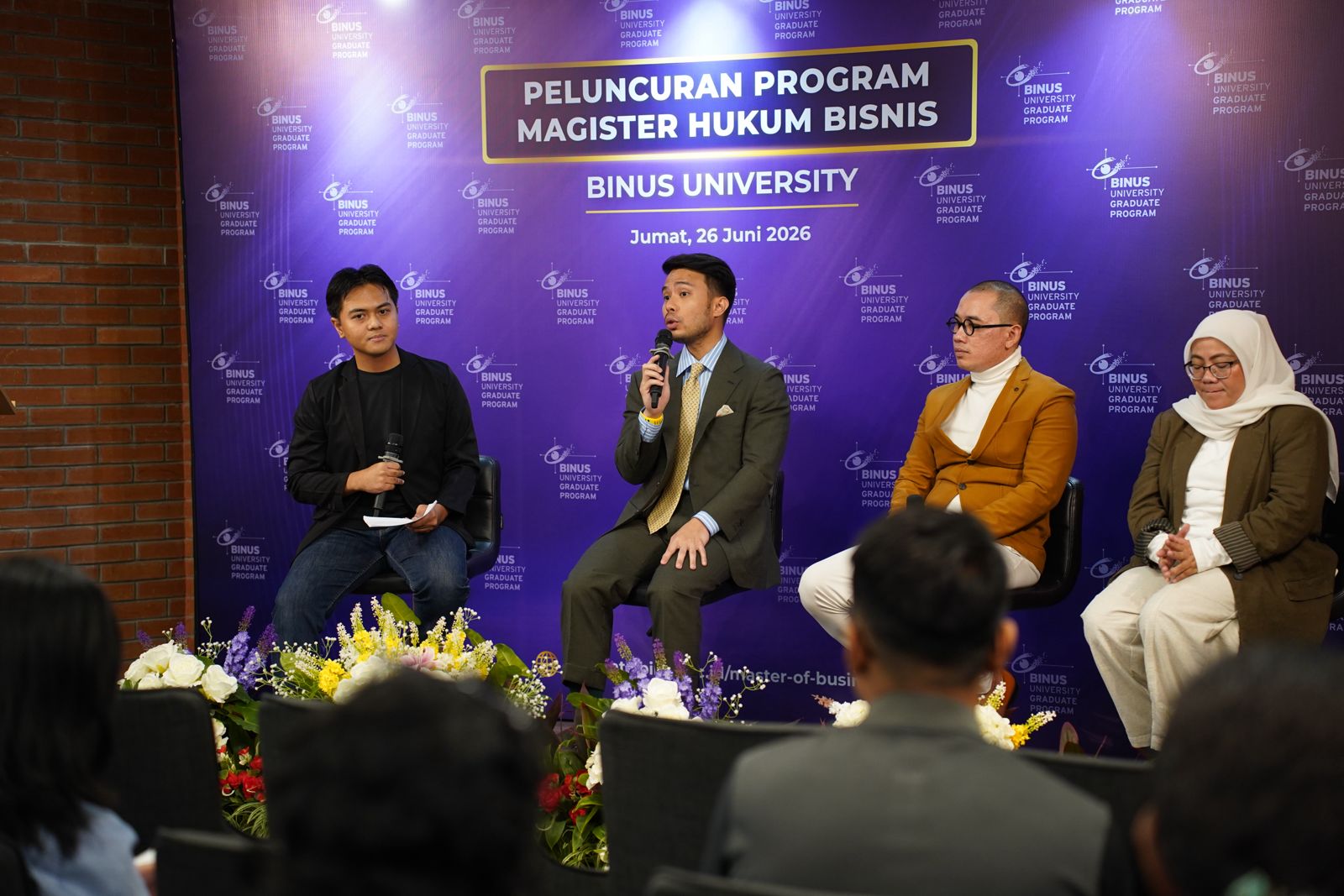
The programme was introduced at an event held at the Binus @Kemanggisan, Anggrek Campus, West Jakarta, on Friday (26/6), attended by students, academics, legal practitioners, regulators, and the public. The event was opened by the Director of the Binus Graduate Program, Prof. Dr. Sani M. Isa, S.Si., M.Kom., alongside the Secretary General of the National Leadership Board of the Indonesian Advocates Association (Peradi), Dr. Hermansyah Dulaimi.
The keynote session featured the Chairman of Commission III of the House of Representatives, Habiburokhman, and the Vice Minister of Trade, Dyah Roro Esti Widya Putri. In their presentations, both highlighted the importance of regulatory readiness and human resources in facing the acceleration of digital transformation, which affects trade, investment, and business activities at both national and international levels. They noted that regulations must evolve adaptively to meet the changing needs of society and the business world.
As part of the launch, Binus introduced the Master of Business Law, which places international trade law as its core focus, strengthened by studies in cyber law, ICT law, and digital forensics. The programme was developed with a multidisciplinary approach that connects aspects of law, business, technology, and international relations, enabling students to understand various legal issues within the modern business ecosystem. Through this approach, students are expected to gain an understanding of emerging issues in digital transactions, cybersecurity, personal data protection, international trade, and technology-related dispute resolution.
Prof. Dr. Shidarta, S.H., M.Hum., Head of the Master of Business Law programme at Binus University, stated that the programme is intended to meet the evolving needs of the workforce amid digital transformation. Unlike conventional master of law programmes, the Binus Master of Business Law is open to graduates from various disciplines. This approach provides an opportunity for professionals from business, technology, communications, government, and other fields to deepen their understanding of legal aspects that are increasingly important in the workplace and industry. The programme also implements a hybrid learning system, combining online and offline learning to provide flexibility for students. With a study period of 18 months, the programme is designed to allow professionals to continue their education without leaving their careers.
The launch was accompanied by a talkshow titled ‘Law in the Age of AI and Digital Economy in International Trade’, featuring CEO of Perqara and lawyer at Hasibuan & Hasibuan, Yakup Putra Hasibuan; International Relations lecturer at Binus University, Dr. Tia Mariatul Kibtiah; and Business Law lecturer at Binus University and Managing Partner of Reza Zaki Law Firm, Dr. Muhammad Reza Syariffudin Zaki. The discussion explored various developments shaping the global business law landscape. From a technological perspective, the discussion covered developments in cyber law, modern litigation practices, business dispute resolution, and legal challenges within the digital ecosystem and technology platforms. The speakers also highlighted how global geopolitical and geo-economic changes are increasingly influencing international trade, investment, and the formation of legal policies in various countries. The international relations perspective was also a focus, particularly regarding the dynamics of global conflict, the role of ASEAN, and their implications for regional stability and regulatory developments in different countries. In this context, business law is seen as playing a strategic role in bridging business needs with the various changes occurring at the global level.
Through the discussion, participants gained insight into how technological developments, international trade, and geopolitics are interconnected and influence modern legal practice. This situation indicates that the need for legal professionals with a multidisciplinary perspective will become increasingly important in the future. According to Shidarta, graduates of the programme are expected not only to have academic understanding but also to be able to provide solutions to various legal challenges emerging in the digital era. He added that admissions for the first cohort, which will begin lectures in September 2026, are now open.