
Ahmad Luthfi Asks Regional-Owned Enterprises to Boost Regional Revenue and Economic Growth
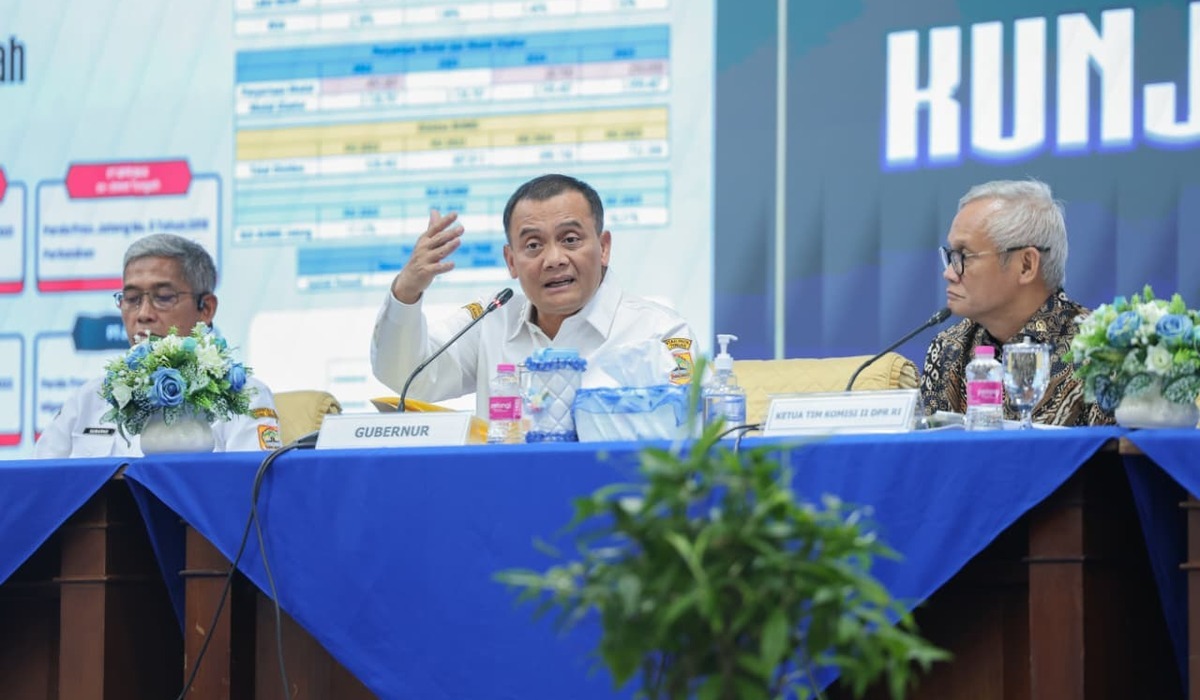
Central Java Governor Ahmad Luthfi has called on Regional-Owned Enterprises (BUMDs) in his province to act as levers for regional revenue and economic growth.
He made this statement while receiving a specific working visit from Commission II of the Indonesian House of Representatives (DPR RI) to the Central Java Provincial Government (Pemprov Jateng) regarding oversight of BUMDs and regional banks, at the Gradhika Bhakti Praja building in Semarang on Wednesday, 1 April 2026.
Luthfi explained that there are currently 122 BUMD entities at the regency/city level in Central Java, comprising 33 financial institution BUMDs, 54 diverse business BUMDs, and 35 drinking water BUMDs.
According to him, their performance up to 2025 shows a positive trend. Total assets reached Rp15.445 trillion, net profit Rp587.684 billion, and Return on Assets (ROA) of 3.80%, with employment absorption of 173 board commissioners, 186 directors, and 11,625 employees.
Meanwhile, the Provincial Government of Central Java owns 41 BUMD entities. Up to 2025, the total assets of provincial BUMDs reached Rp118.038 trillion, net profit Rp1.775 trillion, and ROA of 1.50%. In the same year, dividends from operations were recorded at Rp732.388 billion with a Return on Investment (ROI) of 18.31%.
Based on the results of the RPJMD Coordination Meeting on 13 March 2025, the target for dividend contributions for 2026–2030 is also projected to continue increasing with an average annual growth of 10.58%.
“The principle is that BUMDs must be profitable. If not profitable, no need to be a BUMD,” Luthfi stressed.
Luthfi noted that Bank Jateng serves as the backbone for strengthening regional finances in Central Java. In addition to supporting government financial transactions, Bank Jateng is also encouraged to support productive sectors, MSMEs, food security, housing financing, and the digitalisation of regional financial services.
Luthfi also highlighted the financial BUMDs’ support for MSMEs. The distribution of credit by PT BPR BKK (Perseroda) in 2025 reached Rp10.823 trillion, with a composition of 71% productive credit and 29% other credit. Meanwhile, productive guarantees were recorded at Rp1.630 trillion, with the largest portion for the MSME sector.
Deputy Chairman of Commission II of the DPR RI, Aria Bima, assessed that BUMDs in Central Java, especially those in the banking sector, have the opportunity to become a national benchmark if they can maintain healthy, accountable performance that directly impacts regional development.
According to him, regional banks should not be viewed merely as profit-chasing banking institutions. Instead, they should be seen as tools for regional development, drivers of the local economy, partners of local governments in financial management, supporters of productive sector financing, and real contributors to original regional revenue.
“Regional banks should not be seen only as ordinary banking institutions chasing profits. Regional banks are BUMDs formed with a broader mandate,” said Aria Bima.
He assessed that the measure of success for regional banks is not sufficient to be seen only from profits and dividend contributions, but also from their impact on development, economic equity, and strengthening regional fiscal capacity.
Therefore, they encourage the contribution of regional banks to Original Regional Revenue (PAD) to be truly healthy, sustainable, and obtained through good governance, prudent business expansion, and strong risk management.
Member of Commission II of the DPR RI, Edy Oloan Pasaribu, added that Central Java has the opportunity to become a national benchmark in BUMD management.
“Central Java can be a pilot project to see how regional banks can be accountable for every policy and strategic decision, both fiscally and socially, to the public,” he said.
According to him, Central Java has great potential to produce a benchmark region that can survive, grow, and be fiscally independent amid national challenges.
He added that the biggest challenge for local governments today is reducing poverty rates. Therefore, regional heads are encouraged to have a grand vision, innovation, and an entrepreneurial spirit in running the government, including activating regional assets to contribute to PAD and public welfare.
Through this working visit, Commission II of the DPR RI hopes that Central Java can continue to strengthen the governance of BUMDs and regional banks, while making them strategic instruments to drive regional development, increase PAD, and expand public welfare.